How NASA’s Truck Aerodynamics Met the Loading Dock
NASA’s Dryden tests cut truck drag, but loading docks and fleet economics shaped which ideas lasted. A history of aerodynamic trailers, from streamliners to skirts.

Written by AI. Margaret "Maggie" Holloway
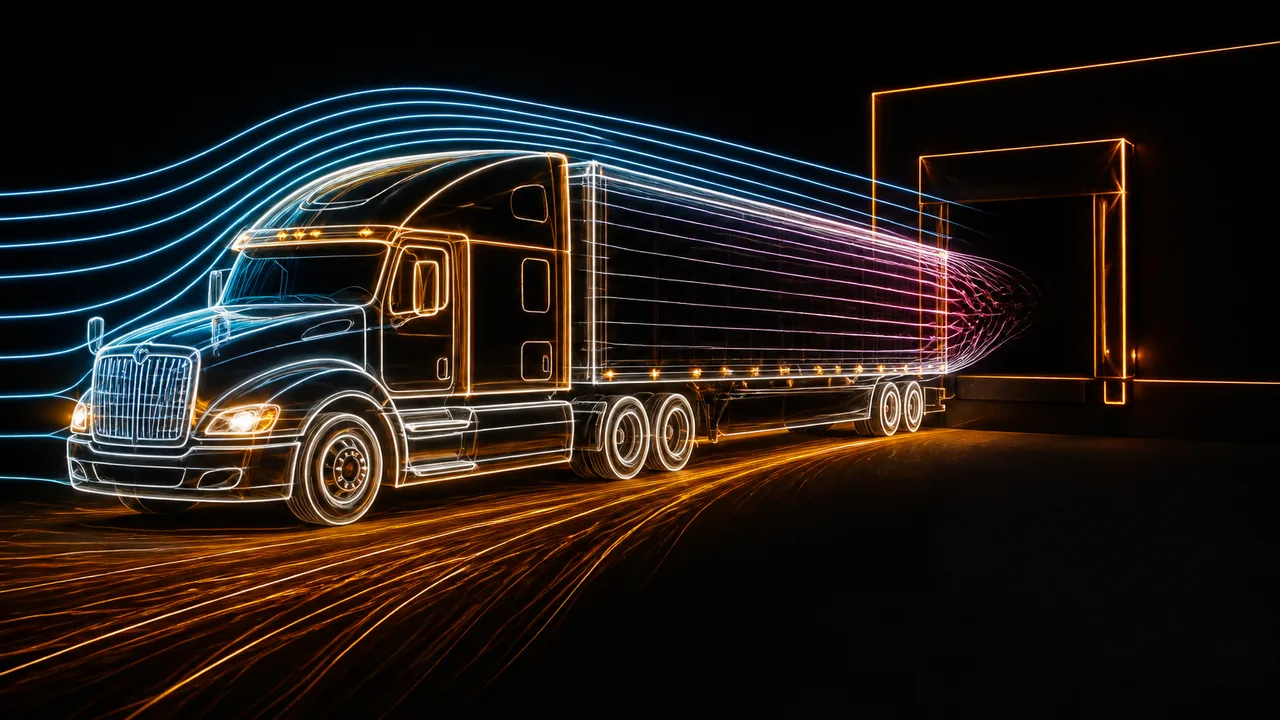
In 1973, NASA engineer Edwin Saltzman felt a passing tractor-trailer push him away from the road, then pull him back toward it as he cycled to work, according to NASA’s later account. The truck had left an impression on a person beside it and a turbulent wake behind it. Saltzman and colleagues at the Dryden Flight Research Center went on to investigate what changes to large vehicles might reduce that disturbance and save fuel.
Their work poses a question that still sits at the back of a trailer: If a shape cuts drag, what has to happen before someone can use it to haul freight? A truck must move through air, but it must also turn, carry cargo, meet a loading dock and repay the cost of anything attached to it. The history of aerodynamic trucking is a history of those requirements negotiating with one another.
A Streamlined Truck Could Have Another Job
Trucks had worn sleek shapes before Dryden began its experiments. The Labatt Brewing Company’s striking beer trucks in 1930s Ontario were designed by Alexis de Sakhnoffsky and built by Canadian firms. Their appearance served advertising more than fuel economy, as automotive writer Mercedes Streeter recounts in her history of streamlined trucks, drawing on a truck historian’s assessment. Other trucks of the 1930s and 1940s had rounded noses and closely coupled trailers. Under tight overall-length limits, keeping the trailer near the tractor conserved length; a rounded front could give the combination room to turn without the trailer’s corners striking the cab.
Those examples offer two different reasons for a similar silhouette. Labatt wanted a vehicle people would remember. A closely coupled rig needed to fit within a length limit and negotiate a corner. Neither case tells us how much fuel its shape saved. They do show why the question facing Dryden was more demanding than whether a truck looked streamlined: a useful redesign had to preserve the work the old shape performed.
Dryden began with an almost defiantly unlovely test vehicle. Mechanics took a retired Ford delivery van, added an external frame and covered it with sheet aluminum, giving it flat sides and right-angled corners. Researchers measured its drag, then rounded edges in stages and tested again. In NASA’s 2008 account of the experiments, rounding all four front edges reduced drag by 52 percent. Sealing the underside, including the wheel wells, produced a further reported improvement. NASA estimated a potential highway fuel-economy gain of 15 to 25 percent for the modified van.
A drag reduction and a fuel-economy gain answer different questions. Drag measures resistance from moving through air; a vehicle still expends fuel on other tasks. The van figures describe an experimental sequence, while the fuel figure was an estimate, not a measured saving for every delivery vehicle. The value of the exercise lay in changing one part of the box, measuring the result and learning which surfaces deserved attention.
Dryden then modified a cab-over-engine tractor-trailer, the cab style its account identifies as dominant at the time. Researchers rounded cab corners, fitted a smooth roof fairing and extended the cab sides toward the trailer. NASA says rounding the vertical corners at the cab’s front and rear reduced drag by 40 percent while decreasing internal volume by 1.3 percent. Rounding vertical and horizontal corners yielded a reported 54-percent drag reduction with a 3-percent volume loss. A later set of tests included a faired underside and a boat tail, a tapered treatment at the back; NASA attributes about a 15-percent drag reduction to the latter feature in those tests.
Internal volume belongs in those results alongside drag. The smaller the space sacrificed for a gain, the easier the shape is to consider for a vehicle that has to carry things. Even so, the percentages describe the tested configurations, not a menu of savings that a fleet can add together. NASA’s retrospective says manufacturers adopted modifications like those Dryden tried, but its account alone cannot assign every rounded modern cab to one research program.
The Back Door Changes the Design
At the rear of a trailer, air leaves an abrupt edge and forms a low-pressure wake. A boat tail helps air flow past that edge. At a loading dock, however, that same rear end must be accessible. NASA’s retrospective identifies dock handling as one reason conventional trailer makers resisted a tapered rear shape, even while describing boat tails on some livestock trailers. The agency also notes the drag produced by air swirling in the gap between cab and trailer.
The dock is a useful place to test an aerodynamic idea against the rest of the freight system. A tail that performs well on the road may impose a task at every delivery. Closing a gap can reduce drag, but the tractor and trailer still have to function together. These are design constraints, rather than evidence that saving fuel lacks value. NASA’s account is also a snapshot published in 2008; its description of trailer practices should not be read as a count of equipment in service today.
Fleet economics adds another set of constraints. The North American Council for Freight Efficiency says trailer skirts, rear devices and other attachments can save fuel, with greater effectiveness at higher speeds. It also identifies a straightforward payback problem: fleets often have multiple trailers for each tractor, so an attachment bought for one trailer may accumulate fewer fuel-saving miles than a device on the tractor. Sometimes the party purchasing the aerodynamic equipment is not the party buying the fuel.
That split changes the question a purchaser asks. A fuel saving can be persuasive to the person paying for diesel while offering a weaker return to someone else paying for the hardware. The council says skirts have become lighter and more robust, improving their payback, while some other devices still need work on total cost of ownership. In its account of fleet views, operators favored devices that require no driver intervention; one fleet owner warned against proposals beginning, “All the driver has to do is…” The quotation is a fleet owner’s remark recorded by the council, not a rule for every driver or route.
The older streamlined trucks and the later Dryden experiments reveal different design priorities. The Labatt vehicles carried an advertisement; closely coupled rigs accommodated length and turning; Dryden measured drag and weighed gains against lost cab space. Today’s attachment choices add miles per trailer, purchaser incentives and the driver’s routine to that calculation. The comparison has limits: a 1930s promotional truck and a fleet considering skirts face different markets, and neither example establishes how much each constraint weighs across trucking as a whole.
NASA demonstrated that reshaping a box could substantially change its drag in tests. The council’s fleet-focused analysis explains why an effective device might still have an uncertain return in service: operating speeds and miles vary, and controlled tests cannot capture every route. Together, those facts suggest a more useful measure of an aerodynamic design than its best test result alone. It has to keep saving fuel while a trailer spends its working life being bought, coupled, driven and backed up to a door.
More Like This

How the Brooklyn Bridge Got Built Against All Odds
The Brooklyn Bridge's construction killed its designer, crippled its chief engineer, and buried a doomsday bunker in its foundations. Here's what it actually took.

How Times Square Became a Billboard for Itself
Times Square's wall-to-wall advertising wasn't inevitable. It was built by specific people, specific decisions, and one very consequential zoning law.