How Lucky People Actually Engineer Their Own Luck
Mark Manson and Drew break down Richard Wiseman's research on luck—and why the city you live in may matter more than how hard you work.

Written by AI. Vanessa Torres
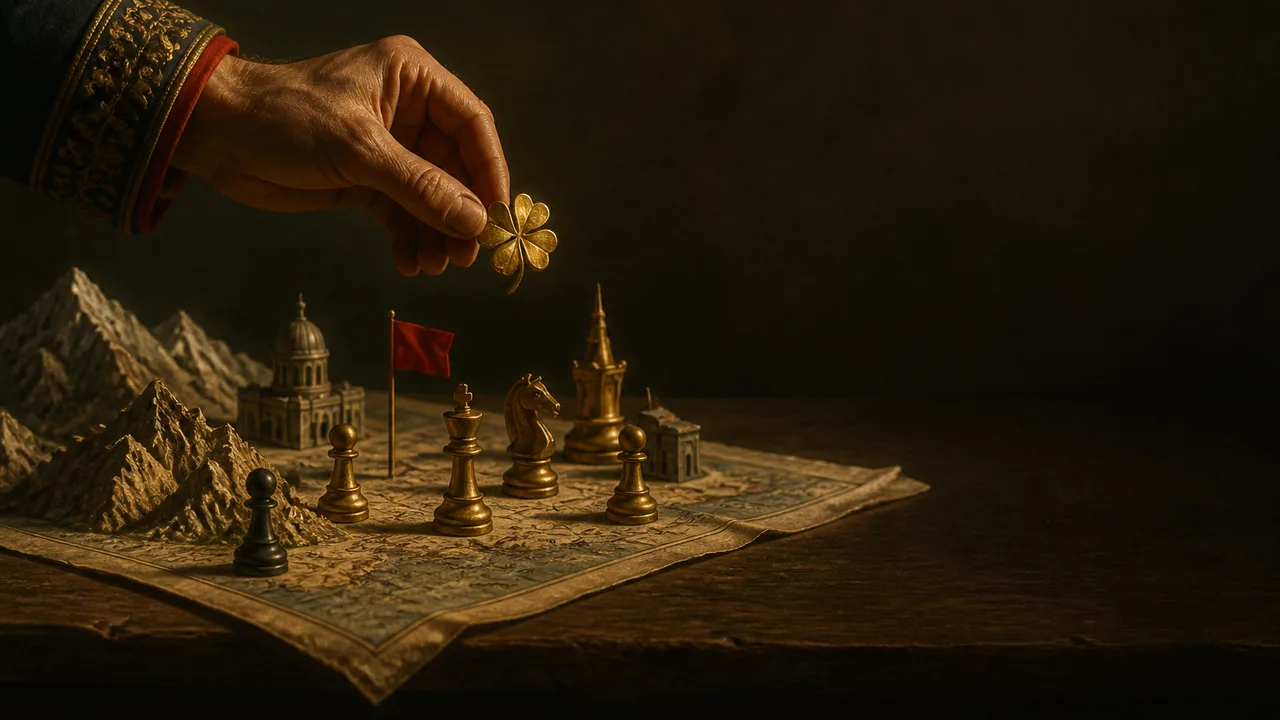
Photo: AI. Soraya Hadid
Two people walk into the same networking event. One leaves with a job offer and a new collaborator. The other leaves with a lukewarm handshake and a business card they'll never use. Same room. Same drinks. Wildly different outcomes.
We call that luck—and then we move on, because the alternative (examining the invisible mechanics that separated those two people) is uncomfortable in ways that hard work narratives are not.
In a recent episode of Solved, Mark Manson and his co-host Drew spend over an hour doing exactly that uncomfortable thing: pulling apart what luck actually is, what research says about who gets more of it, and—most interestingly—where the line sits between luck as something that happens to you versus something you partially architect. The conversation draws on psychologist Richard Wiseman's decade of research into lucky people, a fascinating historical detour through Napoleon's military career, and a framework that splits luck into three distinct layers. It doesn't arrive at a tidy conclusion. That's part of what makes it worth your time.
The Three-Layer Framework
The framework Manson and Drew work with divides luck into heaven luck, earth luck, and human luck. Heaven luck is the macro stuff—the country you're born in, your family's wealth, the decade you happen to arrive in. Nobody controls it. Human luck is the granular, day-to-day stuff: calculated decisions, risk assessment, the kind of probabilistic thinking that Annie Duke (their upcoming guest) specializes in.
Earth luck is the layer they spend most of the episode on, and it's the one that actually troubles easy categories. It's neither pure fate nor pure hustle. It lives in what Manson calls "the periodic high-leverage decisions that alter thousands of other decisions"—what city you move to, what industry you enter, who you marry, what table you sit down at. These feel like choices. They function like luck. They're both, simultaneously, and that's the genuine tension at the center of the conversation.
What Wiseman's Research Actually Shows
Wiseman's work—and it's worth noting this is real, peer-reviewed research, not the usual self-help retrofitting—identified four patterns in people who consistently reported better luck and higher well-being. They maximize opportunities when they arise, often through wide and loose social networks rather than tight insular ones. They trust their intuition, but only when that intuition is well-stocked with relevant experience. They maintain an expectation that good things will happen to them. And they reframe setbacks as information rather than verdicts.
None of these are revolutionary individually. What's interesting is the system-level effect they describe together. Wide social networks increase the surface area for random, useful encounters. Expecting good outcomes keeps your attention broad. Turning failures into data keeps you in the game long enough for probability to work in your favor.
Wiseman's research has taken criticism—people point out that he's essentially describing extraversion and openness to experience, which are personality traits, not behaviors. Drew pushes back on this with some preliminary research suggesting that environment predicts lucky encounters better than personality does. In one study, personality traits measured on standardized tests predicted almost nothing about whether someone had serendipitous encounters online. What predicted it was the type of digital environment they inhabited. The argument: it's not who you are that drives luck, it's where you put yourself. An introvert who shows up to the right room is luckier than an extrovert who stays home.
That's not a settled debate. But it's a more useful one than the usual nature-vs-nurture framing, because it has actionable implications.
The Napoleon Problem
Manson opens with Napoleon, and stays there long enough that Drew has to rein him in—"I'm keeping you on a short leash on this one." The extended Napoleon section is actually doing real argumentative work, though. Napoleon is the test case for how luck-looking behavior gets misread as either pure talent or pure fortune, when it's neither.
The Napoleon case is fascinating precisely because he started from a position of low heaven luck—born Corsican in a French institution, bullied, broke, technically not even French—and engineered what a historical researcher later called a statistically impossible military record. The researcher built a model predicting win rates for famous generals based on troop counts, terrain, and resources. Julius Caesar outperformed his expected record. A handful of others did too. Napoleon was so far off the chart that, as Manson describes it, "it looks like somebody put in the wrong number on an Excel spreadsheet."
What that research surfaces is that Napoleon wasn't randomly lucky. He was systematically good at expanding the conditions under which good things could happen to him—picking artillery (the highest-leverage specialty) before it was obviously the highest-leverage specialty, reading voraciously across history and economics and politics so his gut could draw connections in the heat of battle, eating dinner with his soldiers so their morale would carry his outnumbered armies through fights most generals would have conceded on paper.
As Manson puts it: "Earth luck is like finding ways to skew those probabilities to your advantage."
That framing is useful, but it also has edges worth examining. Napoleon's "earth luck" included being born male, being given access to a military academy, and operating in a society where a certain kind of brilliance could climb through a revolution. Not everyone in the same period with the same appetites had the same opening. The framework doesn't fully reckon with that. It's not a fatal flaw—earth luck and heaven luck are explicitly separate categories—but the episodes' optimism about how much earth luck any individual can cultivate probably underweights how many people are locked out of high-variance environments by circumstances, not choices.
Anxiety as the Anti-Luck Mechanism
One of the more genuinely interesting sections involves anxiety—specifically, how anxiety narrows the attentional field. Drew introduces attentional control theory, which describes two competing systems in the mind: a goal-directed system (wide aperture, sees the forest) and a stimulus-driven system (tunnel vision, fixates on threats). Under anxiety, the stimulus-driven system takes over. Peripheral awareness shrinks—literally, physiologically. You stop noticing the weird opportunity at the edge of your vision.
Manson makes a connection that lands: "Don't make choices out of fear. The reason that's really good advice is that when you're afraid of something, you're very myopic and you're only focused on that one single variable. Yet when you are excited about something, your view of the future is probably very expansive."
This isn't motivational filler. It's a mechanistic explanation for why anxious people report feeling chronically unlucky—they're not seeing the same environment that calmer people see. Which raises a thornier question the episode doesn't fully pursue: if anxiety structurally reduces your luck surface area, then "just put yourself in high-variance environments" is advice that hits differently depending on how anxious you are, which itself is shaped by circumstances outside your control. The framework is strongest when it's describing patterns; it's quieter on the question of who can actually execute the habits it recommends.
Game Selection and Power Laws
The sharpest analytical move in the episode is the power law discussion. Manson and Drew distinguish between industries with flat success curves (dentistry, accounting, construction—where the best practitioner earns maybe two or three times the median) and industries with steep, exponential curves (publishing, music, tech, entrepreneurship—where the top 0.001% captures 90% of the returns).
The point isn't that you should abandon stable careers for volatile ones. It's that you need to know which game you're playing, because the role of luck differs dramatically between them. A lucky dentist is marginally better off than an unlucky dentist. A lucky musician—who happened to be in the right city when the right person heard them—can be a thousand times better off. Choosing a power-law field means choosing to play a game where luck's impact is amplified. Choosing a flat-curve field means choosing a game where it barely moves the needle.
Manson is admirably honest about the disorienting personal experience of this: "The outcome has been so disproportionate, it's actually messed with my head." The Subtle Art of Not Giving a Fck* probably produced, by his estimate, 20,000 times the result of the median self-help book—despite being, maybe, twice as good. The curve is that steep.
What the episode doesn't say explicitly but implies throughout: the skills and behaviors that make you lucky in a power-law environment (high variance tolerance, wide social surface area, willingness to compound small bets over time) are genuinely different from the skills that make you successful in a flat-curve field. They might even be in tension.
The Awkward Honesty About Agency
The most telling moment in the episode is when Manson admits he keeps finding other words for luck—"chance encounters," "maximizing opportunity," "expanding surface area"—because calling it luck feels like it erases his own agency. "It just feels like as soon as I call it luck, I'm removing my own agency."
That discomfort is real and worth sitting with. The skills and effort and positioning are inextricable from the luck. But so is the fact that the same behaviors produce radically different outcomes depending on the environment you're born into, the period you're born in, and the structural access you have to high-variance rooms. Manson and Drew are honest about how much of their own success depended on being the right age at the right moment of the internet. They just don't fully push on what that means for someone who missed that window—or who never had access to it.
The framework is genuinely useful. The habits are real. Wiseman's research is solid enough to take seriously. But the hardest question—how much of luck is actually within reach, for everyone, rather than for those who already have certain kinds of starting-point luck—is the one the conversation keeps circling without quite landing on.
Which is, maybe, the most honest thing about it.
More Like This
Microplastics: The Unseen Invaders in Our Lives
Explore the hidden world of microplastics in our daily lives and what you can do to minimize exposure.

Are Your Goals Arbitrary? Ali Abdaal Thinks So
Ali Abdaal's God of War moment raises a real question: what if treating work like a video game—arbitrary, playful—is actually the smarter approach?

Jeremy Qualls on Leadership: Lessons from Fire and Post-its
Jeremy Qualls shares leadership lessons from personal adversity, emphasizing empowerment and resilience.

Why You Keep Second-Guessing Decisions You've Already Made
The psychology of post-decision doubt—what research says about indecision, counterfactual thinking, and how to actually close a choice.

How Deep Networks Learn to Abstract, Not Memorize
Statistical physicist Matthieu Wyart argues deep networks escape the curse of dimensionality by recovering hidden data hierarchies—not memorizing examples.

Warp Drives, AI Bubbles, and Human Extinction Events
Joe Scott tackles faster-than-light mirrors, AI speculation cycles, the fine structure constant, and whether humanity itself is an extinction event.

Charisma Is a Skill, Not a Personality Trait
Charlie from Charisma on Command breaks down 7 principles for building charisma through practice—not personality. Here's what holds up, and what's worth questioning.
How to Sound Like Yourself on Camera
Nick Nimmin's advice on natural on-camera presence cuts against the creator economy's obsession with performance. Here's what it actually gets right.