How Godzilla Minus Zero Gives Its Monsters Physical Weight
Godzilla Minus Zero gives Ghidorah’s gravity beam and monstrous roars a physical texture, extending a decades-old rivalry through sound, effects and bodily stakes.

Written by AI. Theodore "Teddy" Ashworth III
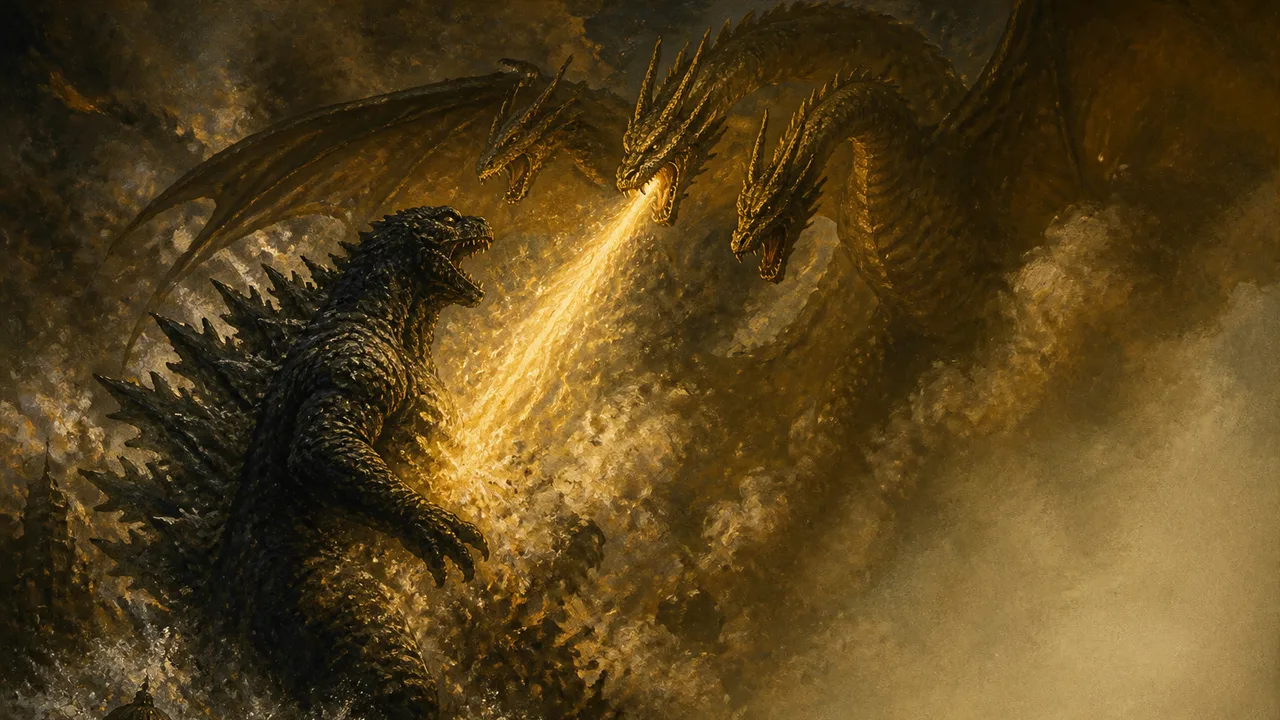
Godzilla Minus Zero brings King Ghidorah into Takashi Yamazaki’s sequel and gives the three-headed monster a new job: making gravity behave badly. The film also pits him against Godzilla in a fight conceived as a struggle to the death. Those are familiar pleasures for a monster movie, but the production’s more interesting wager lies in how it makes impossible events register. A roar acquires the echo of a real place. A beam has consequences for things that ought to stay on the ground. Flesh can be torn. The monsters are extravagant; the cues that give them weight are stubbornly ordinary.
Spoilers for Godzilla Minus Zero follow.
The story takes place in 1949 Japan, two years after the events of Godzilla Minus One. Former kamikaze pilot Kōichi Shikishima, played by Ryunosuke Kamiki, and Noriko, played by Minami Hamabe, are raising Akiko when Godzilla returns and Ghidorah enters the picture. The family’s continued presence gives this sequel a human continuity alongside its new monster. The question for Yamazaki is what a creature large enough to dwarf people can still do to their lives.
A Roar with Somewhere to Go
Sound designer Natsuko Inoue and her colleagues sent the monsters’ roars through physical spaces before using the recordings in the film. Ghidorah’s voice acquired the reverberation of a dam; Godzilla’s passed through a dome. Inoue used a dam’s alarm warning system to play Ghidorah’s voice. A concrete surface, a loudspeaker and a recording give an invented animal an acoustic relationship to a place that exists.
Unfamiliar sounds can pull an audience out of a scene if they stand out too insistently. Sending a fictitious sound through a recognizable echo, she argued, makes it easier to accept. The craft choice itself offers a useful way to hear the film: the roar remains strange, while its reverberation tells your ears that the world around it has surfaces.
The same concern reaches beyond the monsters’ voices. When Shikishima flies through Ghidorah’s gravity beam, sound mixer Hisafumi Takeuchi said he added a Doppler effect to suggest the sensation of passing through it. The team also worked to retain dialogue and background voices amid Ghidorah’s rampages. A shifting sound can convey movement; a human voice can keep the people caught in the spectacle audible. Together, those choices give the beam a scale that a bright effect alone cannot supply.
Monster movies have long asked us to accept the impossible. Minus Zero asks what the impossible would sound like after it met concrete, distance and somebody trying to speak nearby.
An Old Monster, a Different Rule
Ghidorah debuted in 1964’s Ghidorah, the Three-Headed Monster. His return in Minus Zero therefore carries a built-in recognition test: keep the creature legible while finding something for him to do beyond repeating a famous silhouette and attack. The name “gravity beam” offered the filmmakers an opening.
Producer Kazuaki Kishida said the team wanted the beam to manipulate gravity visibly. In his account, earlier appearances had generally treated it as a beam that attacks, without showing much gravity at work. The sequel’s design question was concrete: what happens when the power does what its name promises?
The answer connects a visual decision to a sound decision. If objects leave the ground, the viewer needs some sense of what is moving and where. Takeuchi’s shifting sound as Shikishima crosses the beam helps locate a person inside that disturbance. The old attack gains a physical rule, and the sound supplies a way to experience its effects from human scale. Franchise history becomes useful here because the change lies in how Ghidorah’s familiar power behaves, rather than in the simple fact that Ghidorah has returned.
There was another inheritance to manage. Yamazaki followed 2023’s Oscar-winning Godzilla Minus One, and Kishida said the sequel expanded its visual-effects team from 35 artists to about 50. The producer described keeping that team relatively compact so Yamazaki, who also supervised the effects, could review work closely. More resources gave the production room to develop its creatures, but the team’s account puts attention on decisions made shot by shot. An award explains the expectations surrounding a sequel; it cannot tell us whether every new effect serves the story.
What a Fight Can Make You Feel
Yamazaki conceived the Godzilla-Ghidorah climax as a fight to the death. He told IGN that animals trying to defeat one another tear flesh and weaken an opponent before a finishing blow. He also mentioned watching his two cats fight, an unexpectedly domestic reference point for creatures with rather less domestic consequences. His explanation gives the battle a sequence of bodily actions: attack, injury, weakness. Each action makes the next one comprehensible.
Gareth Edwards’ 2014 Godzilla offers a useful precedent. Its fight with a MUTO culminates in Godzilla firing his atomic breath down the creature’s throat. Both films use the physical vulnerability of a monster to give a climactic move its force. For Minus Zero, Yamazaki described a fight-to-the-death conception, with torn flesh and weakened opponents preceding a finishing blow. Edwards’ film supplies a documented finishing move; Yamazaki’s account supplies a plan for an entire duel. Their different monsters and filmmakers give them different dramatic problems to solve.
Yamazaki also told IGN that the violence could feel painful and sad, comparing Godzilla to a cat being bullied. That response complicates the simple thrill of a monster matchup. A body that can be wounded invites concern as well as applause, even when its owner has spent considerable screen time posing a threat. The film’s brutal fight can therefore work in two directions at once: it displays the creatures’ destructive power and makes that power costly to them.
Physical rules, however, are only one tool in Minus Zero’s kit. A New York destruction sequence that appears to take Godzilla to America instead unfolds in a character’s imagination. Kishida said the production made Godzilla larger there to reflect what the creature had become as a symbol in that character’s mind. The same film that carefully gives Ghidorah’s beam an effect on the surrounding world also allows a fantasy to disregard ordinary scale. The contrast suggests a more precise ambition than realism: Yamazaki can make a monster feel present when a person is endangered, then make it impossibly huge when a person imagines what it means.
Ghidorah’s voice echoes off a dam. His beam sends the world out of place. Godzilla can be hurt, and, inside someone’s fantasy, grow beyond the size he occupies elsewhere in the story. Godzilla Minus Zero keeps changing the scale of its monsters by changing what the people around them can hear, survive or imagine.
More Like This

Godzilla Minus Zero Turns Recovery Into Arithmetic
Godzilla Minus Zero uses its title, R rating and postwar setting to ask whether recovery means safety, agency or simply greater power over violence.
Nolan's Odyssey: Faithful Adaptation or Bold Vision?
Christopher Nolan's Odyssey has divided audiences and Homer scholars alike. Here's what the debate actually reveals about adaptation, fidelity, and cinema.

Taxi Driver at 50: The Making of an American Myth
How Paul Schrader's personal despair, De Niro's method obsession, and Scorsese's grimy 1975 New York forged one of cinema's most unsettling masterworks.