How DreamWorks Runs on Linux and Open Source
DreamWorks senior R&D manager Randy Packer explains MoonRay, the open-source renderer behind every DreamWorks film since 2019, and why the studio runs strictly on Linux.

Written by AI. Mike Sullivan
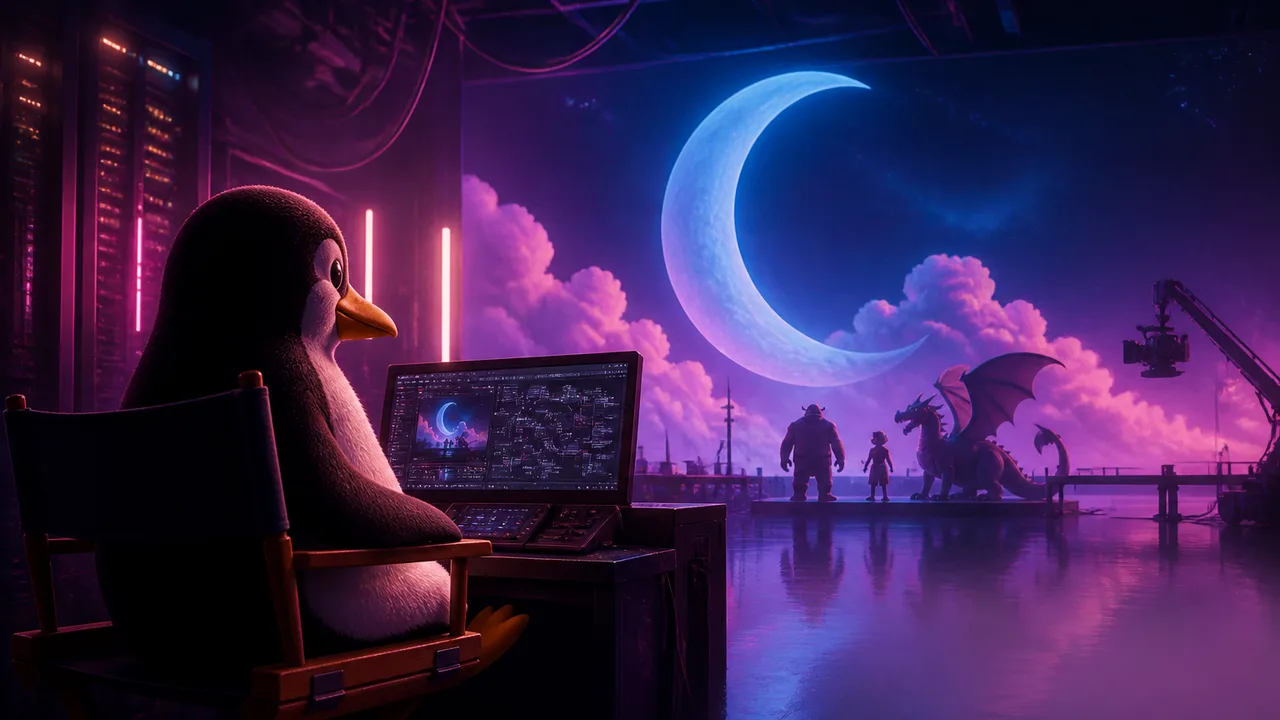
Photo: AI. Quinn Adler
There's a good chance you've seen a DreamWorks movie in a theater and had absolutely no idea you were watching the output of a Linux render farm. That's not a criticism — it's how good infrastructure is supposed to work. The Shrek franchise. Kung Fu Panda. How to Train Your Dragon. The Wild Robot, which made a lot of adults cry in 2024 in ways they weren't fully prepared for. All of it running on open-source tooling, on Linux, rendered through an in-house path tracer called MoonRay. None of that is on the poster.
Randy Packer, senior manager of R&D at DreamWorks Animation, sat down with Michael Tunnell to talk through the technical side of how DreamWorks actually makes movies. The conversation covers MoonRay's architecture, the studio's operating system choices, and the organizational logic of keeping a four-year film production synchronized with software that ships new features every week. It's the kind of interview the trades don't run because it's about plumbing, and plumbing doesn't move tickets.
What MoonRay Actually Is
MoonRay is DreamWorks' production path tracer — a renderer that calculates how light behaves in a scene by tracing the path of individual rays. Development started around 2012-2013, and according to Packer, it first went into production in early 2018 on How to Train Your Dragon: The Hidden World, which released in February 2019. Whether "early 2018" refers to internal production deployment or is a minor misremembering isn't entirely clear from the interview, but the film itself is the 2019 one. Every DreamWorks feature since has run through it.
The renderer touches multiple departments — animation, modeling, lighting. Artists iterate continuously: render, adjust, render again. At scale, that means you need to distribute the workload across a lot of machines, which is where Arras comes in. Arras is DreamWorks' computational framework for distributed rendering — the system that lets MoonRay scale across an on-premises farm or cloud infrastructure, and enables workflows like viewing an entire shot sequence while manipulating lighting in real time. DreamWorks open-sourced both.
The rest of the open-source stack reads like a VFX industry vocabulary test: OpenUSD (the scene description format originally developed by Pixar, now stewarded by a foundation that includes Autodesk, Apple, and Nvidia), OpenColorIO, OpenImageIO, and OpenVDB — the volumetric data format that DreamWorks developed internally and contributed to the Academy Software Foundation, which now maintains it. MoonRay also integrates Intel's OpenImageDenoise, an open-source denoising library that Intel develops and maintains independently; whether it was formally contributed to MoonRay or integrated as a dependency is a distinction worth noting for anyone doing technical due diligence. Packer's summary: "If you name it as something open, we probably used it."
The "Selfish Motivation" Explanation
When Tunnell asks why DreamWorks open-sourced MoonRay — and notes that this isn't exactly standard Hollywood behavior — Packer gives an answer that starts confident and then gets entertainingly tangled in its own vocabulary.
"We don't view our technology as the area that we run a business. We view the making of movies and the stories that we tell as our business. So the technology just serves that business and there's no need really to hide that technology."
That's a coherent position. But then he adds that students who learn MoonRay might want to come work at DreamWorks having already mastered the tool — "there's a little bit of selfish motivations there" — and immediately starts walking it back. "Selfish motivation is not necessarily... it's not really selfish... I mean that seems more... it's I guess in a way it's selfish, but you're also giving an opportunity for anyone who wants to do it. That's much more selfless, I think."
Reader, he used the word "selfish" and then spent thirty seconds explaining that it's actually selfless, before settling on "we just felt like this was a nice thing to be shared with the community."
Look, I'm not being cynical here. The pipeline talent argument is real and the community reciprocity argument is also real, and neither of them requires DreamWorks to be purely altruistic for the open-source decision to be a net positive. The Apache 2 license means anyone can use it, fork it, or build commercial products with it. Contributions are accepted (with a contributor license agreement — they want to make sure submitted code is actually yours, "and not from AI or something," as Packer puts it). The project has joined the Academy Software Foundation, which provides institutional continuity beyond DreamWorks' own roadmap decisions. The motivation being somewhat mixed doesn't make the outcome any less useful.
The CentOS Problem Nobody Wanted
On operating systems: DreamWorks runs strictly Linux, on both workstations and the render farm. No Windows, no Mac. Packer describes alignment with the VFX Reference Platform — an industry specification that coordinates software version compatibility across studios, so the output of one tool actually feeds correctly into the next.
Right now, DreamWorks is on CentOS 7 and migrating to Rocky 9. If that sentence made your eye twitch, you've been in IT since 2020. The short version: Red Hat announced in late 2020 that CentOS Linux — which had been the free, community-supported rebuild of Red Hat Enterprise Linux that half the enterprise world quietly ran their infrastructure on — would be discontinued at the end of 2021 in favor of CentOS Stream, which is a rolling release that tracks ahead of RHEL rather than mirroring it. This was received about as warmly as you'd expect. Rocky Linux was founded almost immediately as a direct replacement: a RHEL-compatible rebuild, continuing the original CentOS mission, started by one of CentOS's original founders. DreamWorks moving to Rocky 9 is the industry executing a migration that was, depending on your temperament, either a crisis or an extremely well-telegraphed infrastructure refresh. Either way, the VFX Reference Platform made it a coordinated industry move rather than every studio figuring it out independently.
Freezing the Feature Set for Four Years
The production timing problem is genuinely interesting: a DreamWorks movie takes roughly four years from greenlight to release. MoonRay's development team ships internal updates weekly. Those two schedules are not compatible without some deliberate mechanism to keep them from interfering with each other.
The mechanism is called a tech lock. Early in a production, the MoonRay team works closely with the show to figure out what needs to be built — what the desired visual style requires that the renderer doesn't currently do. Puss in Boots: The Last Wish's deliberately painterly look, for instance, required research into how to achieve that aesthetic through MoonRay specifically rather than handling it entirely in compositing. Once the look is developed and the production is confident it works, the show tech locks: it freezes on a specific version of MoonRay and stays there until delivery. After that point, the renderer team stops developing features for that show and only provides bug fixes.
According to Packer, at any given time only one production is in tech-lock status — that claim comes directly from him in the interview, so take it as his characterization of how the system tends to work rather than a formal operational policy. All other active productions are early enough that they can absorb the weekly development builds.
This is a feature freeze by another name, and it solves a real problem: the risk of a new feature destabilizing a production that's nine months from delivery. It also means the MoonRay team is running essentially one stable branch plus one active development branch at any moment, which is a sane way to avoid version management becoming a full-time job of its own.
Why Packer's Answer About Favorite Things Actually Lands
When Tunnell asks Packer what he loves most about working at DreamWorks, the answer is not "the technical challenges" or "the collaborative culture." It's the friends-and-family screenings.
"I can actually be in the theater and see that kid love the film. You know, they just love it."
I find this convincing in a way that most answers to that kind of question aren't, because it's specific. Packer works on the renderer — the foundational technical layer that never appears in a press release. There's a real distance between "I optimized the distributed render pipeline" and "a six-year-old is losing their mind over the Trolls." The fact that he closes that distance by physically being in the room strikes me as more than just a good interview answer. It's a reasonable solution to a problem that a lot of technical work creates: you build something that serves something else, and the downstream human effect is genuinely hard to see.
MoonRay is now part of the Academy Software Foundation, with DreamWorks committed to ongoing engineering support. The practical invitation is simple: download it, try it, see what you build with it. The less practical but more interesting question is what happens when enough people outside Hollywood have hands-on familiarity with production-grade rendering tools. The talent pipeline argument Packer made — and then briefly disowned — might turn out to be the most accurate part of the whole conversation.
More Like This
When Agents Generate Their Own UI: The Three Flavors Explained
CopilotKit's Tyler Slaton maps the spectrum of generative UI—from pixel-perfect control to agents writing raw HTML. Each approach makes different tradeoffs.
Cursor's Composer 2 Drama: What Really Powers the Model
Cursor's impressive new Composer 2 model turns out to be built on Moonshot AI's Kimi—raising questions about disclosure, licensing, and transparency.

Apple's Creator Studio: Subscription or One-Time Purchase?
Apple's Creator Studio offers a subscription model. Will it replace one-time purchases?
Black Forest Labs FLUX: Visual AI's Open Source Gambit
Black Forest Labs is building toward 'visual intelligence' with FLUX. The open-source framing is real—but so are the questions about consent, deepfakes, and enterprise data.

OpenAI Images 2.0: What Changed and Why It Matters
OpenAI's Images 2.0 is generating 1.5B images a week. Here's what the team says changed, what's still open, and what users are actually doing with it.
Unreal Engine 5 Still Doesn't Play Nice With Apple Silicon
While most 3D software runs smoothly on M-series Macs, Unreal Engine 5 remains frustratingly unreliable. One creator documents the disconnect.

Inside the Smartphone: 120 Years of Hidden Engineering
Professor Hannah Fry tears apart a modern smartphone to trace 120 years of engineering history — from Marconi's radio waves to a 200-million-pixel camera sensor.

Pokémon Go at Ten: AR's One Durable Success Story
Pokémon Go turns ten this week. A look at what it actually got right—and why the AR industry it was supposed to launch mostly didn't follow.