OpenAI Images 2.0: What Changed and Why It Matters
OpenAI's Images 2.0 is generating 1.5B images a week. Here's what the team says changed, what's still open, and what users are actually doing with it.

Written by AI. Yuki Okonkwo
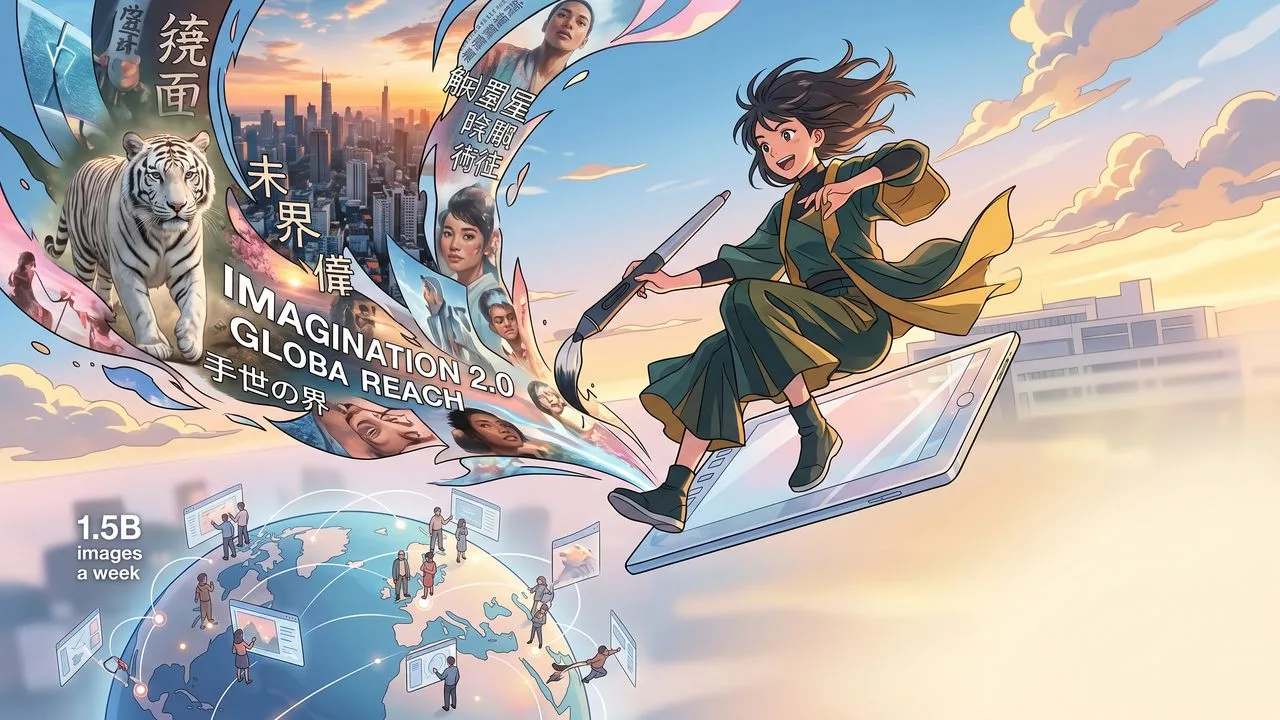
Photo: AI. Mei Fujimoto
1.5 billion images a week. Let that sit for a second.
That's the number Adele Li, product lead for OpenAI's image generation work, dropped in a recent episode of the OpenAI Podcast. In the two weeks following the Images 2.0 launch, usage jumped more than 50%. And the thing that makes that number interesting isn't just the scale—it's what people are making with all those generations, and what it suggests about where this technology is actually going versus where the people building it expected it to go.
The podcast, hosted by Andrew Mayne, features Li alongside researcher Kenji Hata walking through the development of Images 2.0, the evaluations that shaped it, and the emergent behaviors they've observed since launch. It's a promotional format—this is OpenAI's own podcast, so the critical distance you'd want from an independent evaluation isn't really there. But there's enough candid technical texture in the conversation to make it worth unpacking.
From "wispy tendrils" to photorealism
Hata's description of watching early DALL-E checkpoints train is one of those rare moments where you get a real window into what iteration at this scale actually feels like. "At first it was sort of the wispy sort of weird sort of the tendril sort of thing," he said, describing early DALL-E outputs, "and then just like that... everything got crisp."
The inflection point for Images 2.0, he says, was less dramatic—more of a quiet certainty. They sampled a checkpoint mid-training, compared it to Images 1.0, and the gap was obvious. The test image was something simple: a woman by the seaside. The difference between the old output and the new one was clear enough that Hata's internal reaction was roughly why did I ever think that first thing was acceptable? Which is, honestly, how every meaningful improvement in ML tends to land—not as a surprise, but as a sudden inability to unsee how bad the old thing was.
The specific improvements Li and Hata highlight are: text rendering, multilingual support, and photorealism. Text in AI images has been notoriously broken for a long time—the "chimp trying to spell OpenAI" era, as host Andrew Mayne puts it—and the improvement here tracks with a broader pattern Hata describes. In DALL-E 3, ask for a grid of random objects and you'd get maybe 5-8 rendered accurately. Images 1.0 pushed that to around 16. Images 1.5 hit 25-36. Now? Hata says their internal test of "generate 100 random objects" returns almost all 100 correct. That's not a vibe—that's a measurable, consistent capability jump that compounds into genuinely new use cases like infographics, presentation decks, and detailed instructional imagery.
The photorealism improvement is harder to quantify from the outside, but the framing Li uses is revealing: the old model "altered their face or their bodies." The mandate was to make the output feel more like you. That's a different design goal than "make beautiful images"—it's asking the model to subordinate its aesthetic tendencies to the user's actual appearance, which is a non-trivial alignment challenge.
The token efficiency question nobody asked
Here's something I find genuinely interesting that the podcast glosses over quickly: how does the model get faster while getting more capable?
Hata's answer is token efficiency—they did significant work to make the model produce high-quality outputs with fewer tokens (the discrete units the model processes). That's not nothing. In diffusion models and autoregressive image generators, the computational cost scales with how many steps or tokens the generation requires. Finding ways to hit the same quality bar with less compute is an engineering win that tends to get underreported because it's not as flashy as "the images look better."
But it's worth noting that we're taking OpenAI's word for this. There's no published technical report accompanying Images 2.0 that I can point you to right now—the podcast is essentially the technical disclosure. For a model generating 1.5 billion images a week, the absence of a methods paper is a gap worth flagging, even if it doesn't mean the claims are wrong.
The MS Paint paradox
The most counterintuitive thing in this conversation—and the thing I keep thinking about—is the viral trend of using Images 2.0 to generate intentionally bad-looking images. MS Paint style. Crayon scribbles. Deliberately janky.
Li's read on this: "One thing that I think people are really striving for is authenticity, imperfection, nostalgia."
Hata adds the technical angle: "It takes a lot of intelligence to actually create something that is imperfect."
Both of these are true, and together they point at something the discourse around AI image generation tends to miss. The goal was never just "make beautiful things automatically." A significant chunk of people using these tools are using them as instruments of self-expression—and self-expression often involves strategic ugliness, humor, and the aesthetic of effort. Ghibli-style portraits were one thing; MS Paint portraits of your friends are another. The latter is arguably more personal, not less.
This raises a question worth sitting with: if the model gets so good that it can flawlessly simulate imperfection, does the nostalgia still land? There's something slightly recursive about a state-of-the-art model rendering a convincingly bad drawing. The inauthenticity is hidden one layer deeper. Whether users care about that is genuinely unclear.
Who's prompting, and does it still matter?
The prompting conversation is where I think the podcast surfaces its most practically useful tension. Li describes receiving vague prompts constantly—"make me cuter," "make it better"—and training the model to interpret that intent rather than fail on it. The model has, in her framing, a "personality" that's been trained to bridge the gap between what users say and what they actually want.
At the same time, Mayne points out something that's held true from DALL-E through the current generation: artists—people who come to this with an actual visual vocabulary—consistently get better results than people who learned to "prompt engineer." Understanding depth of field, composition, lighting language, the difference between a photograph and an illustration—these still matter, maybe more than they did when the models were worse and specificity was a workaround for capability gaps.
The interesting open question is whether that changes as models get better at reading intent. If "make it more cinematic" produces something genuinely cinematic without knowing what cinematic means technically, does visual literacy still confer an advantage? Or does it shift from being a necessary skill to being a ceiling-raiser—still valuable, but no longer gating?
360 images and the capability-discovery loop
One feature that emerged somewhat accidentally: 360-degree panoramas. Adele Li describes discovering that users were generating extremely wide-aspect-ratio images, and someone realized those could be mapped to a spherical view. The feature shipped. Mayne's immediate use case: dogs playing poker, rendered as an immersive environment you can look around inside.
I'm being sincere when I say this is the part of modern AI product development I find most fascinating and most underexamined—the loop where a capability emerges, users find an application for it the team didn't anticipate, and that application becomes a feature. The team isn't driving all of this; users are discovering the terrain and marking the paths. Li and Hata describe this repeatedly: use cases "we didn't even think existed," results "far beyond what we expected."
That's not spin. It's genuinely how capability-first AI product development tends to work right now, and it has real implications for how you evaluate these systems. The benchmark tests—Hata's 100-object grid, his colleague's woman-holding-orange-juice, the wine-glass-filled-to-the-brim—are designed to probe known failure modes. The surprising capabilities show up sideways, in user behavior, after launch.
What that means for safety and oversight is a question this podcast isn't asking, but probably should be somewhere.
The "renaissance" framing Hata opens with—"if DALL-E was the stone ages, Images 2.0 is a renaissance"—is a good line. It's also a frame that deserves scrutiny: a renaissance implies a flourishing of human creativity enabled by new tools, not a replacement of it. The evidence from user behavior—the MS Paint requests, the 360-degree poker dogs, the birthday card evals—suggests people are mostly using this as a genuinely creative tool, not a creativity substitute. Whether that holds as the models keep improving, and as the line between "expressing yourself" and "having a model express a version of yourself" continues to blur, is the question that doesn't have an answer yet.
More Like This
Grok's Photo Editor: Magic Wand or Magic Beans?
X's Grok AI now edits photos with text prompts. Julian Goldie demos the feature—cleaning rooms, enhancing products. But what's actually new here?
OpenAI's Image Gen 2.0 Thinks Before It Draws
ChatGPT Images 2.0 introduces 'thinking mode' for AI image generation—creating multi-page manga, error-free text in any language, and production-ready visuals.
Google's Imagen 2 Fills the Gap Between Cheap and Good
Google's new Imagen 2 model balances quality and cost for AI image generation, excelling at text rendering and multi-reference consistency.

Black Forest Labs FLUX: Visual AI's Open Source Gambit
Black Forest Labs is building toward 'visual intelligence' with FLUX. The open-source framing is real—but so are the questions about consent, deepfakes, and enterprise data.
GPT-Realtime-2: Voice AI That Actually Does Things
OpenAI's GPT-Realtime-2 can operate UIs, call parallel tools, and translate live speech. Here's what that actually looks like in production.
Google's Imagen 2 Promises Speed and Quality. Here's What's Real.
Google's new Imagen 2 model claims to merge speed with quality in AI image generation. We look at what it actually delivers—and what it doesn't.

How Optimization Powers Modern AI and Engineering
From training ChatGPT to imaging black holes, optimization is the hidden engine behind modern AI and engineering. Steve Brunton's lecture explains how.
David Patterson on CPUs, GPUs, TPUs, and 50 Years in Computing
Turing Award winner David Patterson breaks down RISC vs. CISC, the GPU-to-TPU shift, Moore's Law's real status, and what 50 years in computing actually taught him.