How Buy Now Pay Later Companies Actually Make Money
BNPL is engineered to increase spending, structured to benefit retailers over borrowers, and now operating without a federal regulatory floor. Here is how it works.

Written by AI. Jin Seo
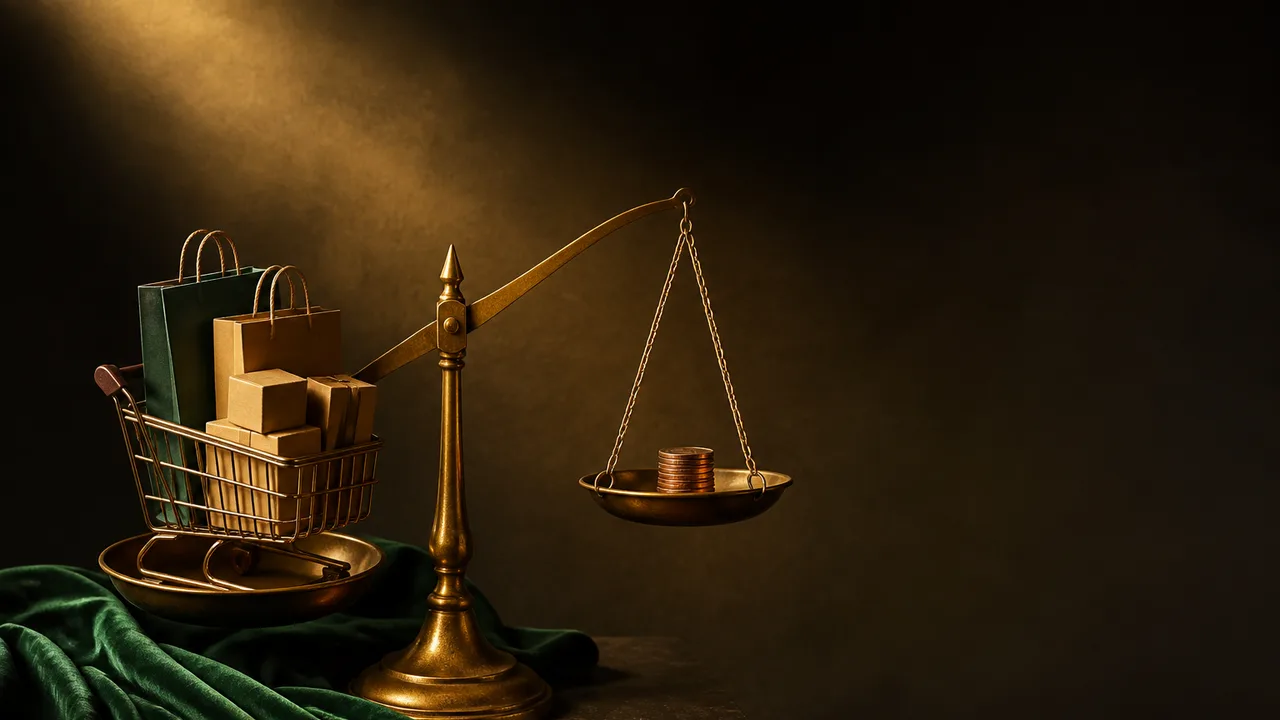
Photo: AI. Liora Goldstein
There is a button on nearly every checkout page now. Four payments, no interest, nothing to pay today. It costs you exactly what the label said. So somebody paid for that. It was not you.
Ask people where the money comes from, and you get the same answer almost every time: late fees. It is a reasonable guess. It is also wrong by a factor of about 30.
The American consumer regulator pulled the actual loan books of the six biggest buy now, pay later lenders in the country, every loan and every fee across a full year. Late fees came to 0.18% of the money lent. Not 1.8. Zero point one eight. As Tony Talks Business puts it: "That is the entire late fee business, a rounding error sat on top of something much bigger."
The real money is on the other side of the counter.
The fee the retailer volunteered to pay
The Federal Reserve published a product overview of the BNPL market that puts the fee a merchant pays on a buy now, pay later transaction at around 5%. A credit card at the same register costs the merchant two to three percent. The regulator measured the average BNPL order at $135. Run the numbers and the shop is losing somewhere between $6.75 and $10.80 on that basket, versus what it would have paid on a card swipe. Roughly triple the cost.
And the shop agreed to it. A lot of retailers put the BNPL button above the card logos.
The reason is not mysterious, even if the incentive structure is a little uncomfortable to look at directly. BNPL is not sold to retailers as a payment method. It is sold to them as a sales tool. The pitch, as the video frames it, is that "baskets get bigger when the button is there, that fewer people abandon the checkout, that they come back sooner." Those numbers come from the companies selling the service, so they deserve the same skepticism you would apply to any vendor's deck. But the underlying logic is not in dispute.
"$135 is a decision," the video observes. "$33.75 four times over is not a decision, it is a shrug. The price never moved, the size of the number you had to look at did. That is the product."
These companies are not selling credit to consumers. They are selling a smaller number to the shop.
The float, the spread, and the third engine
The merchant fee is one revenue stream. The second is structural and less visible. When you split a $135 purchase into four payments, the shop gets its money within days. The lender covers the full amount upfront and collects it back a quarter at a time. Across 335 million loans in a single year, according to the regulator's figures, that is an enormous pile of other people's shopping being financed on borrowed capital. That capital has a price, and that price moves with interest rates, which is why this business looked like a money machine when borrowing was cheap and looks considerably more complicated now.
That thinness in the margin is why the industry has been quietly shifting its product mix. The Federal Reserve's overview counted roughly $157 billion of BNPL credit written in one year. The classic four-payment, no-interest product accounted for about half. The rest was longer loans: six months, twelve months, in some cases five years. About 60% of the total carried no interest. The remaining 37% did, and that is where the growth in revenue has been concentrated.
Affirm, the American lender that has leaned furthest into interest-bearing products, illustrates what that shift looks like at scale. The company will lend up to $30,000 over as long as five years at rates reaching 36%. That is not a four-payment button. As the video puts it: "That is a finance company with a checkout page bolted to the front. The free version was the doorway. It was always the doorway." The video references specific quarterly figures from Affirm showing interest income outpacing merchant fees, but without a named earnings release I can verify, the precise ratio is better understood as a directional structural trend the company has been building toward rather than a pinned data point.
Affirm also reported $127 million in a single quarter from selling loans to investors, then keeping a fee for collecting payments. The loan is not the asset; the loan is inventory. Write it, sell it, use the proceeds to write the next one, and take a cut on collections either way. The faster that wheel spins, the less capital the company needs to hold.
Then there is what the video calls the third engine, and it is not lending at all. Klarna has roughly 118 million users and close to a million merchants on its platform. Those users do not just tap a button at checkout; enormous numbers of them shop inside Klarna's own app. That means Klarna knows what you searched for, what you bought, and what you picked up and set back down. It sells that attention: placement fees, promoted retailers, advertising, all billed back to the same merchants already paying the transaction fee. Klarna has said that a customer who banks with it is worth about $107 a year. An ordinary user is worth about $30. The lending got people through the door. The app is why they came back. At which point calling Klarna a buy now, pay later company is, as the video notes, "like calling a supermarket a car park."
The blind spot that regulators just noticed
For most of its existence, this product was essentially off the books. BNPL loans did not appear on credit files, which meant the second lender had no way of knowing what the first one had already extended. The industry has a name for this: loan stacking. The regulator's own data showed the average user taking more than six of these loans a year and running about $848 through them annually. That is not occasional. That is a habit with no paper trail.
FICO has since built a credit score that counts these loans, and that matters in both directions. Pay on time and you can build a credit history you may never have had. Miss payments and that record follows you. The money was partly free because it was unrecorded, and that era is ending.
The regulatory picture is messier. In 2024, the Consumer Financial Protection Bureau issued a rule that would have treated BNPL lenders broadly like credit card providers: dispute rights, refund rights, proper statements. In 2025, the bureau revoked it. By June of that year, it confirmed there would be no federal replacement. What remains is a state-by-state patchwork. New York passed legislation. Others are working on their own versions. The same button on the same website now means different things depending on which side of a state line you tapped it from.
The case that holds up, and the context it sits in
The honest version of the BNPL pitch is real and should be said plainly. Pay a four-payment plan on time and it costs you nothing. Not a hidden nothing. Actually nothing. Set that against carrying the same purchase on a credit card at around 25% annually. For someone with no credit history and no card, $135 split into four is likely the cheapest short-term credit they have ever been offered. The charge-off rate on these loans, the share lenders never recover, came in at 1.83% in the period the regulator examined. The equivalent figure for American credit cards was 4.19%. Short loans fail fast and fail small; that is the structural advantage, and it is genuine.
The objection was never the four payments.
The objection is the architecture around them: a product engineered to make $135 feel like $33.75, sold to retailers on the explicit promise that it increases spending, concentrated among borrowers with the least margin for error, kept off the credit record until very recently, and now operating without a federal regulatory floor.
"You were never the customer," the video concludes. "You were the reason there was one."
That framing is sharper than it is unfair. The incentive structure of BNPL runs from merchant to lender to advertiser, with the consumer at the end of the chain, generating value at every step. Whether that is a problem depends partly on what you think the button is for. The companies will tell you it is a payment innovation that makes credit more accessible. The Federal Reserve's own data will tell you it is a sales instrument that costs retailers three times more than a card swipe because the math on what it does to basket size makes that premium worth paying.
Both of those things are true. The question worth asking is which one you are when you tap it.
More Like This

What Fintech Affiliate Models Could Teach iGaming
Line Peteri argues fintech's education-first affiliate model and retention focus offer a playbook iGaming has ignored for a decade. Here's what that gap actually costs.

Agentic Commerce Is Rewriting Who Controls the Sale
Stripe's agent commerce launch signals a fundamental power shift in e-commerce—from seller-controlled funnels to buyer-driven AI agents. Here's what's actually changing.
How Pawnshops Actually Make Their Money
Pawnshops look like stores. They're not. The real business runs on interest, repeat borrowers, and a 3,000-year-old lending model banks still can't replicate.

DoorDash's Business Model: Who Pays and Who Profits
DoorDash moved $102 billion in food last year and kept under 1% as profit. Here's how the fee stack works—and who actually bears the cost.

How Amazon Actually Makes Its Money
Amazon's $717B in revenue hides a counterintuitive truth: the boxes and vans are the least profitable part. Here's where the money actually flows.

How Hedge Funds Really Make Money: The Fee Machine
Hedge funds manage $5 trillion, but their real profit engine isn't brilliant trades—it's a fee structure built to pay managers in any market condition.

How Climbing the Investing Ladder Costs You Ownership
From a $100 index fund to managing billions as a pension CIO, each rung of the investing ladder hands you more money to move and less of it to keep.

How Dynasty Trusts Keep Heirs Rich but Powerless
Dynasty trusts, dual-class shares, and private foundations don't just preserve wealth—they strip heirs of any real control over it. Here's how the architecture works.