How Pawnshops Actually Make Their Money
Pawnshops look like stores. They're not. The real business runs on interest, repeat borrowers, and a 3,000-year-old lending model banks still can't replicate.

Written by AI. Jin Seo
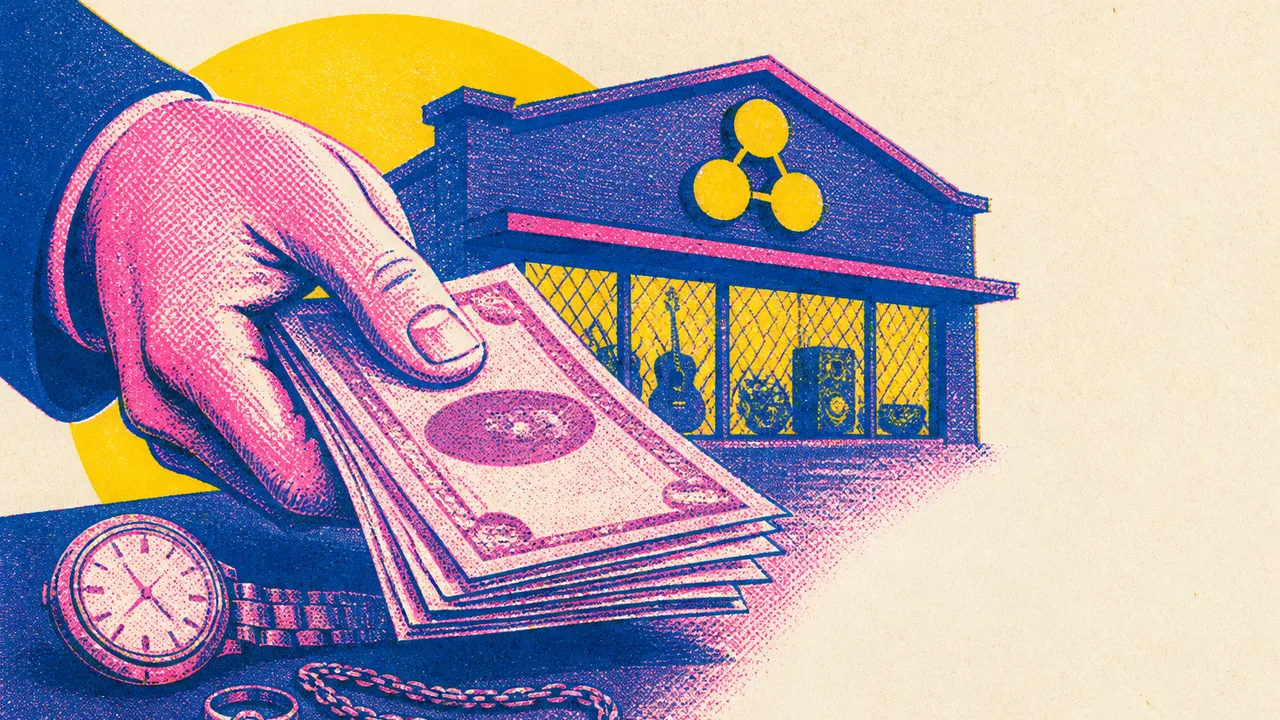
Photo: AI. Jorah Maktoum
Walk into a pawn shop with a watch. Five minutes later you walk out with cash, no credit check, no paperwork, and no consequences if you never return. The loan just... evaporates. The shop keeps the watch, you keep the money, and nobody calls anyone.
On paper, that's a catastrophic lending model. In practice, it's one of the most durable financial structures ever invented — older than central banks, older than double-entry bookkeeping, possibly older than coined money. A recent breakdown by Tony Talks Business lays out exactly why, and the answer is less obvious than the cluttered shelves suggest.
The Pawn Broker Was Never Lending to You
The fundamental insight that makes pawnbroking work is also the thing most people miss when they look at it. As Tony Talks Business puts it: "The pawn broker was never lending money to you. He was lending money to your watch."
A bank lends against your future — your income, your credit history, your demonstrated willingness to behave financially for years at a time. That's why banks need all the forms. A pawn broker doesn't need any of that because the collateral is already in the safe before the cash leaves the drawer. If a broker thinks your watch would resell for $400, he'll lend you $150 against it. If you vanish, he sells the watch and covers the loan with room to spare. The risk, as the video puts it, walks out the door with you.
That structural security is also why the national average pawn loan sits around $150. This isn't a business serving people with $400 watches who happen to need grocery money. It's a business built around the lower end of the asset spectrum, which points directly to who it's actually serving.
The Real Product Is Interest, Not Inventory
Here's where the business model gets interesting. According to industry data from Pawn Shop Statistics 2026, around 85% of pawn loans in the U.S. get repaid — the item goes home with its owner. Pawn brokers are not quietly hoping you default. A defaulted item is the bad outcome: now they have to clean it, price it, find floor space, and wait for a buyer willing to haggle.
What they actually want is the interest.
And the interest rates across this industry are not a polite conversation. They vary enormously by state — California caps pawn loan rates around 2.5% per month, while states like Alabama, Georgia, and Mississippi permit up to 25% per month, which annualizes to 300%, territory that payday lenders also occupy. The video illustrates this with a woman in Cincinnati who pawned her grandmother's ring for a $150 loan and paid $30 a month for two years — $720 in interest on a $150 principal — and still owed the original $150 at the end to get the ring back.
The store you walk through, all those guitars and power tools and glass cases of rings, is what the video calls "the side effect." The counter is the business. The items on the shelves are mostly what's left when the bet went wrong and the customer didn't come back.
The Appraisal Problem Is Actually a Feature
One of the stranger structural realities of pawnbroking is how wildly inconsistent the valuations are. A pawn marketplace experiment cited in the video sent the same four items — including a 1-carat diamond with a resale value around $2,500 — to four different shops in Houston in the same week. One shop offered $1,400 for the diamond. Another offered $200. Same stone, same city, offers 600% apart.
That's not pure greed. It reflects the fact that every pawn shop is simultaneously a lender, a used goods retailer, and an appraiser — and every shop weights those roles differently. A shop run by someone who knows firearms has no particular edge on Cartier watches. A shop short on cash that week can't write big loans even if it wants to. Offers on luxury watches reportedly vary by more than 250% between shops in the same city for exactly this reason.
The practical implication for anyone who's ever used or considered using a pawn shop: the first offer is not the market price. The first offer is that particular shop's particular read of their inventory, their cash position, and their expertise — on that day.
Gold Is the Exception to Every Rule
All that appraisal uncertainty collapses for one item. Gold is the thing every pawn broker on the planet takes immediately, with confidence, regardless of condition. Snapped chain, outdated design, someone else's initials engraved on the clasp — none of it matters, because under the design it's just metal with a globally published price updated in real time.
The rule is simple, as the video explains: lend under the melt value and the loan cannot lose money, no matter what the customer does. If they walk, the shop melts the chain and sells by the gram. There's no buyer to find, no haggling, no waiting.
The macro environment has been exceptionally kind to this logic. According to the World Gold Council, gold crossed $4,000 an ounce in 2025. Every pawn vault holding gold collateral got safer at the same moment the collateral got more valuable — the kind of trade that collateralized lenders dream about.
Who's Actually Walking Through the Door
The customer profile is the part of this business that says something uncomfortable about American financial infrastructure.
According to the 2023 FDIC National Survey of Unbanked and Underbanked Households, 5.6 million U.S. households have no bank account at all, and another 19 million have an account but exist largely outside the formal credit system — no credit card, no access to loans. The Federal Reserve has repeatedly found that roughly four in ten American adults would struggle to cover a surprise $400 expense without borrowing or selling something.
A bank cannot profitably solve this problem. Processing a small loan costs a bank hundreds of dollars in compliance and staff time before a single dollar goes out the door. On a $200 loan, the economics are impossible. Banks didn't abandon small-dollar lending because they're indifferent to low-income customers — they abandoned it because the unit economics don't work at that scale. The pawn shop fills the gap banks structurally cannot.
Pawnbroking, the video notes, traces back roughly 3,000 years to ancient China. Buddhist monasteries were running organized pawn counters by the 5th century. The Medici family built part of their banking fortune lending against valuables. The three golden balls that still hang outside pawn shops descend from the sign of medieval Italian moneylenders. The modern bank was invented into a world where pawnbroking was already ancient.
About 1 in 13 American households has used a pawn shop. Among lower-income households, it's closer to four in ten.
The Machine Under the Machine
Here's the part that flips the business model from interesting to ingenious: the best pawn shop customer isn't the person who brings in a treasure. It's the person who brings in the same item repeatedly.
The video describes this customer — and the pattern is confirmed by how pawn operators talk about their regulars. The same gold chain crosses the counter multiple times in a year. Pawn it when money runs short, pay the interest, redeem it on payday, wear it a few weeks, bring it back. Small interest payment each visit, month after month, year after year. The shop knows these customers by name. Some of these loops run for decades.
What the shop is selling that customer isn't really a loan. As the video frames it: "It's selling access to the value of their own property on demand for a fee forever." The chain functions like a debit card that lives behind the counter. The income never has to end because the loan was never really meant to end — it just renews.
Compare that to the nearest alternative. A payday loan chases you, stacks fees on fees, and damages your credit if it goes wrong. A pawn loan can't chase anyone. The worst case is already sitting in the safe. "Lose the chain and the debt dies with it," as the video puts it. For someone operating at the margins of the formal financial system, that's not a bad deal — it's the least dangerous bad deal available.
Pawn shops, the video argues, "worked out recurring revenue about 3,000 years before Silicon Valley gave it a name."
That framing is a little cute, but the underlying structure is real. The industry's steadiest profit comes not from selling the things customers leave behind, but from correctly predicting that most people will come back, pay for the time their property spent in the safe, and eventually need to bring it in again.
The guitars on the wall are the small fraction of times that prediction was wrong.
The question the video ultimately lands on isn't really about business mechanics. It's about what it means that a 3,000-year-old workaround — lending against personal property at rates the banking system would consider illegal to advertise — remains the most accessible financial product for millions of Americans. The pawn shop didn't survive empires and currencies by being predatory. It survived by being useful in a way the formal financial system has never quite managed to replicate. Whether that's a testament to pawnbroking's ingenuity or an indictment of everything built around it is a question worth sitting with.
More Like This

Rockefeller's Wealth-Building Secrets Revealed
Explore how John D. Rockefeller built a $400 billion fortune through strategic discipline and overlooked industries.
UK Banks Are Failing Vulnerable Customers
UK regulators say major banks are failing homeless and financially distressed customers. The fintech "inclusion" pitch may be making things worse, not better.

What Fintech Affiliate Models Could Teach iGaming
Line Peteri argues fintech's education-first affiliate model and retention focus offer a playbook iGaming has ignored for a decade. Here's what that gap actually costs.
America's Economic Cycles: Reinvention or Stagnation?
Examining America's economic pivots every 80-90 years and their impact.
Taiwan Spent Billions on DRAM and Lost Every Time
Taiwan dominates logic chips but repeatedly failed in DRAM memory. Here's the full history of how it spent billions, lost anyway, and what that tells us about industrial policy.
Bank Cards Are Built From Cold War Spy Tech
From CIA security passes to a Soviet bug hidden in a wooden seal, the technology inside your bank card has a wilder history than you'd expect.

Vetting Expired Domains in iGaming SEO
Craig Campbell explains why domain rating misleads iGaming SEO buyers, what the Wayback Machine reveals, and how to vet expired domains before spending.
Auditing Vibe-Coded Apps Without Reading Them
A Brainqub3 video argues you can safely ship 100k-line AI-generated codebases without reading them. The framework is sound. The business model behind it is worth examining.