How Bluetooth Mirrors Make Hotel Technology Disappear
Bluetooth hotel mirrors hide speakers behind glass. Their path from novelty to fixture reveals what smart-room technology may adopt next, and what may stall.

Written by AI. Tomas Reyes-Kim
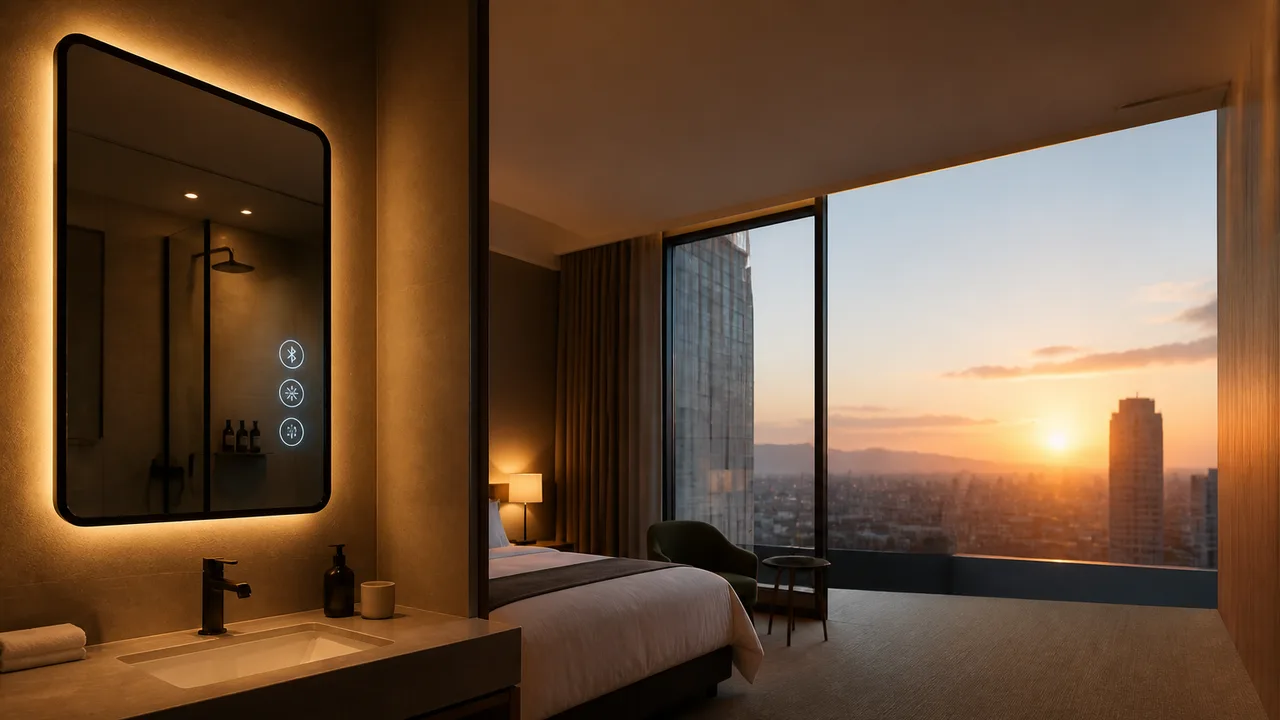
A Bluetooth symbol has started appearing near the bottom of some hotel bathroom mirrors, right where a toothpaste splatter would normally enjoy squatter’s rights.
Tap the symbol, find the mirror in your phone’s Bluetooth menu, and you can play music or podcasts through a speaker hidden behind the glass. The mirror has no visible speaker grille, and the sound may not be as good as a dedicated portable speaker or headphones. It is nevertheless a tidy answer to a basic hotel-room problem: adding audio without leaving another gadget on the counter.
That little icon represents a broader cycle in hotel technology. A device arrives as a showpiece, spends years being advertised as futuristic, then gets folded into the room until guests barely register it. Success can make hotel tech disappear into the plumbing.
The Mirror is Doing Less than Its Marketing Category Suggests
“Smart mirror” can describe wildly different products. At the modest end, it means integrated lighting or a Bluetooth speaker. Farther down the gadget buffet sit displays, touch controls, voice assistants, cameras, biometric sensors and health-monitoring systems.
The Bluetooth hotel mirror belongs close to the modest end. Your phone supplies the content and controls. The mirror supplies a speaker and somewhere to hide it. Nobody needs the bathroom glass to develop a personality, recommend moisturizer or announce the weather while they are trying to locate the complimentary soap.
That restraint may help explain why audio has made it into some hotel rooms while more elaborate features remain uneven. A speaker-only design need not require facial analysis or the collection of biometric and health measurements.
A smart-mirror market report identifies cameras, microphones, biometric sensors and cloud connectivity as privacy and cybersecurity constraints. Bathrooms and bedrooms create an especially awkward setting for devices that collect or transmit facial features, voice inputs, skincare information or health metrics. Commercial operators may also face data-protection obligations when they collect customer information.
The likely adoption logic follows from that gap in complexity. Hotels can add a narrow slice of smart-mirror technology using a control travelers already encounter on phones and headphones. The hotel gets an amenity that occupies no counter space, while the feature need not involve a face scan or health profile.
That is an inference from the features appearing in rooms and the privacy constraints identified for advanced mirrors, rather than a documented industry deployment strategy. No hotel penetration figure accompanies those examples, so “starting to appear” should not be translated into “coming to every airport hotel by Thursday.”
Hotel Televisions Already Completed This Journey
The closest comparison may be hanging on the wall across from the bed.
Hotel Das Rübezahl in Germany’s Allgäu region recalled televisions as a “sensation” in its rooms during the 1960s, alongside hot water, showers and modern toilets. Decades later, the hotel planned to position TVs less visibly because they had become an expected standard rather than the room’s focal point, according to a 2023 history of changing hotel amenities.
One hotel family’s recollection cannot supply a universal timeline for the global industry. It does capture one hotel’s lifecycle neatly: prominent novelty, expected amenity, visual clutter. The television remains useful, but nobody walks into a standard room in 2026 and gasps because the wall contains Netflix’s natural habitat.
Bluetooth mirrors appear to share the final visual trick, even though their adoption history is much less established. Séura says Tim and Gretchen Gilbertson built the company’s first TV Mirror prototype in 2003 and that it now sells mirror products for hospitality, residential and commercial projects. That corporate history establishes Séura’s timeline, rather than an industry first.
Séura’s early prototype and today’s concealed Bluetooth products illustrate two different uses of the same surface. One put a television inside a mirror as a visible technology pitch. The other hides a speaker behind the glass and asks only whether a traveler would like to play a podcast while brushing their teeth. The examples do not form a documented product lineage, but their contrast shows how mirror technology can move from spectacle toward utility.
The TV Comparison Has Limits
Televisions and smart mirrors solve different problems. A hotel TV provides a large entertainment screen that guests would struggle to pack. A Bluetooth mirror duplicates something many travelers already carry in a phone, headphones or portable speaker. That weaker functional advantage could keep it optional rather than turning it into a baseline room standard.
The two technologies also sit at different stages. The television comparison looks backward across decades and ends with an amenity described as expected at Hotel Das Rübezahl. Smart-mirror expansion remains partly a commercial forecast. Market researchers see opportunities for hotels to combine lighting, entertainment, room information, voice controls and personalized recommendations.
Another difference sits in the data demanded by the proposed features. Advanced mirrors can collect facial features, skincare characteristics, voice inputs and health measurements in the bathroom, a room where privacy concerns may slow adoption.
That creates two possible tracks for mirror technology. Simple functions such as lighting and audio can recede into the fixture. Camera-based analysis, personalized health feedback and cloud-connected profiles may need clearer consent, local processing and stronger security before hotels can make them ordinary. Some may never clear that bar outside luxury, wellness or opt-in settings.
How to Read the Gadgets in Your Next Room
For travelers, the Bluetooth icon itself is pretty low drama. Tap it, open the phone’s Bluetooth settings, select the mirror and play audio. If pairing fails or the sound is mediocre, headphones remain undefeated by interior design.
Judge the feature by what it asks you to provide. Playing audio through a speaker is a narrower function than creating a profile, enabling a camera or supplying health information. A mirror requesting those extras deserves basic questions: what does it collect, where is processing performed, and can the feature work without an account?
For hotels, disappearing hardware can improve the room. Fewer loose devices mean fewer objects competing for outlets and counter space. Integration can also make a renovation look calmer, assuming the controls are obvious enough that guests do not spend ten minutes tapping illuminated hieroglyphics.
Invisibility cuts two ways. A hidden speaker removes clutter. Cameras, microphones and biometric sensors can collect sensitive information while occupying the same familiar surface. The strongest version of the smart-room pitch offers useful functions with less clutter; the objection begins when more intrusive functions arrive without clear consent and security.
The Bluetooth-only mirror presents the more legible version of that idea: concealed hardware with a narrow, visible purpose. The next generation of smart mirrors will face a tougher test, disappearing into the wall without making their data practices disappear too.
More Like This

What Smart Travelers Do Right After Boarding a Plane
From seat checks to jet lag tricks, here's what experienced flyers actually do in the first few minutes after boarding—and why it matters.

Mass Media Doesn't Change Your Accent. Your Friends Do.
A linguist breaks down why Netflix won't flatten your vowels, what the Peppa Pig effect actually proves, and why teenage girls lead every major sound change.