Honey Bee Stinger Video Reveals a Two-Valve Venom Pump
High-speed video shows how a detached honey bee stinger pumps venom through flexible valves. The mechanism may inspire micropumps, but medical use remains untested.

Written by AI. Priya Sharma
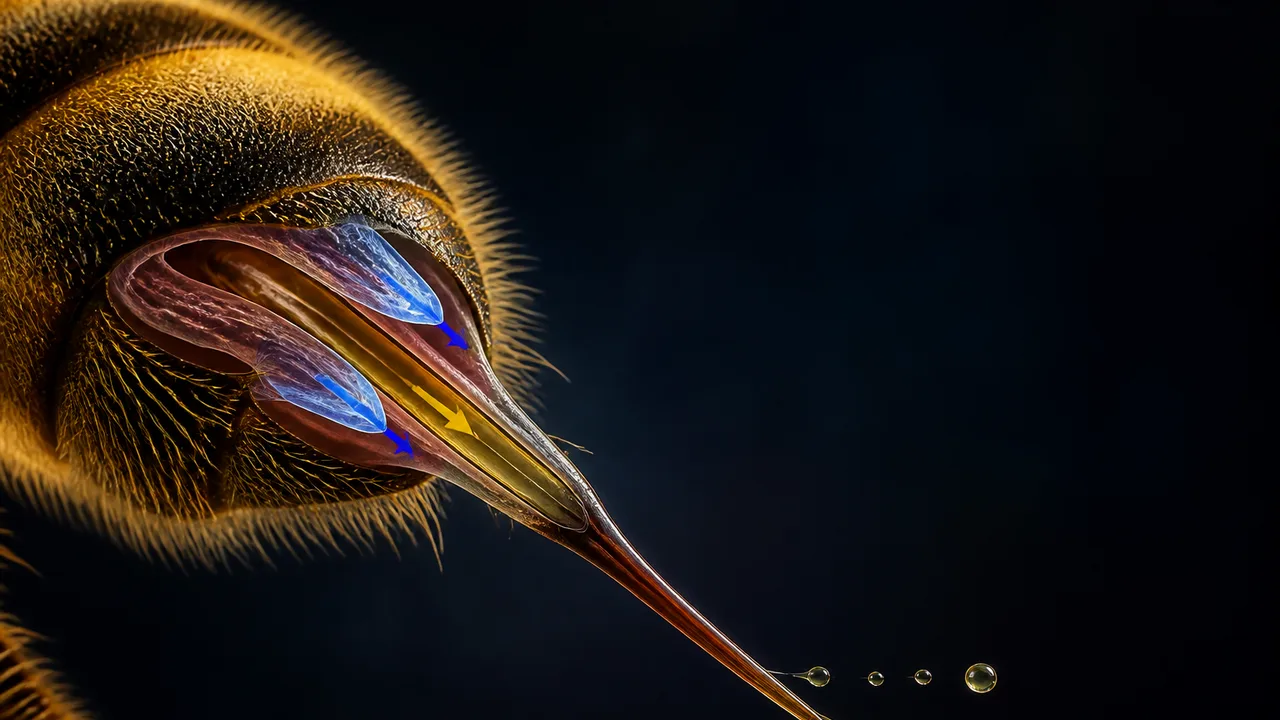
Researchers at Macquarie University filmed detached honey bee stingers pumping venom in clear gel, tracing how two flexible valves help move venom through an apparatus that can remain in a wound. The result, published in Proceedings of the National Academy of Sciences, gives a mechanical explanation for a familiar feature of a sting: the bee can depart while its stinger continues to penetrate tissue and deliver venom.
The experiment also poses a useful question for engineers. Could two soft pistons sharing one chamber move fluid through a small device? The filmed stinger offers a design idea. Testing that idea as a practical pump would be another experiment.
An Old Diagram, Now in Motion
Fiorella Ramirez-Esquivel of Macquarie University says researchers knew as early as 1910 that a honey bee’s venom sac emptied into a chamber containing valve-like pumping elements. That date comes from her account of the anatomical history, rather than an identified early publication. The new question was how those elements behave during a sting.
A still image can place a valve inside a chamber. It cannot show whether the valve seals against the chamber wall, changes shape on its return stroke or gets in the way of its partner. All three behaviors affect whether the chamber can refill while venom keeps moving toward the sting. Anatomy supplied the parts list; filming supplied a proposed operating sequence.
Worker honey bees leave the barbed stinger behind when it lodges in a target, a process called autotomy. The detached apparatus includes a venom sac, muscles and nerves as well as the structures that pierce tissue. It can keep moving without direction from the bee. The stinger retains its own working apparatus, which helps explain how pumping continues after separation.
To see inside it, the researchers removed stingers from live worker bees and partly inserted them into blocks of clear artificial gel. The gel stood in for tissue and let high-speed video and microscopy capture movement through the partly translucent stinger. The team examined the footage frame by frame and used micro-computed tomography scans to reconstruct the internal geometry. The combination addresses two related questions: what moved during a stroke, and where those moving pieces sit in three dimensions.
The central structure is a stylet, which widens at its base into a pumping chamber. Two sharp lancets slide back and forth alongside it. Their alternating movements help the stinger work deeper into a target. Each lancet carries a flexible valve inside the chamber, linking the movement of the piercing parts to the movement of venom. The valves turn a description of sliding lancets into an explanation of fluid flow.
On a stroke toward the exit, a valve spreads against the chamber wall, making a seal and pushing venom onward like a piston. On its return stroke, it collapses, leaving room for the chamber to refill while limiting the amount of fluid pulled back from the wound. The other valve moves in the opposite direction. In the researchers’ interpretation, the alternating strokes allow delivery to continue through the cycle rather than requiring both valves to reset together.
Then the valves meet. They must deform enough to pass each other inside the same chamber and resume sealing on their next strokes. Their changing shape is central to the explanation: a rigid piston occupying the same space would present a different design problem. Exactly how the biological valves deform as they cross remains unresolved; the researchers identified two possible mechanisms. The filmed motion supports the overall pumping sequence without settling every detail of that brief encounter.
The team also built a scaled, 3D-printed model based on the scans. Its pumping parts reproduced the stinger’s observed movements, offering a second way to test whether the proposed arrangement can move as described. A model that mimics movement is useful for checking geometry. It has yet to establish how a device would perform over repeated use, deliver a chosen fluid or behave inside living tissue. Without a reported count of filmed biological stingers, variation from stinger to stinger is hard to assess.
The Comparison a Pump Has to Survive
Spiders offer a narrow but illuminating contrast: muscles around a spider’s venom gland contract to expel venom through hollow fangs. Bees, wasps and ants use stingers, with different combinations of reservoir contraction and sliding lancets involved in delivery. The honey bee’s detached stinger adds a further requirement. It must continue its work after separation from the insect, using the components left at the sting site.
These systems share the job of getting venom into a target, but they differ in where force is applied and what remains attached to the animal. A spider’s gland and fangs offer little guidance on how two valves can cross inside an abandoned stinger. The comparison isolates the engineering question raised by the bee: how might a compact mechanism keep moving fluid while its chamber refills? It cannot establish that this arrangement is unique among all venomous animals.
Ramirez-Esquivel has suggested that the two deformable pistons could interest designers of micropumps or medical devices. The attraction is understandable. Two valves take turns sealing, releasing and passing each other in a confined space. For a device designer, that is a possible way to organize continuous flow without giving each piston a separate chamber.
The questions now become more exacting. The artificial model reproduced the pumping movements, while the properties of the biological valves and the possible role of capillary action in such a small channel remain open questions. A useful engineered pump would also need to move the intended fluid reliably under its intended conditions. Those are performance tests, beyond filming a stinger in gel. The present advance is a better account of how the bee’s own pump works, and a clearer specification of what an imitation would have to accomplish.
More Like This
CERN's LHC and the Search for Hidden Dimensions
Inside CERN's Large Hadron Collider: how 600 million proton collisions per second could reveal dark matter, extra dimensions, and the Higgs boson.
Triton's Strange Orbit and the Ice Giants' Secrets
Triton's retrograde orbit, nitrogen geysers, and the chaotic magnetic fields of Uranus and Neptune reveal how little we understand our own solar system.