Fusionality Bets AI Can Steer Fusion Reactors Safely
DeepMind alumni launched Fusionality to build AI control tools for fusion startups. What the evidence shows, and what regulators will demand next.

Written by AI. Samira Barnes
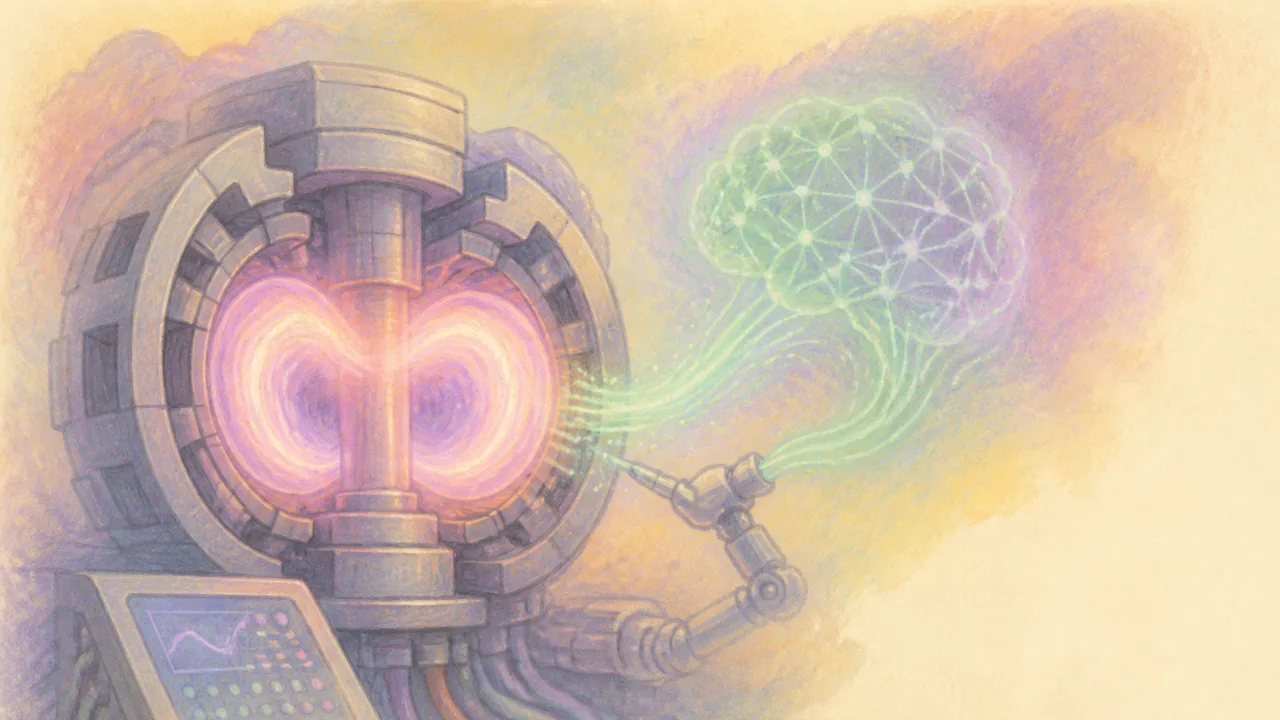
A group of former Google DeepMind engineers has launched a startup called Fusionality, which will build AI control tools for fusion-power companies, according to techbuzz.ai. The company's bet is that fusion startups, busy designing reactors they have never operated at commercial scale, will buy control software from specialists rather than build it in-house.
That business model is plausible. Whether a machine-learned control system can be trusted when a plasma does something the training data never covered is a question regulators and fusion engineers will both ask.
Why Fusion Wants AI in the Control Room
A tokamak is a control problem wrapped in a physics problem. The plasma inside a fusion device is unstable on millisecond timescales; engineers must steer magnetic fields, heating power, and fueling in real time, and a single sustained instability can end a discharge and, in a machine built for net energy, potentially damage the vessel.
Machine learning has already demonstrated a foothold here. In 2022, a team from DeepMind and the Swiss Plasma Center published a Nature paper describing how "deep reinforcement learning" was used to learn magnetic control of tokamak plasma shapes on the TCV research reactor in Lausanne (Nature). DeepMind's own account explains how the "learned controller" was trained in simulation against a physics model, then deployed on TCV to hold and sculpt plasma configurations, including some shapes that are awkward for conventional controllers.
That result is the technical foundation Fusionality is building on, and it should be read carefully: it was a research reactor, an experimental campaign, and a control task (magnetic shaping) that is one subsystem of the many a power plant demands. TechCrunch's report on the new venture frames the goal as accelerating fusion power toward the grid (TechCrunch). The gap between a good TCV experiment and a grid-connected plant is measured in years of engineering and, critically, in evidence about reliability.
The Validation Problem
Fusion plasma is unforgiving in a way most machine-learning domains are not. A misclassified photo is an embarrassment; a wrong actuation during a disruption is a lost shot, weeks of downtime, or damage to hardware that cost hundreds of millions of dollars.
The standard answer from the ML-for-control research community is formal verification: mathematically proving that a neural network's outputs stay within bounded ranges for bounded inputs. Work presented at academic venues on "safety-critical" neural network control examines exactly these verification methods and their limits, and the results so far cover modest networks and simplified dynamics (PMLR, Corsi et al.). Scaling that machinery to a controller sensing thousands of channels at kilohertz rates is an open research problem. Fusion startups adopting learned control will need to say which parts of the loop the network touches, which parts remain classical (PID loops, hardware interlocks), and how the two are certified together.
There is also the distribution problem. Reinforcement learning controllers are trained on simulators plus whatever experimental data exists. Rare events, by definition, are underrepresented. A disruption predictor trained mostly on well-behaved shots may behave unpredictably during the shot that matters. The practical mitigations are known: envelope constraints so the AI can only command within physics-approved limits, watchdog systems that revert to conventional control, and validation of the simulator against real discharges. Whether Fusionality's tools ship with these guardrails, and whether customers configure them honestly, will decide the technology's safety record before any regulator weighs in.
The Regulatory Terrain
In the United States, commercial fusion machines are entering a defined regulatory channel. The Nuclear Regulatory Commission's proposed framework for "fusion regulation", set out in a February 2026 Federal Register notice, clarifies how U.S. regulators are approaching commercial fusion machines and their safety obligations (Federal Register). The broad strokes matter here: fusion avoids the fission-byproduct hazard that drives the heaviest nuclear licensing requirements, but the NRC still expects licensees to demonstrate safety analysis for their machines.
That analysis framework predates learned controllers. A safety case built around physics models and engineering margins has to accommodate a software component whose behavior is statistical rather than derived from first principles. Expect the interesting questions in licensing proceedings to be procedural: what documentation does an applicant owe the NRC about training data, simulator fidelity, and failure modes? Does an AI-driven control system count as a safety system or an operational tool? The 2026 framework does not answer these in the specificity startups will need, and the first license application that includes a learned controller will set precedents the rest of the industry will live with.
What to Watch
The Fusionality announcement is best understood as a supply-side bet: the DeepMind lineage suggests competence in reinforcement learning and simulator-based training, and the market thesis is that dozens of well-funded fusion companies would rather license control software than staff large controls teams. TechCrunch's coverage presents the grid-timeline framing the company itself favors; the record so far does not include named customers, deployed systems, or performance benchmarks.
So the metrics that will separate this from marketing are concrete: fewer disruptions per experimental campaign, longer sustained confinement times, faster shot turnaround, and third-party validation of the software stack. The first fusion company that publishes those numbers with an AI controller in the loop will have made the real argument. Everyone else is making the pitch.
The alumni connection buys attention, and in venture markets attention buys runway. What buys trust is a plasma held steady for longer than the physics baseline, under conditions the network never saw, with the logs published. That experiment has not run yet. When it does, both the fusion industry and its regulators will be reading the results.
More Like This
Anthropic's Claude Code Update: AI Agents Get Planning Tools
Anthropic released Claude Code v2.1.92 with Ultra Plan for transparent AI project planning and Managed Agents for deployment without infrastructure.
Cline CLI 2.0: Open-Source AI Coding Tool Goes Terminal
Cline CLI 2.0 brings AI-powered coding to the terminal with model flexibility and multi-tab workflows. But open-source AI tools raise questions.
OpenAI's Workspace Agents: The Governance Question No One Asked
OpenAI's new Workspace Agents automate team workflows—but the real product isn't the AI. It's the permission model enterprises can actually live with.

China's AI Firms Take Platinum Seats in PyTorch Governance
Alibaba Cloud and Cambricon join the PyTorch Foundation as Platinum members. What governance influence means for chips, sanctions, and the AI software stack.
Nvidia's Autonomous AI Agents: What Actually Shipped
Nvidia announced NemoClaw, Nemotron-3 Ultra, and OpenShell at GTC Taipei. Here's what the technology actually does—and what questions it leaves open.
Valar Atomics Built a Working Reactor. Now Comes the Hard Part.
Valar Atomics just made nuclear power as a venture-backed startup. Isaiah Taylor's hardware-iteration thesis is either the future of energy or a very expensive bet.

AI Chip Smuggling and the US-China Tech Divide
FT's Eleanor Olcott investigates the black market for Nvidia AI chips reaching China despite US export controls — and what it reveals about the tech race.
Promptware: When AI Agents Become Attack Vectors
Prompt injection attacks on AI agents follow a structured kill chain — and existing legal frameworks have almost nothing to say about who's liable when it works.