Francis Halzen’s Physics Nobel Honors IceCube Astronomy
Francis Halzen’s 2026 Physics Nobel honors IceCube’s detection of cosmic neutrinos. Here is how Antarctic ice became an observatory, and what remains unknown.

Written by AI. Amelia Nwofor
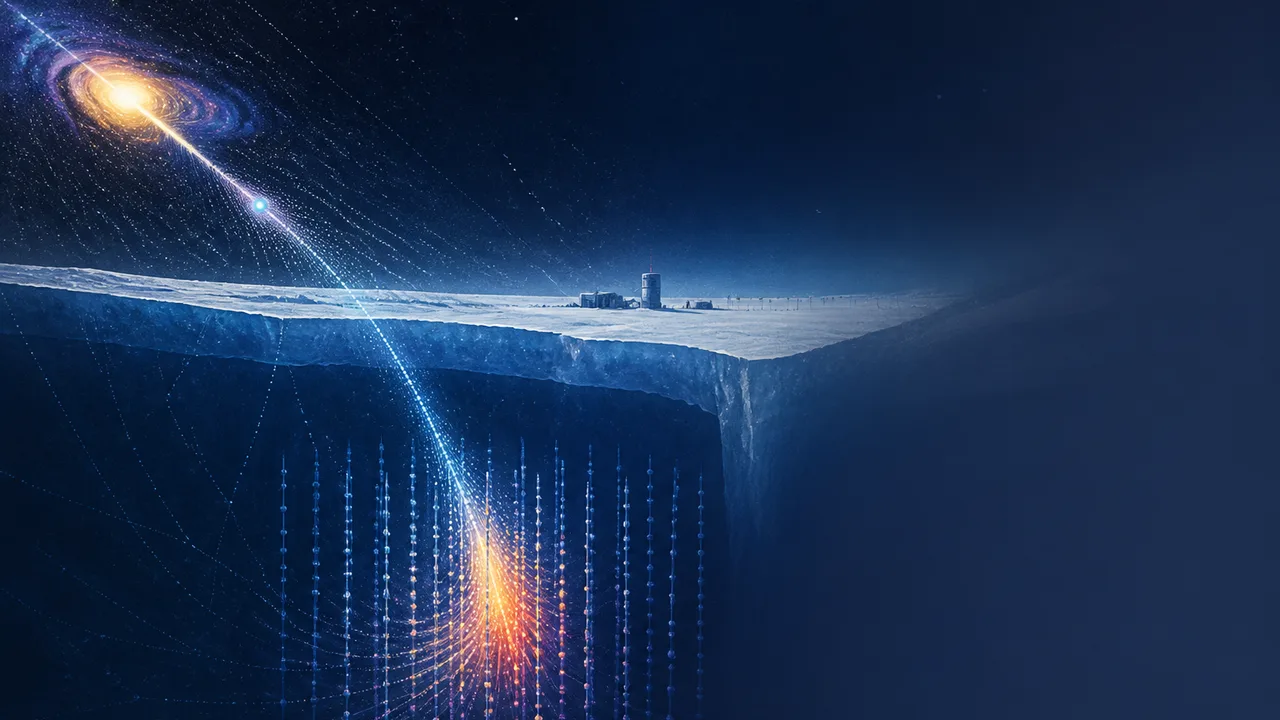
Francis Halzen won the 2026 Nobel Prize in Physics on October 6 for work that turned Antarctic ice into an observatory for particles arriving from beyond the Solar System. He made “decisive contributions to the IceCube Neutrino Observatory and the discovery of high-energy neutrinos of astrophysical origin”.
The citation rewards two linked achievements. IceCube detects a particle that rarely leaves a trace, and its measurements let researchers investigate where some of those particles came from. The first achievement required a cubic kilometre of ice and years of instrument-building. The second opened a way to study violent cosmic environments, while leaving questions about their precise sources and workings.
How Ice Becomes a Detector
A neutrino can pass through Earth without interacting with it. That makes neutrinos difficult to catch, but it also lets them travel through dense regions that light cannot easily penetrate. IceCube uses the enormous Antarctic ice sheet to give an occasional neutrino a chance to collide with an atomic nucleus within reach of its sensors.
The sensors do not take a picture of the neutrino itself. When an interaction produces fast-moving charged particles, those particles emit light as they cross the ice. The pattern and timing of that light allow researchers to estimate the incoming neutrino’s direction. IceCube’s thousands of light sensors sit on cables drilled and frozen into the South Pole ice.
Scale is the answer to a probability problem. Most neutrinos pass straight through the detector. A small container of ice would offer far fewer opportunities to register the rare interactions researchers need. The South Pole supplies a vast volume of clear ice; the sensors turn an occasional flash within it into a measurement. IceCube must be large because the particles are elusive, even though that elusiveness is what makes them useful for studying distant places.
A direction estimate has astronomical value because neutrinos carry no electric charge: magnetic fields do not bend their paths through space. Their energy can also offer clues about the conditions that produced them. Together, those properties make a detected neutrino more than a particle count. It can be a lead about an extreme environment elsewhere in the universe. A direction estimate remains an estimate, however, and a lead does not by itself identify every source or explain the process inside it.
The Long Route from Proposal to Observation
Halzen presented his South Pole detector idea in 1988. Other researchers joined the effort, and preliminary tests of sensors in ice followed a few years later. IceCube, with instruments spread through a cubic kilometre, was finished in 2011. Researchers subsequently detected high-energy neutrinos and later established that some originated far beyond the Solar System.
That sequence helps explain the Nobel citation’s attention to the observatory and the discovery. Researchers first had to make rare collisions measurable; only then could they use those measurements to investigate cosmic origins. Instrument-building was part of the scientific result, carried out by an international team of researchers and engineers that Halzen led. As Mark Pearce, chair of the Nobel Committee for Physics, put it in the Academy’s announcement, the team supplied “a fantastic instrument.”
The 1988 idea also depended on choosing the right setting. Clear glacial ice could carry the light from an interaction to sensors, while the South Pole offered a large, geologically stable area with little interference. Those practical conditions are easy to lose behind the phrase “ghost particle.” IceCube needed ice that would serve as detector material, room enough to make rare events observable, and sensors capable of extracting information from the light.
An occasional interaction creates particles whose passage through the ice helps researchers determine where in the sky the neutrino arrived from. The prize will be presented in Stockholm on December 10. The observatory’s continuing work is a reminder that an instrument can merit recognition while the questions it was built to address remain active.
The Same Particle, a Different Question
Neutrinos themselves were familiar long before IceCube. The Sun produces vast numbers of them; billions pass through an area the size of a fingernail every second. IceCube searches for much higher-energy neutrinos from violent processes far beyond our Solar System. The comparison clarifies what is distinctive about this observatory: neutrino detection can address very different questions depending on which neutrinos a detector is built to study.
There is a Nobel precedent, though it has a narrow lesson. Frederick Reines received a 1995 Physics Nobel for the discovery of neutrinos, described there as low-energy; the 2026 citation concerns high-energy neutrinos of astrophysical origin. Both prizes involve the same elusive particle. Halzen’s award recognizes the use of its cosmic arrivals to investigate distant environments. The comparison says little on its own about the two projects’ methods, so the clearer measure of IceCube’s achievement is what its own observations made possible.
High-energy cosmic processes can accelerate particles to extraordinary energies, yet researchers still want to know where the relevant sources are and what happens inside them. Neutrinos can bring clues through matter that obscures light, and their paths are not scrambled by magnetic fields. IceCube catches a fraction of them and estimates where they arrived from.
The prize marks the distance between Halzen’s 1988 proposal and a working detector that can register particles from beyond the Solar System. Each useful flash in the ice now points researchers back toward the question that justified building a cubic-kilometre observatory: what, out there, made it?
More Like This
How Tectonic Forces Shaped the European Continent
From 3-billion-year-old Norwegian rocks to the Alps still rising today, Europe's geological story is wilder than any human history we know.
TON 618: The Black Hole That Defies Its Own Physics
TON 618 weighs 66 billion solar masses—more than current black hole growth models can explain. Here's what that gap in our knowledge actually means.