France's Thunder Boat: One Ship, Every Mission
France's BPC Thunder Boat is a 22,000-ton amphibious assault ship that functions as a seaport, hospital, helicopter carrier, and command center—all at once.

Written by AI. David Oyelaran
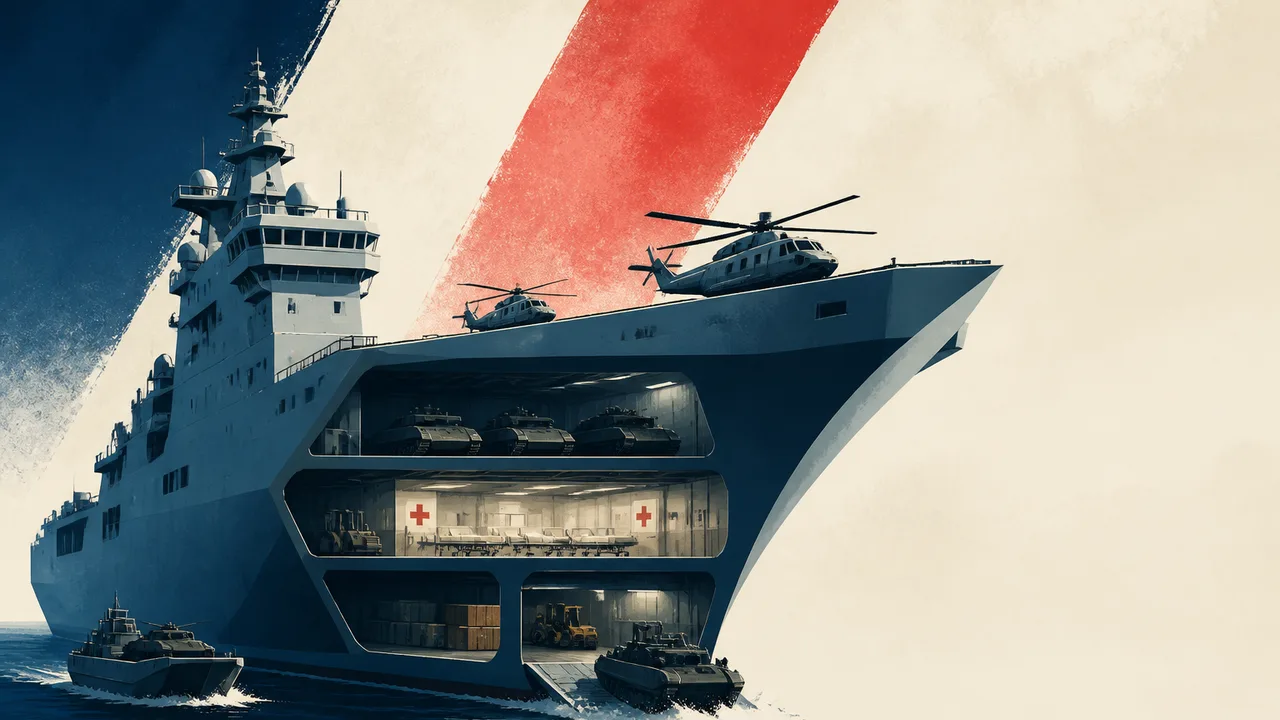
Photo: AI. Mika Sørensen
There's a moment in director Lionel Langlade's documentary about the French Navy's BPC Tonnerre—known here as the Thunder Boat—where the film crew is walked to the edge of the ship's most secured interior zone and told, essentially: this is as far as you go. No cameras. No documentation. Two hundred high-ranking officers from France's three military branches work behind those armored doors, connected via encrypted satellite to naval forces, ground troops, the defense ministry, and, if necessary, the Élysée itself. The hull acts as a Faraday cage, blocking electromagnetic signals from the outside world.
It's the kind of detail that makes you sit with a question for a while: what exactly is this ship for?
The answer, it turns out, is almost everything.
A Ship That Refuses to Be One Thing
The Thunder Boat—formally the Tonnerre, second in France's trio of Bâtiments de Projection et de Commandement—commissioned in 2007 and displacing 22,000 tons, measures 200 meters from bow to stern. That's two football pitches. Its peak rises 64 meters above the waterline, taller than the Arc de Triomphe. It carries up to 900 personnel, 100 vehicles, and can stay at sea for 45 days covering 10,000 kilometers without resupply.
The documentary, produced by Best Documentary and directed by Langlade, walks through each of these capabilities in careful sequence—amphibious operations, helicopter operations, command functions, medical capacity—and the cumulative effect is genuinely disorienting. This isn't a ship that does one thing very well. It's a ship that does five or six things, each of which would be the defining feature of a lesser vessel.
The French military calls this versatility. There's a more pointed word for it: ambiguity. A ship that can wage war, provide disaster relief, serve as a floating hospital, and host a joint command center is also a ship whose presence near any coastline carries multiple simultaneous meanings.
The Engineering Underneath the Branding
Before getting to the larger questions the Thunder Boat raises, the technology itself deserves attention—because it's genuinely interesting.
The most striking system is the propulsion. Traditional warships link their propellers to internal motors through long shafting lines, which means steering requires a separate rudder. The Thunder Boat uses azimuth pods—electric motors mounted externally, directly inside rotating housings beneath the hull. The propellers become fully independent. The documentary describes the effect: "Two simple joysticks are enough to guide them."
This isn't military innovation. The Saint-Nazaire shipyards first tested pod propulsion on commercial cruise liners in 2001. What the French Navy did was recognize that civilian engineering had solved a military problem—maneuverability at scale—and adapt accordingly. Combined with bow thrusters at the ship's front, the Thunder Boat can hold a fixed GPS position in open water without dropping anchor, a capability called self-positioning that makes amphibious operations significantly safer in variable weather.
The ship's ballast system is equally clever. Borrowing submarine technology, two large ballast tanks—fore and aft, with a combined capacity of 10,000 cubic meters—can be filled with seawater to sink the ship up to two meters lower in the water. When the stern submerges, the rear apron floods just enough to function as an inland harbor. Landing barges float directly out. The whole process takes thirty minutes. The pumps involved, if you're curious, can fill an Olympic swimming pool in ten minutes.
The door-to-door landing technique goes a step further. Rather than flooding the full apron, only the rear ballasts engage, pushing the stern down until it sits exactly at sea level. Smaller amphibious vessels—the EDA rapid landing craft, which travel at over 60 km/h and can carry 80 tons—dock directly against the Thunder Boat's stern doors as though docking at a pier. A 60-ton Leclerc tank can drive straight across. The maneuver demands extraordinary coordination: "The slightest error and precious equipment will end up on the seafloor."
What Fifty Years of Doctrine Looks Like
The documentary roots all of this in history, specifically D-Day. On June 6, 1944, 42,000 landing barges put 156,000 men on Normandy beaches. It remains the reference point for amphibious doctrine, and for good reason: the logistical complexity of moving an armed force from sea to land under fire has never been solved cheaply or easily. The thunder Boat is, among other things, France's answer to what that complexity looks like in 2024.
Only five nations, the documentary notes, currently possess the capacity to mount operations at that scale: the United States, the United Kingdom, France, Russia, and China. The Thunder Boat's existence is partly about capability and partly about that list—about which countries can project force from the sea and which cannot.
That framing is worth sitting with. The documentary is straightforwardly promotional—this is a film made with French Navy cooperation, and it shows. But the underlying strategic logic it describes is real, and the questions it implicitly raises are not resolved by the film's enthusiasm for the ship's capabilities.
The Hospital That Lives on a Warship
One of the Thunder Boat's most unusual features is its medical facility: 1,000 square meters on the fifth level, 69 beds, two operating theaters, a burns unit, a sterilization room. The documentary describes it as "equivalent to a hospital of a city with 30,000 inhabitants." A dedicated elevator connects the flight deck directly to the ward, so casualties can move from helicopter to operating table without delay.
The hospital's existence raises a tension the documentary doesn't fully explore. The same ship designed to deposit armored vehicles on hostile coastlines also carries the infrastructure to treat the wounded those operations will inevitably produce. It's designed for both the making and the mending of casualties. Whether that dual function represents moral complexity or simply military pragmatism probably depends on what you think war is.
After Hurricane Irma devastated Saint-Martin in September 2017, the Thunder Boat was deployed to deliver 500 personnel, 12,000 tons of cargo, and 100 vehicles across 6,000 kilometers of ocean. The documentary presents this as evidence of the ship's humanitarian value, and the relief it provided was real. What it also demonstrates is that the infrastructure required to project military force is often the same infrastructure needed to respond to a catastrophe—and that nations maintaining that capacity for one reason suddenly find themselves holding the only available tool when the other reason arrives.
A Floating Contradiction, in the Best Sense
The Thunder Boat's flight deck covers 5,200 square meters and accommodates six helicopter pads, the forward-most of which is reinforced to handle 27 tons—enough for the MV-22 Osprey, the tilt-rotor hybrid aircraft that blurs the line between helicopter and fixed-wing plane. Up to 16 helicopters can be stored below deck, raised to the flight deck via two hydraulic platforms. At night, a three-color beam guidance system called the IPD—slope and descent indicator—keeps pilots on a 4-degree approach path despite the deck moving beneath them. The ship can physically rotate, using its pods and thrusters, to point the flight deck directly into the wind during operations.
The engineering is meticulous. The documentary is generous with it, and the detail rewards attention. But what stays with me after spending time with this material is the central tension the Thunder Boat embodies: it is a ship designed to be everywhere, do everything, and adapt to whatever situation presents itself—which is another way of saying it was designed to make its own deployment easy to justify.
"It's one of the only ships in the world to perform so many missions," the documentary states plainly.
That's not a criticism. It's a fact about what powerful states build when they decide they want to remain capable of acting, at sea, in almost any scenario. The Thunder Boat doesn't resolve the question of when or whether to act. It just removes the logistical excuse for not being able to.
More Like This
Inside the $65M Car Carrier Crossing the North Atlantic
The Faust carries $65M in luxury cars across a winter North Atlantic. What the documentary reveals about the people and systems keeping it all afloat.

How to Build Git Version Control Into Your Apps
LibGit2 lets developers embed Git functionality directly into applications. Here's what that actually looks like in practice, and why it matters.

When Agents Generate Their Own UI: The Three Flavors Explained
CopilotKit's Tyler Slaton maps the spectrum of generative UI—from pixel-perfect control to agents writing raw HTML. Each approach makes different tradeoffs.

Unitree's Mech Robot and the Regulation Nobody Wrote
Unitree's GD01 manned mecha is commercially available and already deploying abroad. The regulatory framework to govern it doesn't exist yet.

The WWII Flying Boat Still Fighting Wildfires Today
The Martin Mars water bomber—a WWII relic with a 60m wingspan—is fighting Mexico's worst wildfires in 30 years. Here's how it actually works.
ZimaCube 2 Review: A Meaningful Upgrade or Incremental Refresh?
The ZimaCube 2 is a compact home server that earns attention for its processor upgrade—but a quiet software licensing twist deserves yours too.

DNA Names a Revolutionary War Teen Soldier After 245 Years
Genetic genealogy has identified Private John Pumphrey, a Maryland teen who died at the Battle of Camden in 1780 — one of America's oldest John Doe cases.

Cicero and the Fall of the Roman Republic
Marcus Tullius Cicero defended Rome's Republic with words alone—and paid with his life. A look at history's most consequential orator and his impossible political moment.