Foldscape's Cellular Automata Show the Limits of a Demo
Foldscape lets visitors explore mathematical rules in motion. Conway's Game of Life and Rule 110 show what those patterns reveal, and where proof begins.

Written by AI. Amelia Nwofor
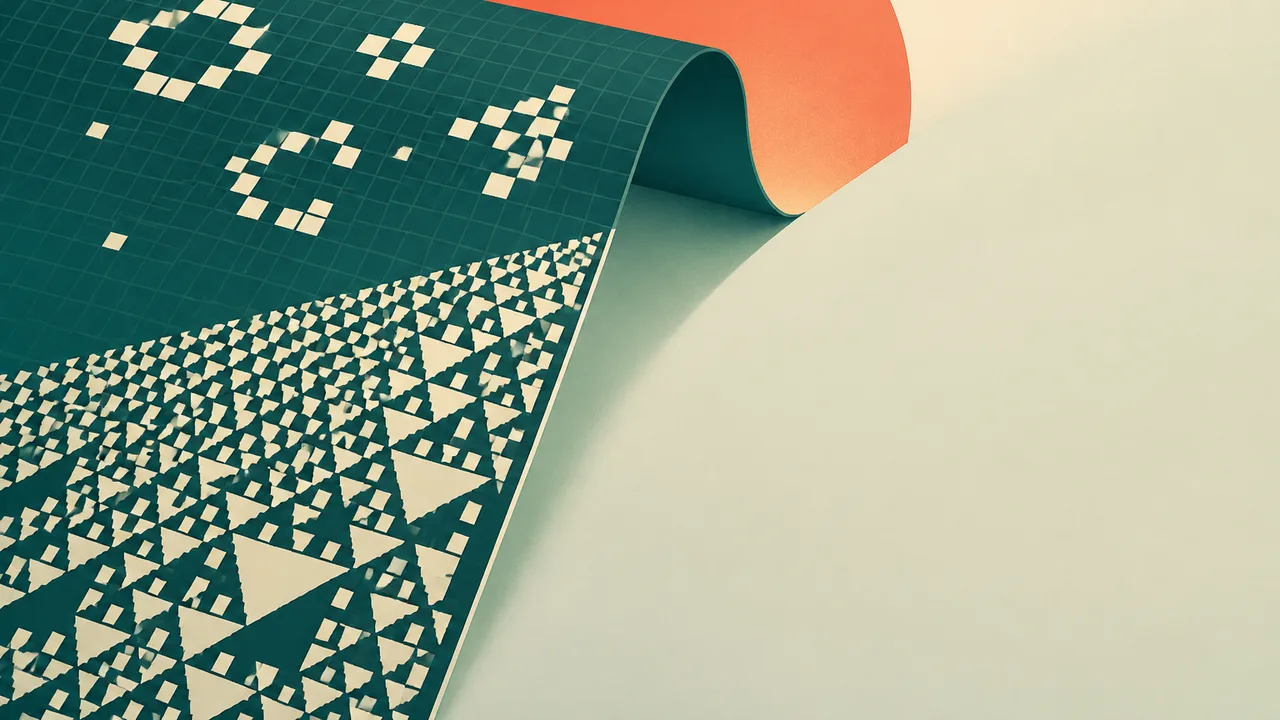
Foldscape puts Conway’s Game of Life and Rule 110 in an interactive atlas of mathematical curiosities. Its invitation is to adjust controls, restart iterations and watch a small rule develop into a pattern. That is an excellent way to begin a mathematical question. It also raises a second one: after the pattern appears, what have you actually established?
For a cellular automaton, the immediate answer is fairly precise. Choose a starting arrangement, apply the rule and inspect the successive states. You can see what happened for that arrangement over the steps displayed. Change the starting arrangement and you have a new experiment with the same rule. The screen makes both actions easy; the reasoning still depends on keeping the rule, the starting state and the claim about them separate.
One Grid, Many Possible Beginnings
Conway’s Game of Life supplies a clean example. Its mathematical setting is a square grid extending without limit. Each cell is alive or dead. In each generation, every cell updates according to the eight cells beside it, including diagonal neighbors. A dead cell with exactly three live neighbors becomes alive; a live cell survives with two or three. All cells update simultaneously. Set an initial pattern and the rules determine the next generation, then the next. Despite its name, Life has no opponent or winning move to make after the start.
Those instructions are compact enough to check by hand and rich enough to produce different behaviors. A still life keeps its configuration from one generation to the next. An oscillator returns to an earlier configuration after a number of generations. A spaceship repeats its shape while moving across the grid. Watching one of these appear gives a viewer something more useful than a decorative animation: a candidate pattern to examine, step by step, against the update rule.
There is a small but consequential distinction even among these examples. If the entire state of a deterministic automaton returns to precisely the same arrangement, its subsequent states must repeat too: the same rule applied to the same state gives the same successor. A shape that merely looks familiar inside a cropped display gives less information. Cells beyond the visible area could affect what comes next. The argument about repetition needs the relevant complete state, while the screen may show only a window onto it.
That reasoning also explains the value of changing the seed. A still life found from one starting pattern says that this pattern persists under the rule. It does not say that every starting pattern settles down. Several striking runs can suggest a broader question, but selecting attractive examples is no substitute for answering it. A viewer can ask: Is the claim about this configuration, a family of configurations, or every configuration allowed by the rule? Each step outward asks for a different argument.
Before the Animation
The pleasure of watching local rules grow into surprising pictures predates browser-based exhibits. In Stephen Wolfram’s retrospective history, Stanisław Ulam and colleagues generated rule-based geometrical objects on computers around 1960; Edward Fredkin simulated a related two-dimensional rule around 1961. These were different investigations, with different aims. Their presence in the history prevents Conway’s much more familiar game from becoming the imagined starting point for all work on cellular automata.
Conway began experimenting with two-dimensional rules in 1968, at first largely by hand and later on a computer, Wolfram recounts. By 1970 he had developed the Game of Life. Martin Gardner’s presentation in Scientific American helped bring it to a wide audience. Early investigators also tracked small patterns using graph paper, blackboards and physical boards. Foldscape changes how readily a visitor can reset and inspect an iteration; the underlying habit of trying a starting arrangement and following its consequences is older than the interface.
That history contains a useful warning against equating ease of display with ease of understanding. A person can discover an oscillator with pencil and paper or watch it cycle on a screen. In either case, noticing it may lead to a sharper question about its period, its dependence on nearby cells or the range of starting states that produce it. Faster iteration increases the number of examples available to inspect. It does not settle what an example can stand for.
The Harder Claim Hiding in Rule 110
Rule 110, another item in Foldscape’s atlas, makes the boundary clearer. Life updates a two-dimensional grid using eight neighbors. Rule 110 updates a one-dimensional line: the next value at each position depends on that position and its two immediate neighbors. Both systems build successive states from local instructions. Their displays can therefore invite the same response: pick a starting pattern and see what develops. The dimensions and neighborhood differ, so a moving shape in one should not be treated as evidence for a claim about the other.
Rule 110 also carries a mathematical claim that no displayed run can show. The Wikipedia entry on Rule 110 reports that Matthew Cook published a proof in 2004 that the rule, with a particular repeating background, can support universal computation. The same entry notes that the Game of Life is also known to be Turing complete, so the contrast here is between watching a run and proving a capability, not between a capable rule and an incapable one. In plain language, carefully configured patterns can emulate a computational system capable, in principle, of carrying out any algorithmic calculation. As that entry describes Cook’s construction, localized moving patterns on the repeating background emulate a cyclic tag system, itself a universal computational model, and their initial spacing is crucial to getting the interactions required.
That construction is a useful comparison with watching Life evolve. A Rule 110 animation can show that certain localized patterns appear and interact in the displayed run. The universality argument has to connect arranged patterns to the workings of another computational model, with the required background and timing. A pleasingly complicated image supplies neither that connection nor a demonstration that an arbitrary starting line performs computation. Conversely, a simple-looking run does not undo the construction. The claim is about what the rule can support under specified conditions, not what every run will visibly do.
The same care applies to Life’s visual vocabulary. Calling a recurring shape a spaceship describes its behavior under the rule. Calling a rule computationally universal asks for a further account of how configurations represent information and how their interactions process it. Both claims concern patterns; they carry different burdens of explanation. Foldscape places Life and Rule 110 near each other as things to explore, which makes that change in burden unusually easy to ask about.
A practical way to use an interactive atlas follows from these examples. First identify what changes at each step and what stays fixed. Then identify the starting conditions, including anything outside the visible window that the proposed claim relies on. Finally, put the claim into words: “this seed produces an oscillator” can be checked very differently from “this rule can emulate a universal computer.” The first may yield to tracking a complete returning state. The second needs a construction of the sort Cook provided. Restarting an iteration is an invitation to test the next question, not a shortcut past stating it.
More Like This
Computing Can Self-Replicate. That Doesn't Make It Alive.
Mathematician Barbora Hudcova proves that computational universality doesn't guarantee self-replication—and neither one is sufficient for life.

A YouTuber Got a Sequence Into the OEIS With XOR Math
Gary Explains got an original integer sequence accepted into the OEIS by XOR-ing numbers in loops. Here's why that's genuinely fascinating—and what it connects to.

How Tectonic Forces Shaped the European Continent
From 3-billion-year-old Norwegian rocks to the Alps still rising today, Europe's geological story is wilder than any human history we know.

TON 618: The Black Hole That Defies Its Own Physics
TON 618 weighs 66 billion solar masses—more than current black hole growth models can explain. Here's what that gap in our knowledge actually means.