The Flawed Pi Proof That Almost Looks Convincing
A circulating proof claims pi equals (14 minus root 2) over 4. Michael Penn shows the verification is circular and rules out the entire construction.

Written by AI. Priya Sharma
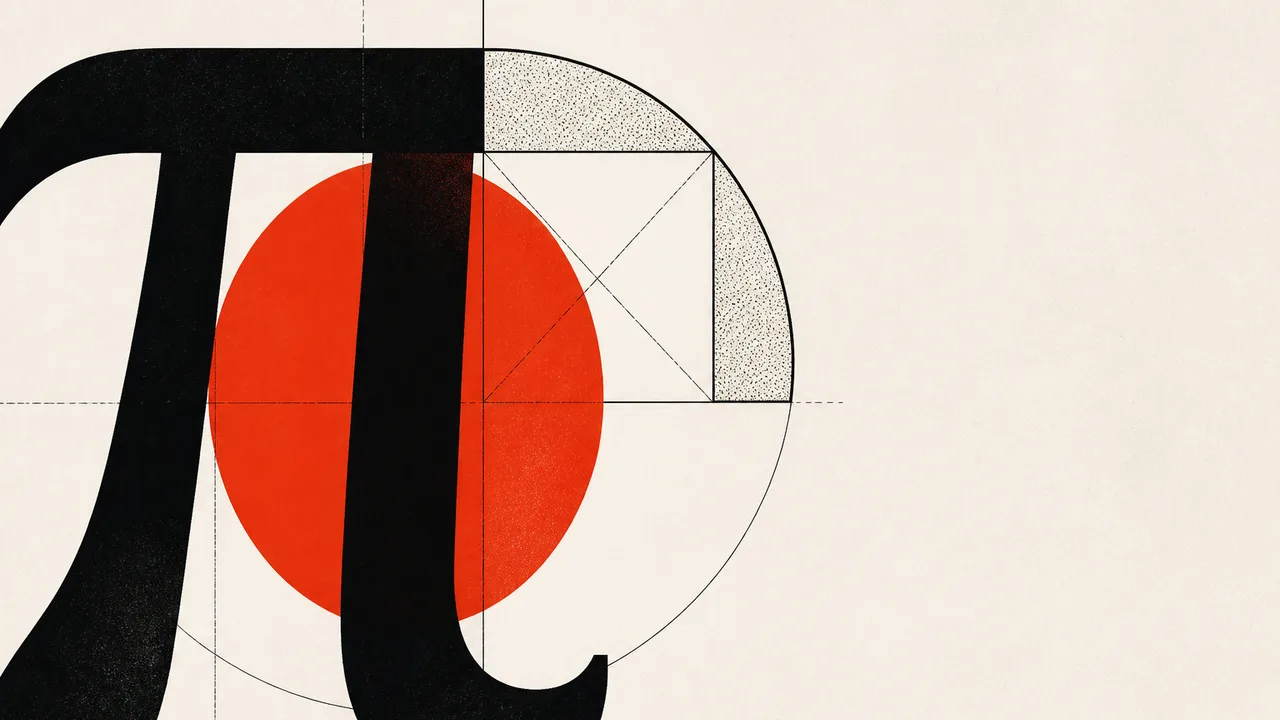
Photo: AI. Ondine Ferretti
Michael Penn received a circulating proof claiming that pi equals (14 minus the square root of 2) divided by 4, a value of approximately 3.1464, close enough to 3.14159 that it survives a casual glance. What Penn found when he examined the argument carefully was not just a flawed conclusion but a specific failure of verification: a "check" that is algebraically guaranteed to pass regardless of what value you assign to pi.
That failure mode interests me as much as the geometry does. The proof's author was using "wishful thinking," Penn's term for the legitimate mathematical practice of making an educated geometric guess and then confirming it rigorously. The problem is that the confirmation step, as built, cannot fail. A test that cannot fail is not a test.
The Setup
Penn begins with a unit square containing an inscribed circle of radius 1/2, giving the circle an area of pi/4. He draws the square's diagonals, marks where they intersect the circle, and uses those intersection points to define a horizontal strip of height c = (2 - sqrt(2))/4 across the top of the square. The geometry here is correct.
He then partitions the square into seven pieces: the top strip of height c, a middle strip, a lower rectangle, and four smaller rectangles in one corner. The pivotal claim is that those four small rectangles together have exactly the same area as the four corner regions of the square that fall outside the circle. If true, the remaining rectangles must together equal the circle's area, and you can solve for pi.
Nothing Is Being Checked
The offered verification is to sum all seven piece areas and confirm they equal 1. The algebra produces c + (1 - c) = 1. Clean, satisfying, and completely uninformative.
As Penn observes: "This calculation doesn't use the value of c at ever. It just has the c's cancel." Move the dividing lines anywhere, change c to any positive value less than 1, and the same cancellation occurs. You have confirmed only that the pieces of a square sum to the square, which holds by definition no matter where you placed the cuts.
The circularity runs further. When Penn substitutes the derived value of pi back into the area equations, the expression again reduces to 1. But as he demonstrates, it reduces to 1 if you substitute pi = 1,000,000. "This is equal to one even if we let pi equal to 1 million." The algebraic structure of the partition guarantees cancellation; the numerical value of pi does no work at all.
This is a verification failure that concerns me in scientific contexts as well. A test that is guaranteed to succeed by the structure of the experimental design is not generating evidence; it is generating the appearance of evidence. Penn has found the geometric version of an unfalsifiable protocol: the conclusion is baked into the architecture, and no observation could dislodge it.
Why Rectangles Cannot Do This
Penn then establishes that no construction of this type can succeed. The theorem: cut a unit square into finitely many rectangles with algebraic side lengths, and no subcollection of those rectangles has area equal to pi/4.
The proof is direct. Algebraic numbers are closed under addition and multiplication, so rectangles with algebraic sides produce algebraic areas, and any finite sum of algebraic areas is algebraic. Pi is transcendental: it satisfies no polynomial equation with rational coefficients, a fact established by Ferdinand von Lindemann in 1882. Pi/4 is therefore also transcendental. No sum of algebraic numbers can equal a transcendental number.
Those two number classes, algebraic and transcendental, do not overlap. An area built from algebraic dimensions will always land in the algebraic class; pi/4 sits permanently outside it. This forecloses the entire category of construction Penn's correspondent attempted, not just their specific diagram. Redraw the lines, choose different dimensions, add more rectangles: none of it helps if the side lengths are algebraic. You would need to encode transcendental lengths into the rectangle sides to obtain a transcendental area, at which point pi is assumed rather than derived.
Where the Boundary Bends
Penn closes with a case where a circular area and a rectilinear area are equal, a result due to Hippocrates of Chios, whose work dates to the fifth century BCE.
Inscribe a right triangle in a semicircle with the hypotenuse as the diameter. Construct semicircles outward on each leg. The resulting crescents, called lunes, have a combined area equal to the area of the inscribed triangle.
The proof moves through the Pythagorean theorem. If the legs are AC and BC and the hypotenuse is AB, then AC^2 + BC^2 = AB^2. Multiply by pi/4 and the sum of the two smaller semicircle areas equals the large semicircle area. Decompose each semicircle into its lune and the circular segment beneath the triangle's edge; those segments appear on both sides of the equation and cancel. What remains: area of lune AC plus area of lune BC equals area of triangle ABC.
The cancellation here is doing real work. The circular segments disappear because the Pythagorean relationship forces them to be equal on both sides of the equation. Pi cancels structurally, leaving a purely rectilinear quantity. That is exactly what the rectangle proof failed to achieve: its cancellations erased c, not pi/4, and so they said nothing about the circle.
The lune theorem is a demonstration, roughly 2,500 years old, that curved and straight areas can be reconciled -- but only when the algebra is arranged so the circular pieces eliminate each other through a genuine geometric relationship. The conditions matter because transcendental quantities do not simply vanish; they have to be set up so that they cancel. Wishful thinking about whether they will, as Penn put it, produces arguments that are "quite beautiful" as geometry, and nothing as proof.
More Like This

Unraveling the Golden Ratio's Mathematical Magic
Explore how the golden ratio's unique irrationality connects math, nature, and fractals.

Seven Proofs That the Harmonic Series Diverges
Michael Penn's 31-minute video walks through seven distinct proofs that the harmonic series diverges—from a 1350 grouping trick to a prime-number infinite product.

Why Some Number Systems Can't Divide
Explore why division with remainder is elusive in certain number systems like Gaussian and Eisenstein integers, and the geometric insights behind it.

Water as Rocket Fuel: The Case for Electrolysis
Water electrolysis propulsion could reshape space travel. Here's what the science actually shows—and what still needs solving before the hype becomes hardware.

Exploring Black Holes and Asteroids with StarTalk
Neil deGrasse Tyson delves into black holes, asteroids, and more in StarTalk's latest Cosmic Queries episode with Chuck Nice.

The Pythagorean Theorem Belongs to Everyone
The theorem bears one Greek man's name, but Babylonians, Egyptians, Chinese, and Indian scholars knew it first. The history is more interesting than the myth.

Primordial Black Holes as Dark Matter Candidates
After decades of failed WIMP searches, physicists are turning to primordial black holes as a serious dark matter candidate. Here's what the evidence actually shows.

Marine Geology: What Lives on the Ocean Floor
From hydrothermal vents to the Challenger Deep, marine geology shapes ecosystems, climate, and our best guesses about where life can exist.