The Fed’s Next Hike Is Only Half the Interest-Rate Story
Markets expect another Fed hike, but 5% Treasury yields expose a deeper tension among inflation, federal debt costs and long-term borrowing rates economywide.

Written by AI. Jin Seo
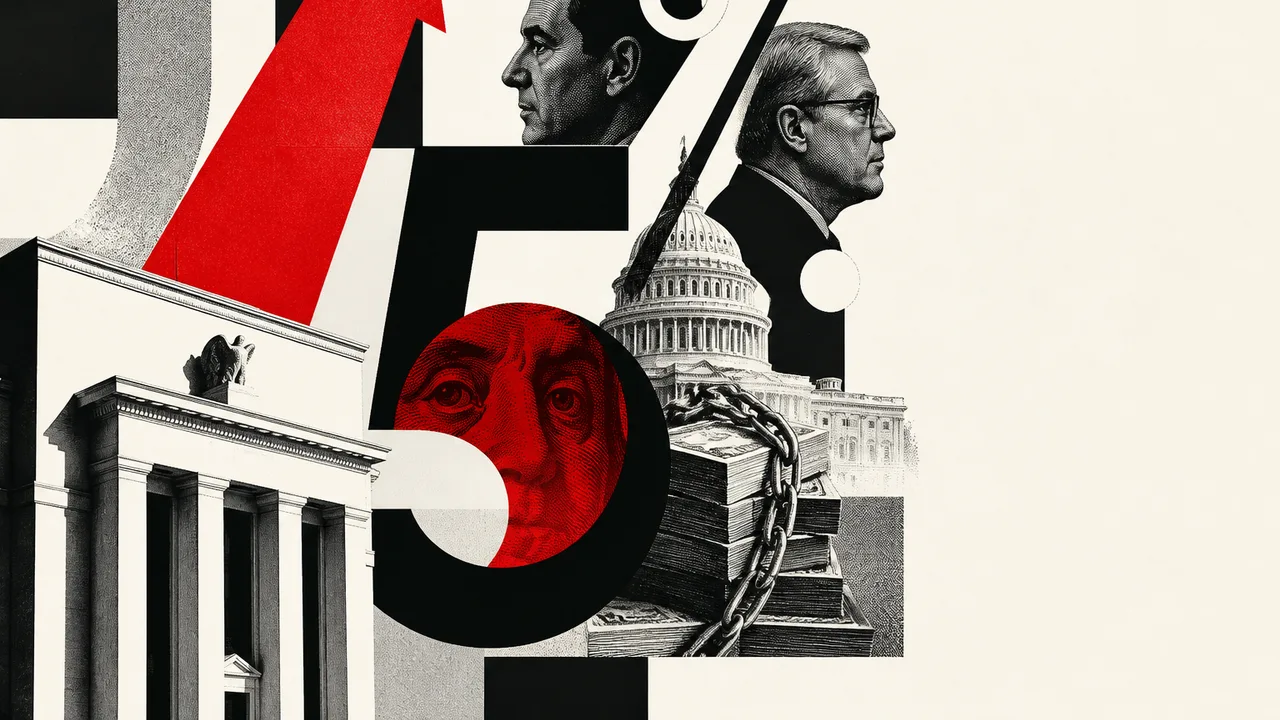
New York Fed President John Williams said Thursday that another interest-rate increase by year-end would be a “reasonable” expectation, and traders needed little encouragement.
CME’s futures market put the probability of an October increase at 77.5%, up from roughly 53% one day earlier. That is a 24.5-percentage-point swing in a day. Futures-implied probabilities move with prices and feed timing, so 77.5% should be read as a snapshot of market positioning, not a promise from the Federal Open Market Committee.
The immediate question is whether the Fed raises its target range again in October. The larger question is who sets borrowing costs once the policy announcement ends. The Fed controls an overnight rate. Households, businesses and the federal government also live with longer-term yields set in the Treasury market, and the 10-year yield has climbed above 5%.
That is where a quarter-point Fed decision runs into a much larger pile of debt.
Why Markets Changed Their Minds so Quickly
The Fed increased its target range by 25 basis points on Sept. 16, to 3.75% to 4%, in a unanimous 12-0 vote. It was the first increase since July 2023, when the benchmark reached 5.25% to 5.5% before the subsequent cutting cycle.
The projections released with September’s decision initially looked restrained. The median policymaker forecast showed a 4.1% rate through the end of 2027, which traders interpreted as room for only one additional increase rather than a long campaign. Market pricing softened after the meeting, then reversed this week.
Two developments drove that reversal. First came stronger activity data. S&P Global’s September services purchasing managers’ index rose to 58.7, its highest reading in almost five years, while manufacturing reached 56.7, a level last seen more than four years ago. Oil prices and comments from Fed officials added pressure to bond prices, sending Treasury yields higher.
Second, policymakers described inflation risk as increasingly troublesome. Governor Michael Barr said further adjustments would likely be needed and argued that risks to the inflation target had increased while labor-market risks had receded. Boston Fed President Susan Collins said a somewhat more restrictive federal funds rate could help return inflation to target after “five and a half years of too high inflation.” Core personal consumption expenditures inflation, the Fed’s preferred measure, was reported at 3.4%, versus a 2% target.
Williams also said the era of explicit forward guidance was “over.” Investors will receive fewer advance hints about the next vote and will have to react to incoming data and speeches instead. The 24.5-point move in October odds offers an early demonstration of the arrangement: less guidance does not eliminate market forecasting; it makes the forecast jumpier.
A 5% Yield Has Two Histories
The 10-year Treasury reached 5.108% on Wednesday, its highest level since July 2007. Stocks moved in the other direction: the Dow fell 0.68%, the S&P 500 lost 0.75% and the Nasdaq declined 1.13%.
For anyone whose financial memory formed after the global financial crisis, a 5% Treasury yield looks exotic. Over a longer window, it looks familiar. The 10-year averaged about 5.9% from 1990 through 2006, before years of slower growth and lower rates reset expectations.
That comparison explains why policymakers may view 5% as survivable, but it cannot establish that today’s economy can absorb the rate without strain. The federal government must refinance a large stock of debt while running large deficits. Companies and households have also spent years making decisions under cheaper financing. A familiar number can arrive in a changed balance sheet.
The selloff also extended beyond the United States. Japan’s 10-year government-bond yield rose to 3.055%, its highest since August 1996, while British and German yields increased too. The parallel suggests investors were repricing inflation, growth and government borrowing across several markets. It does not prove one common cause, since each country has its own inflation outlook, central bank and fiscal position.
Warsh Listens to the Yield; Bessent Pushes Back
Fed Chair Kevin Warsh and Treasury Secretary Scott Bessent have adopted different approaches to the same 10-year rate.
Warsh has called the 10-year Treasury “the most important asset anywhere in the world” and has changed the Fed’s communications approach to obtain a less filtered market signal. Bessent has shown more willingness to act when he believes that signal has become distorted. He recently increased Treasury buybacks of some longer maturities after describing a market “fever,” saying his job was to push conditions back toward equilibrium when disequilibrium emerged.
The comparison is institutional, rather than personal. The Fed sets monetary policy to pursue price stability and employment. Treasury manages federal borrowing. Warsh’s approach lets the long-term yield deliver information about inflation credibility and demand for capital. Bessent’s approach recognizes that dysfunctional trading can produce its own economic damage and raise taxpayer costs.
Their tools can pull on adjacent parts of the same curve. If Treasury issues more short-term bills to reduce pressure on long maturities, the government becomes more exposed to the overnight rates the Fed is raising. If it keeps issuing long debt into a selloff, it locks in higher costs for longer. Debt management offers choices, but no trapdoor beneath the interest bill.
The Fiscal Constraint Behind the Rate Debate
The Committee for a Responsible Federal Budget estimated that a 5% 10-year yield is about 80 basis points above the Congressional Budget Office baseline. If that gap persisted over the coming decade, annual federal interest costs would reach $2.7 trillion, more than either Social Security or Medicare. The same report cited a CBO projection that the federal deficit will exceed 6% of gross domestic product this year.
The inference from those figures is that monetary tightening now carries a larger fiscal echo. A Fed increase raises short-term government financing costs directly, while persistent inflation or doubts about the fiscal path can keep long-term yields elevated. Higher debt service then consumes revenue that could otherwise fund programs, reduce taxes or shrink borrowing.
That does not mean fiscal costs will determine the Fed’s October vote. The central bank’s mandate remains inflation and employment, and September’s projections point toward caution rather than an extended staircase of increases. Sixteen of 18 policymakers projected at least one more hike this year, but only four saw two more as possible. Their median forecast did not show inflation returning to 2% until 2029.
The case for another increase therefore rests on resilient activity and inflation above target. The case for restraint rests on how much tightening has already arrived through the bond market, and on the possibility that one month of strong purchasing-manager surveys will not persist. A weaker employment or inflation report could move October probabilities as rapidly as Williams’s remarks moved them Thursday.
For households, the split is straightforward. Borrowers face higher costs as market rates filter into credit, while savers can earn more on cash and government bonds. Stockholders absorb pressure when higher bond yields make future corporate profits less valuable in today’s dollars. Taxpayers inherit the slowest-moving bill of all, as old federal debt matures and gets refinanced.
October may deliver another quarter point. The longer contest is over whether the 10-year yield becomes a warning policymakers heed, a price Treasury tries to manage, or an interest bill Congress can no longer treat as background noise.
More Like This
Fed Rate Hike Opens a Harder Phase for the Economy
The Fed lifts rates to 3.75%-4%, raising borrowing costs and testing whether inflation can cool without a sharper slowdown in jobs, spending and growth.
Fed Rate Hike Odds Hit 92% as Warsh Faces a Divided Committee
Traders price a 92% chance of a Fed rate increase under Chair Kevin Warsh. What the vote, the dissents, and the guidance mean for borrowers and markets.

Why Friday's August CPI Report Matters More Than Usual
The August CPI lands Friday at 8:30 a.m. with the Fed split 9-3 on rates. What the inflation report could settle, what it can't, and who feels the answer first.

The $40 Trillion Debt Bill Now Competing With Growth
US debt hits $40 trillion with $1.25 trillion in annual interest. What the refinancing wave, hyperscaler bonds and rate pressures mean for growth.

Fund Managers Go Defensive on AI Stocks as Yields Rise
Rising oil prices and Treasury yields push Wall Street to raise the bar for AI stocks. What a higher discount rate means for data centers and software.
Trump Pressures Fed Chair Warsh as September Rate Hike Looms
The White House wants Kevin Warsh to hold rates down, markets expect a hike, and the September meeting will test how much pressure the Fed can absorb.

Vetting Expired Domains in iGaming SEO
Craig Campbell explains why domain rating misleads iGaming SEO buyers, what the Wayback Machine reveals, and how to vet expired domains before spending.
Auditing Vibe-Coded Apps Without Reading Them
A Brainqub3 video argues you can safely ship 100k-line AI-generated codebases without reading them. The framework is sound. The business model behind it is worth examining.