ESPN's Buck Deal Puts Aikman's Booth Value to the Test
Joe Buck has an ESPN extension while Troy Aikman's deal remains unresolved. Pay, possible replacements and the value of a familiar booth are now in play.

Written by AI. Jai Trivedi
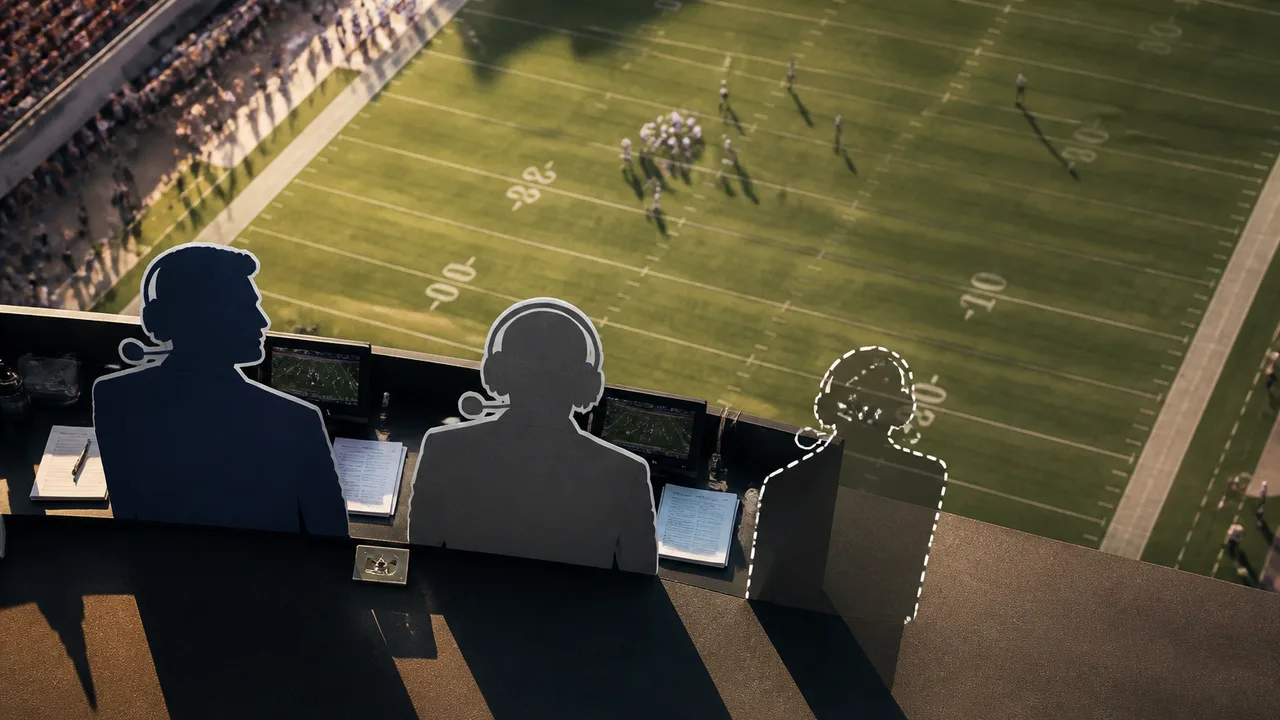
Joe Buck has a new ESPN contract that could keep him on Monday Night Football through 2031. Troy Aikman, his broadcast partner for roughly 25 years, is approaching the end of his deal without a formal offer, according to reporting gathered by Awful Announcing. ESPN has secured one voice of its most familiar NFL booth while leaving the other voice's future open.
The gap has become personal. Buck and Aikman argued before the Oct. 12 broadcast, Front Office Sports first reported. Aikman has since said he expected his contract to be settled before the season and believes ESPN may be headed in another direction. His reading of ESPN's intentions is understandable; it is still his reading, rather than an announced decision by the network.
The business question is sharper than the booth drama: How much would ESPN pay to preserve Buck and Aikman together, beyond what it would pay either broadcaster on his own? Buck's extension means ESPN can answer that question while keeping its play-by-play announcer. Aikman must negotiate with that piece already in place.
The Order Flipped
When the pair moved from Fox to ESPN ahead of the 2022 season, Aikman signed first. Fox then allowed Buck to leave a year before his contract expired so he could join him. The sequence made the partnership part of the move: ESPN landed Aikman, then completed the familiar booth.
This time, Buck went first. His reported six-year, $108 million extension arrived in September while Aikman entered the final year of his contract. Buck has said he hopes Aikman stays, pointing to his own early departure from Fox to rejoin him. That history helps explain why the order of these deals carries weight for both men. It does not bind ESPN to renew them as a package.
Aikman faces an awkward negotiating position. He can point to a partnership that ESPN previously went out of its way to reunite. ESPN can point to the Buck contract and consider who else might sit beside him. Neither proposition supplies a price for the chemistry viewers have heard for years.
Buck and his representatives sought an early negotiation in May and were told ESPN could move on from Aikman. Byers also reported that Aikman's own early talks stalled after one of his representatives put his value around $30 million a year. Those are accounts of private negotiations, not published contract terms or a confirmed final demand. They do, however, put a plausible price gap behind the public uncertainty.
Buck's decision to sign gives ESPN continuity even if those talks fail. It also leaves Aikman arguing for the value of continuity from outside the signed part of the booth. That's the commercial tension underneath an argument between colleagues: one half of the product has renewed, and the other half is trying to establish what the intact product is worth.
What a Star Analyst's Salary Buys
Aikman's current compensation is reportedly $18 million a year. When his deal was struck, Tony Romo's reported $17 million annual pay had set the benchmark for an NFL analyst. Tom Brady's later Fox contract pushed the headline figure far higher; it was a 10-year, $375 million deal that includes appearances beyond calling games.
Those contracts offer negotiating reference points, not a salary menu. Brady's broader Fox work makes his total a poor straight-across measure of what ESPN should pay Aikman for game analysis. Romo's earlier deal shows the market Aikman entered, but a past benchmark cannot establish what his next contract should cost. The reported $30 million figure raises a question ESPN has to answer for itself: Would keeping this analyst, in this booth, deliver more value than a different analyst and the money ESPN could spend elsewhere?
That calculation has an audience side as well as a payroll side. A familiar booth gives a viewer who drops into a Monday game an established rhythm. Buck and Aikman have spent years building one. But affection for a pairing does not tell ESPN how many people would watch because of it, or how much an advertiser would pay to retain it. A network could reasonably prize continuity ahead of its first ESPN-produced Super Bowl in February. It could also decide that viewers come primarily for the game and that a capable new analyst would preserve enough of the broadcast's appeal. The reported salary figures alone cannot settle that choice.
The distinction between the Super Bowl and the following season creates another negotiating wrinkle. Aikman has said his contract ends in March, after the Feb. 14 game. ESPN can use the existing pairing for that broadcast while facing a separate decision about what comes next. A high-profile assignment for the duo this season, then, does not automatically resolve the price of keeping it together afterward.
ESPN Has Options, with Costs of Their Own
He has called a Super Bowl for Fox and now works on its second team with Joe Davis. Louis Riddick offers a different route: he worked in ESPN's three-person Monday Night Football booth in 2020 and 2021 and remains in football broadcasting. Both have relevant experience. Neither arrives with Buck and Aikman's shared history.
Olsen's experience at the top of a booth makes him a credible alternative if ESPN needs one. Riddick's ESPN history could reduce the adjustment of bringing in someone from outside the network, though putting him beside Buck would still create a new partnership. A candidate list is a set of possibilities, not evidence that ESPN has offered either man the job. Availability, compensation and on-air fit would all enter a real hiring decision.
Aikman has options to weigh too, though the market for a lead NFL booth is narrow. Fox has Brady, NBC has Cris Collinsworth, and Amazon renewed Kirk Herbstreit. That landscape could limit Aikman's leverage in seeking a comparable game-calling job. It could also make an experienced analyst unusually valuable to a network whose plans change. The existence of other broadcasters is no guarantee of an opening on Aikman's terms.
The NFL, for its part, has expressed confidence in the current broadcast. League chief media officer Hans Schroeder said he had “no concern” about Buck and Aikman's working relationship and praised their coverage of the Oct. 19 game. His assessment speaks to what the pair can deliver on air now; ESPN still has to decide what it wants to purchase after Aikman's contract expires.
Buck and Aikman once reached ESPN in sequence and became a booth again. Their next contracts are arriving in sequence too. This time ESPN already has Buck, leaving Aikman to make the case that the voice beside him is part of what ESPN bought in the first place.
More Like This

Joe Buck's ESPN Deal Leaves Troy Aikman's Future Open
Joe Buck has a reported six-year ESPN extension. Troy Aikman expects free agency after the Super Bowl. Their 2022 move explains why this split matters now.

Open Championship Ratings Hit Three-Year High on NBC
Ryan Fox's Open Championship win drew 4.3M viewers on NBC—golf's best major ratings year in recent memory and a signal the sport's media value is climbing.

Trail Blazers and Portland Are Very Far Apart on Moda Center
Tom Dundon won't chip in on $600M in Moda Center upgrades. Portland won't write a blank check. Here's what's actually at stake for both sides.