Discipline Is About Removing Options, Not Building Willpower
Mark Manson argues discipline has nothing to do with willpower—it's about eliminating choices. Here's what the research says, and what the theory leaves out.

Written by AI. Samir Patel
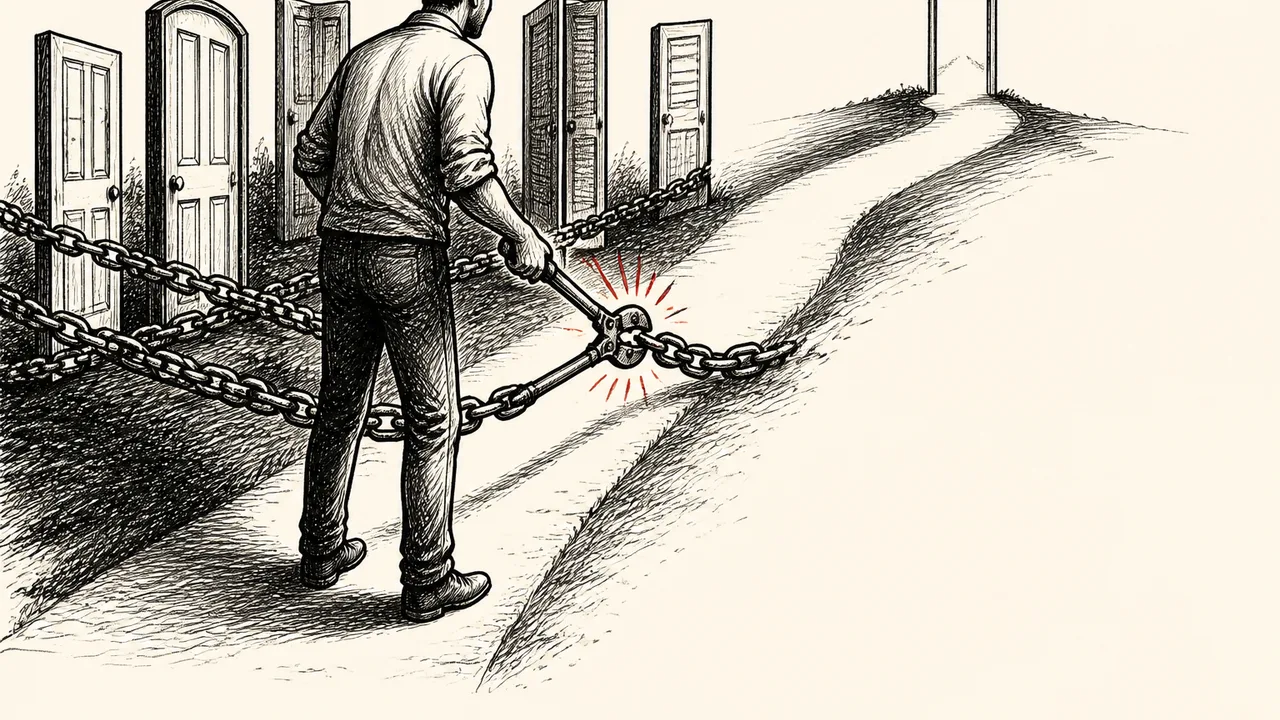
Photo: AI. Eira Pendragon
There's a version of productivity advice you've heard a thousand times: wake up earlier, build better habits, find your why, optimize your morning. Mark Manson's recent video isn't that. It's closer to the opposite, and it's worth sitting with — not because it's entirely right, but because the parts it gets right are genuinely underrepresented in how we talk about focus, discipline, and change.
The core argument: discipline isn't a character trait you either have or don't. It's the downstream effect of removing your ability to do anything else.
Manson opens with a story. In 2019, behind on his third book, he and a friend renting a cabin in the woods with no cell service and a rule: nobody leaves until they've each written 100 pages. Six days later, both had their best output of the year. His read on this is deliberately deflating: "If we were disciplined, we wouldn't have to drive three hours into the woods and rent a cabin to get any work done. There was nothing disciplined about this. There was no willpower, no motivation, no grit, no determination, no resolve. Yet we both got the best results that we had gotten all year. And the reason was simple. There was nothing else to do."
This framing — discipline as structural absence rather than internal virtue — is the engine of the whole piece, and it has some genuine behavioral science behind it.
The Optionality Problem
Manson names something he calls "optionality addiction": the modern habit of refusing to fully commit to any one path because something better might still be out there. He grounds this in Kierkegaard's observation that infinite freedom produces not liberation but vertigo — an existential paralysis in the face of too many possible lives.
This isn't just philosophy. Barry Schwartz's research on what he called the "paradox of choice" documented something similar: past a certain threshold, more options produce worse decisions and lower satisfaction, not better ones. The psychological cost of maintaining open options — evaluating them, comparing them, grieving the ones you don't pick — is real and measurable. Manson's framing of non-commitment as "cognitively expensive" lines up with that literature reasonably well.
He uses this to reframe what looks like ambition: the person who's "exploring five different career paths, has three side hustles going, and is dabbling in two business ideas." From the outside, that looks like hustle. Manson's read is that it's a defense mechanism — if you never fully commit, you never fully fail, and the escape hatch stays permanently available.
That's a provocative claim. It's also not universally true. Some people genuinely are in exploratory phases — early career, recovering from burnout, navigating major life transitions — where keeping options open is appropriate rather than avoidant. Manson's argument lands harder when you're not in one of those phases and you're using "exploring" as a way to avoid the discomfort of actually choosing.
Commitment Devices and the Cortés Problem
The most interesting concept in Manson's framework is what psychologists actually call a commitment device: a structure you build into your life before the moment of temptation that removes your ability to quit. The cabin was one. He argues marriage is one. Ten-day silent meditation retreats are one.
He uses the story of Hernán Cortés burning his ships after landing in Mexico in 1519 to illustrate how this works at scale. The standard motivational-poster read of that story is: be bold, go all in. Manson's read is more interesting: "Cortés did not motivate his men. He didn't give a rousing speech that made them want to fight harder. All he did was simply eliminate the alternatives."
The point being that motivation isn't a fuel you add — it's what happens when the alternatives disappear. This maps onto a well-established finding in behavioral science: motivation tends to follow action rather than precede it. The sequence most people assume (feel inspired → take action → get results) inverts in practice. Action generates momentum, and motivation catches up.
The Cortés example is rhetorically useful but worth scrutinizing. Burning ships is also a coercive act — Cortés's men didn't vote on this. The commitment device framing works a lot better when you're removing your own options than when someone else is removing them for you. That distinction matters more than Manson's telling of the story acknowledges.
The Grief Nobody Talks About
The section of this video that I found most genuinely unusual — and most honest — is where Manson talks about grief.
He describes the years after he met his wife: slowly losing interest in the party lifestyle he'd lived through his 20s, not as a relief but as something more complicated. The old life fading out "like a volume knob gradually being turned down on a song until you can't hear it anymore." And then, underneath the relief of growing up, something quieter: a sadness.
"It was just this silent grief in the same way you grieve an old place from your childhood that you know you'll never see again, or an old friend who you've lost touch with. There's like a sweetness and a sadness to it at the same time."
This is the part of commitment that self-help culture almost never names. Every time you choose a path, you're not just moving toward something — you're killing off the other versions of yourself that could have existed. The you that moved to Berlin. The you that spent two years backpacking. Those aren't just plans you abandoned; they're identities that never got to form.
Manson argues that people avoid commitment largely because they're unconsciously avoiding this grief. And so they perform commitment — research obsessively, plan meticulously, buy the equipment, tell their friends — without actually making the irreversible move that costs them something. "All that preparation, all the performance, it gives you the feeling of the commitment without the actual cost of it. It's the illusion of forward motion."
This is psychologically astute, and it connects to something therapists recognize: the anxiety of commitment isn't just about fear of failure. It's about the loss that comes with choosing. Identity-level loss, specifically. That's not irrational — it's just rarely named.
Boredom as the Actual Ceiling
Manson ends on boredom, drawing on the work of psychologist Anders Ericsson — famous for his research on expertise and deliberate practice. Ericsson spent decades studying elite performers: concert musicians, chess grandmasters, Olympic athletes. His finding, which Manson cites here, is that the practice that actually separates the great from the good is deeply, designedly monotonous. The same scales. The same drills. The same micro-corrections, repeated until they're automatic.
"Your tolerance for boredom is your ceiling for mastery," Manson concludes. "That's it. That's 90% of the game."
It's a clean line. Whether it's literally 90% is obviously unverifiable, but the underlying point has research support. Ericsson's work suggests that what looks like talent from the outside is often accumulated hours of unglamorous repetition from the inside — and that most people stop before the compounding kicks in, not because they can't do the work, but because they can't tolerate the texture of the work.
What This Framework Can't Carry
Manson's argument is internally consistent and draws on real behavioral science. But it's built almost entirely from his own experience — a self-employed author with the resources and flexibility to rent cabins, travel the world, and structure his own days. The framework works best for people with similar latitude.
For someone working two jobs, managing a chronic illness, caring for a family member, or navigating the kind of systemic barriers that make "just eliminate the options" advice ring hollow — the commitment device framing doesn't map cleanly onto lived reality. The ability to burn your ships presupposes you own some ships.
There's also a quieter question the video doesn't fully answer: how do you know which path to commit to in the first place? Manson treats the grief of unchosen lives as a cost worth paying. But for some people, especially younger people or those in genuine transition, the exploratory phase isn't avoidance — it's necessary. The hard part isn't committing. It's knowing what you're committing to.
Manson's video is most useful as a diagnostic rather than a prescription. If you recognize yourself in the "choice theater" he describes — all the research, none of the action — the framework has something real to offer. If you're genuinely uncertain about direction, the advice to simply eliminate options may close doors that were worth keeping open a little longer.
More Like This
Eckhart Tolle Says Know Less. Your Body Already Does.
Eckhart Tolle's case for 'not knowing' as spiritual awakening has real overlap with movement science—and a $139/year subscription attached to it.

Your Childhood Coping Strategies Are Running Your Life
The marshmallow test wasn't measuring self-discipline. It was measuring trust. What that means for how we parent—and how we were parented.

When Feeling Stuck Is Actually Feeling Safe
The Art of Improvement argues comfort—not laziness—is what keeps people stuck. The idea is compelling. It's also worth examining carefully.
Understanding Emotion Regulation with Dr. Marc Brackett
Explore emotion regulation with Dr. Marc Brackett, focusing on practical strategies for emotional intelligence in personal and professional contexts.
The Emotional Resonance of Sound: Teresina's Journey
Explore how Teresina Kerubo uses sound to navigate love and grief, finding peace through recorded memories.

The Psychology Behind Elite Athletic Performance
Dr. K of HealthyGamerGG breaks down the mental mechanics of Jordan, Kobe, Phelps, Brady, and Woods—and what they reveal about motivation, fear, and agency.

Neurotic vs. Psychotic: What the Terms Really Mean
Alain de Botton's School of Life video reframes "neurotic" and "psychotic" as degrees of self-awareness—not insults. Here's what the distinction actually reveals.

Masculinity Myths That Keep Men Emotionally Stuck
Coach Joe Hudson and Charisma on Command break down five masculinity myths—on vulnerability, grinding, emotions, childhood, and guilt—that quietly hold men back.