Dinosaur Bone Holds Blood Traces, but Cell Claim Is Open
A 115-million-year-old dinosaur bone contains blood-related molecules. The harder question is whether its cell-shaped structures are preserved red blood cells.

Written by AI. Priya Sharma
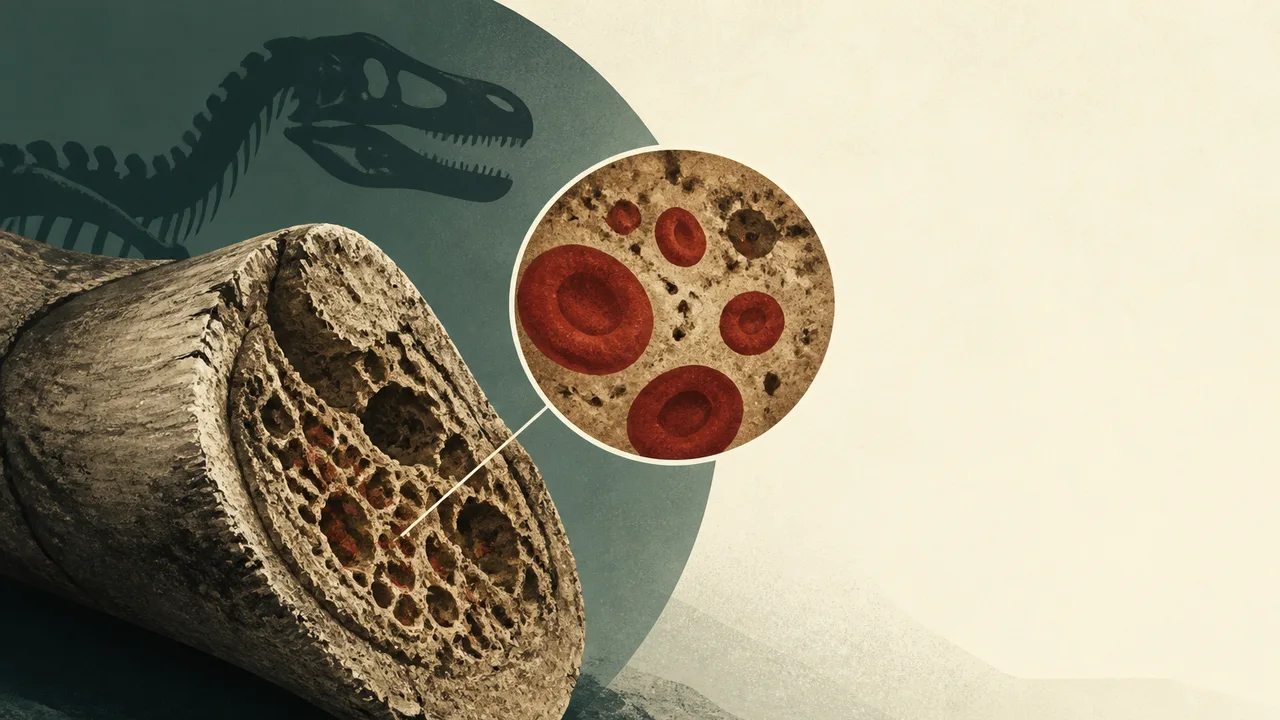
A 115-million-year-old dinosaur bone from Brazil contains tiny structures in former blood-vessel channels and chemical traces associated with blood. The researchers studying Aratasaurus museunacionali argue that the structures are fossilized red blood cells. Their finding, published November 2 in the Proceedings of the National Academy of Sciences, puts a demanding identification problem inside an unusually well-preserved limb: a bone can retain blood-derived molecules even if the identity of every cell-shaped object within it remains unsettled.
The team examined thin sections of the bone with electron microscopy and found ellipsoid structures roughly 20 micrometers across. They mapped iron, carbon and nitrogen in those structures, then used techniques that probe molecular composition to look for porphyrins and heme-related compounds. Heme forms part of hemoglobin, the oxygen-carrying protein in red blood cells. An analysis of material extracted from the bone also suggested heme. Taken together, the imaging and chemical results give the researchers more to work with than a microscopic resemblance.
Each test answers a different question. The images locate and describe the structures; an elemental map identifies constituents, though iron, carbon and nitrogen alone cannot establish that something is a blood cell. The molecular tests address whether compounds associated with blood survived in the bone. None of those steps, by itself, identifies the contents of one particular ellipsoid.
Study coauthor Kliti Grice describes the structures as confined to vascular canals, where blood would have circulated when the animal was alive. The surrounding sediment, she writes, lacked comparable structures. Her account also describes a chemical contrast: the sediment contained mostly plant- and bacteria-associated compounds, while the fossil bone had a heme-dominated signature. Anatomical placement and a sediment comparison make an explanation based simply on material outside the bone less compelling. They do not, on their own, tell us precisely where within the bone the heme-derived compounds sit.
That last question has a history. In 1997, two paleontologists investigated small spheres in a fossil limb that had been considered possible ancient blood cells. They identified the spheres as pyrite deposited after death. The lesson was practical rather than rhetorical: mineral-rich fluids moving through a fossil can manufacture convincing biological shapes. The researchers proposed checking candidate cells against living relatives and looking for biomarkers, including heme compounds, before assigning a blood-cell origin.
The Aratasaurus team has attempted both tests. Its structures occupy plausible anatomical sites, and its analyses indicate blood-related chemistry in the bone. The 1997 spheres were identified as pyrite; the new team instead found a manganese oxide mineral, hausmannite, within its ellipsoids. Grice proposes that mineralization helped protect traces of the original biological material as the fossil formed. This is a comparison of identification problems, rather than evidence that the two fossils underwent the same process. Pyrite was the answer in the earlier case. Hausmannite is part of a proposed preservation mechanism in this one.
There is a difficulty with the biomarker test. Mary Schweitzer, a paleontologist at North Carolina State University who was not involved in the study, told Science News that the heme biomarkers do not appear confined to the round structures; the relevant molecular analysis drew on the bone more broadly. She also questioned their size and shape relative to red blood cells in living birds and reptiles. Her objection leaves room for blood-derived compounds in the specimen while challenging the tighter claim that the imaged structures themselves have been chemically demonstrated to be red blood cells.
The researchers have a plausible answer to part of the shape objection. Fossilization can deform a structure, and the team compared the shapes with cells from birds and crocodilians. Grice describes the fossil forms as somewhat larger and rounder than those modern examples; deformation or an original difference in dinosaur cells could account for that appearance. Shape cannot decide between those possibilities without firmer identification of the structures. Nor can a comparison with living relatives recreate the original cell before mineralization changed it.
Grice says the dinosaur was rapidly buried in a low-oxygen setting, which could have slowed decay, and suggests that hausmannite helped stabilize vulnerable molecules. The mineral occurs inside the ellipsoids, giving the team a physical reason to investigate its role. Finding a mineral alongside a chemical trace, however, cannot show exactly when the mineral formed or how much protection it supplied. The mechanism is an explanation for an unusual survival, rather than a measured preservation rate that can be applied to other fossils.
That restraint also helps with the physiological possibilities raised by the finding. Grice has suggested that identifying ancient blood structures could eventually inform questions about dinosaur metabolism and activity. A blood-related molecular signature from one partial hind limb does not yield either measurement. For now, the immediate scientific payoff is narrower and substantial: different tests on one fossil have produced an anatomical setting, cell-like forms and chemical indications of blood-related material that researchers can assess together.
The earlier pyrite case explains why the tests accumulate without becoming interchangeable. A mineral can imitate a cell's outline. In Aratasaurus, the claim about ancient blood has several lines of support; the claim about individual fossilized red blood cells still turns on the finer question of what, precisely, lies inside those ellipsoids.
More Like This
Earthquake Science: What We Know and Cannot Predict
Seismologists can forecast earthquake risk but cannot predict the next big one. Here's what the science actually says — and why that distinction matters.
The Electromagnetic Spectrum Explained by Neil deGrasse Tyson
Neil deGrasse Tyson and Chuck Nice trace how electricity and magnetism unified into the electromagnetic spectrum—and what that means for everything we see and build.