Cross-Realm Flipping in Midnight WoW: A Beginner's Guide
Boophie's cross-realm flipping guide for Midnight WoW breaks down TSM, Flipping Power, and Flip Q — but the real question is what happens when everyone's running the same stack.

Written by AI. Derek "D-Block" Washington
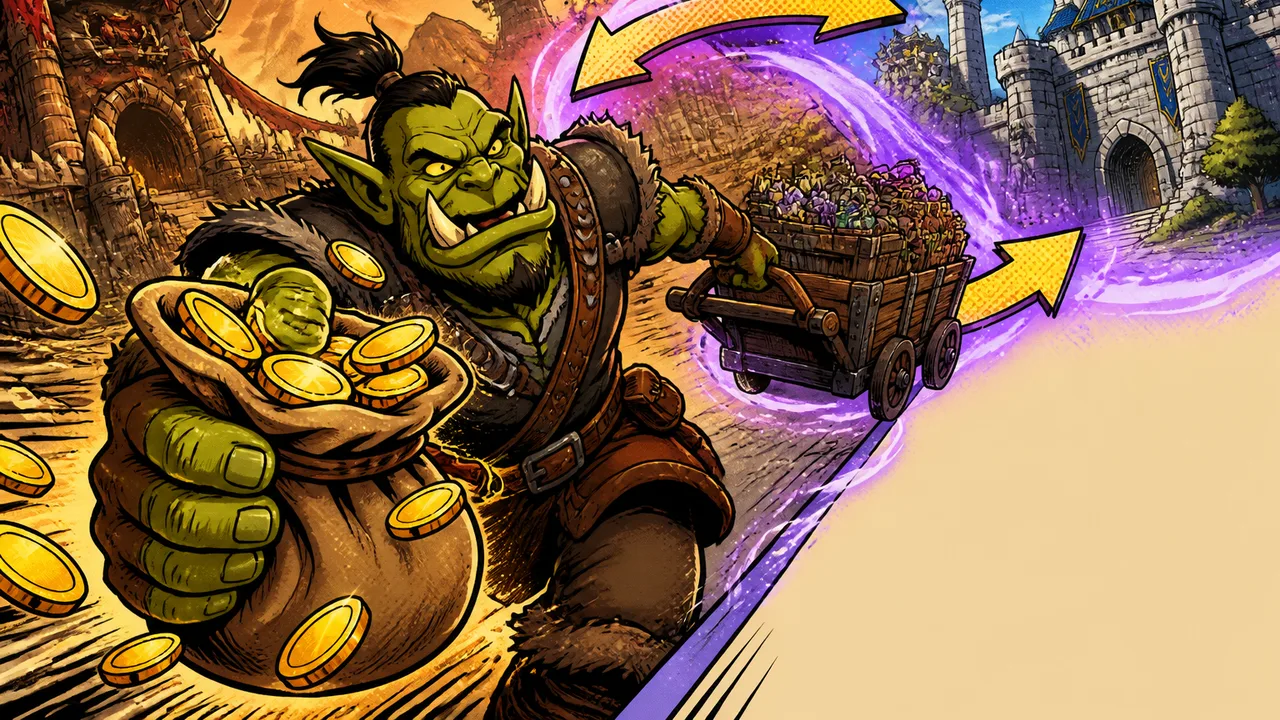
Photo: AI. Marco Velez
The WoW economy has always had its own ecosystem of players who treat the auction house like a second job — and not in a bad way. These are the people who've built spreadsheets, parsed API data, and argued about price source weighting in Discord servers at 2am. If you've ever floated into that world and immediately felt overwhelmed, Boophie's new beginner guide to cross-realm flipping in Midnight WoW is genuinely trying to meet you where you are.
Boophie is one of the more recognizable names in the WoW gold-making space — the kind of creator who's built enough of a reputation that people will actually buy a six-hour training course from him. He also co-built Flipping Power, the tool central to this guide, which makes the video a particular kind of thing: a tutorial from someone who has skin in the game, literally. That's worth naming upfront. It doesn't make the information bad — a lot of what he covers here is sound — but it's the context that shapes how you should receive it.
What Cross-Realm Flipping Actually Is
The core mechanic is simple: buy an item cheap on one realm, move it through the Warband Bank (Midnight's shared storage system), log into a different realm, and relist it at a higher price. The profit comes from price variance between realms — something that's existed in WoW economies for years but that the Warband Bank makes significantly more accessible than older cross-faction or cross-server workarounds.
Boophie's walkthrough covers the full stack: Trade Skill Master for price data and posting operations, Flipping Power for identifying deals across realms, and Flip Q (a community-built addon that integrates with Flipping Power) for routing your inventory to the right realms automatically. Each of these does something distinct, and the guide is at its most useful when it's explaining why you need all three rather than just telling you to install them.
The TSM setup advice is practical. Turning on regionwide trading in settings — so that your data aggregates across all realms rather than treating each server as isolated — is the kind of thing that seems obvious in retrospect but will completely wreck your analysis if you miss it. Boophie's framing of the region sell average (what items have actually sold for across all realms over 60 days) versus the region market value (what items have been listed for) is a genuine conceptual distinction that beginners often get backwards.
The Cluster Problem Nobody Talks About
Easily the most practically useful section of the guide is the one on realm clusters. Blizzard groups many realms together into shared auction houses — if you're on Frostmourne and three other realms share that same AH, posting on all four doesn't make you a cross-realm flipper, it makes you someone doing a lot of extra logging in for no reason.
Boophie's example is almost funny: imagine someone excited to start cross-realm flipping, dutifully rolling characters on seven different realms — only to discover they've been posting on the same auction house the whole time. Nothing cross-realm about it. The trap is real because publicly-available cluster lists online are frequently outdated, and Blizzard does occasionally adjust them. Flipping Power pulls from the live API, so it stays current automatically. That alone is a legitimate reason to check the tool even if you don't pay for it.
His beginner recommendation is to start with four to eight selling realms, not every realm on your region. "I recommend not covering every single realm on your region because you'll get burned out right away," he says in the video. That's the right call. The temptation to maximize coverage immediately is how people quit flipping before they've made back their first investment.
High-Pop vs. High-Margin Realms — And What I'd Actually Do
Boophie lays out the real tension in realm selection: high-population realms move items faster but at lower prices, while realms with the most expensive items yield bigger margins but slower sales. He presents both as valid strategies without really picking one.
I'll pick one. If you're starting out with a limited gold stack and you don't have the capital to sit on expensive inventory for weeks, go high-pop. Velocity matters more than margin when you're building from nothing. The worst outcome in flipping isn't buying something cheap — it's buying something that never sells and locking up your liquid gold in dead inventory. A faster-moving item at a lower profit per flip compounds into real gold way quicker than a high-margin item that takes three weeks to find a buyer.
Once you've built up a buffer — enough that you could absorb a few items not selling immediately without panicking — then you start mixing in the higher-margin realms. But starting there? That's how you end up staring at unsold inventory and blaming the method when the method is fine and your bankroll management is the problem.
Sell Rate: The Number That Actually Matters
Boophie's recommendation for beginners is to prioritize items with high region sell rates — specifically, he suggests targeting items with sell rates that indicate quick turnover, and he attributes this threshold guidance to his own experience rather than to a default in the tool. (Sell rate in TSM terms is how often an item sells relative to the time it's listed, so higher is always faster.) Decor items in Midnight are his go-to example: "Pretty much all of the decor has very, very good sell rates."
The logic tracks. For cross-realm flipping specifically, sell rate might matter even more than it does for single-realm trading, because you're managing inventory across multiple characters and auction houses simultaneously. An item that sits unsold on one realm while your capital is locked up in it is friction in a system that lives and dies on throughput.
The Flipping Power tool lets you filter by sell rate before scanning for deals, which is the right order of operations. You're not looking at all deals and then checking if they sell fast — you're defining "fast-selling" as a prerequisite, then finding deals within that universe.
Sniping: The Reactive Layer
Beyond the active scanning workflow, Boophie walks through Flipping Power's Discord notification system for deal-sniping. You define target prices for specific items or item-level ranges, connect your Discord account, and the bot pings you when something hits your threshold.
The item-level sniping feature is genuinely clever. Instead of tracking specific items by name, you can set alerts for entire item-level brackets — useful for open-world BOEs and gear pieces where you care more about the stats and level than the exact name of the item. Boophie also notes the ability to track WoW Token price drops, which is a different use case but shows the breadth of what the alert system covers.
One thing worth flagging: he's explicit that you should only monitor realms where you already have characters ready to buy. "What happens if you get the alert, then you have to make the character, you have to get to the auction house and buy the item — by then, someone could have beat you to it." The speed loop matters. An alert is only as useful as how fast you can act on it.
The Conflict of Interest Question You Should Ask
Here's the thing I keep coming back to: Boophie built Flipping Power. He also sells a six-hour flipping course and a premium guide through GoldCapped, both of which are advertised throughout the video. He's not hiding any of this — the affiliate links are right there in the description — but the guide is also genuinely walking you through how to use his own tool as the centerpiece of your operation.
That's not inherently disqualifying. A lot of the best tool documentation comes from the people who built the thing. And the Flip Q addon he features was built by a community member, not him, which at least shows the ecosystem isn't entirely his own IP. But readers should know that "this is by far the best way to actually buy items cross realm" coming from the person who built that way of buying items is a different kind of claim than it would be from an independent voice.
The free trial for Flipping Power exists, so you can run the workflow yourself before deciding if the premium tier is worth it. That's the right approach regardless of who's recommending it.
The Question the Guide Doesn't Answer
Cross-realm flipping as Boophie describes it is an information-arbitrage play: you're finding price gaps that other people aren't seeing, moving fast, and capturing profit before the market corrects. The tool is powerful precisely because it automates the detection layer.
But every time a tool like this gets popular, the same thing happens. More people running identical filters on the same realms means more competition for the same deals. Prices on the cheap realms start rising as buyers compete for inventory. Prices on the selling realms get compressed as more supply shows up. The edge that exists right now — especially at the launch of Midnight, before the flipping community fully settles in — will narrow.
This isn't a reason not to start. Early movers in a new expansion's economy consistently come out ahead. But the players who've been doing this for years don't just copy a setup and run it forever — they're constantly adjusting filters, finding new item categories, identifying clusters of items that haven't been discovered yet by the Flipping Power crowd.
The guide teaches you how to run the system. What it can't teach you is how to think ahead of it. That part's on you.
More Like This

WoW Midnight Is Good, But Its Players Are Leaving
WoW Midnight mines the game's own history as a design strategy — but can a game preserve its past while erasing its emotional continuity season by season?

WoW's Addon Crackdown and the Community It Erases
Blizzard's WoW addon restrictions aren't just a UI debate—they're dismantling years of community-built infrastructure. Here's what's actually at stake.

Peter Molyneux's Final Game: Masters of Albion
Peter Molyneux calls Masters of Albion his last game. The Fable creator reflects on legacy, AI in gaming, and why the UK industry needs more respect.

WoW Dawn of the Infinite Raw Gold Farm Guide
Boophie's Dawn of the Infinite dungeon farm delivers 10,000–13,000 raw gold per hour in WoW. Here's exactly how it works and who it's actually built for.

WoW Gold Farming Strategies From ElonCS's Midnight Stream
ElonCS breaks down lumber farming, cross-realm flipping, and abundance runs in a recent WoW Midnight stream. Here's what actually holds up under scrutiny.

Dune: Awakening Adds Single-Player Mode for Console Launch
Funcom is adding a full single-player mode to Dune: Awakening alongside its September 22nd console launch. Here's what that actually means for the community.

Steam's Record Revenue and the Older Games Driving It
Steam is having its most profitable year ever — fueled by pricier games and players going back to old titles. Here's what that tension actually means.

Epic Games Settles Fortnite Collaboration Leaks Lawsuit
Epic Games settled its lawsuit against former contractor Hayden Cohen, aka AdiraFN, permanently barring further leaks of Fortnite's confidential collaboration plans.