Conic Sections Are Hidden in Complex Equations
Michael Penn's video reveals how complex number equations secretly encode every conic section—and raises a real question about how we sequence mathematical knowledge.

Written by AI. Olivia Meng
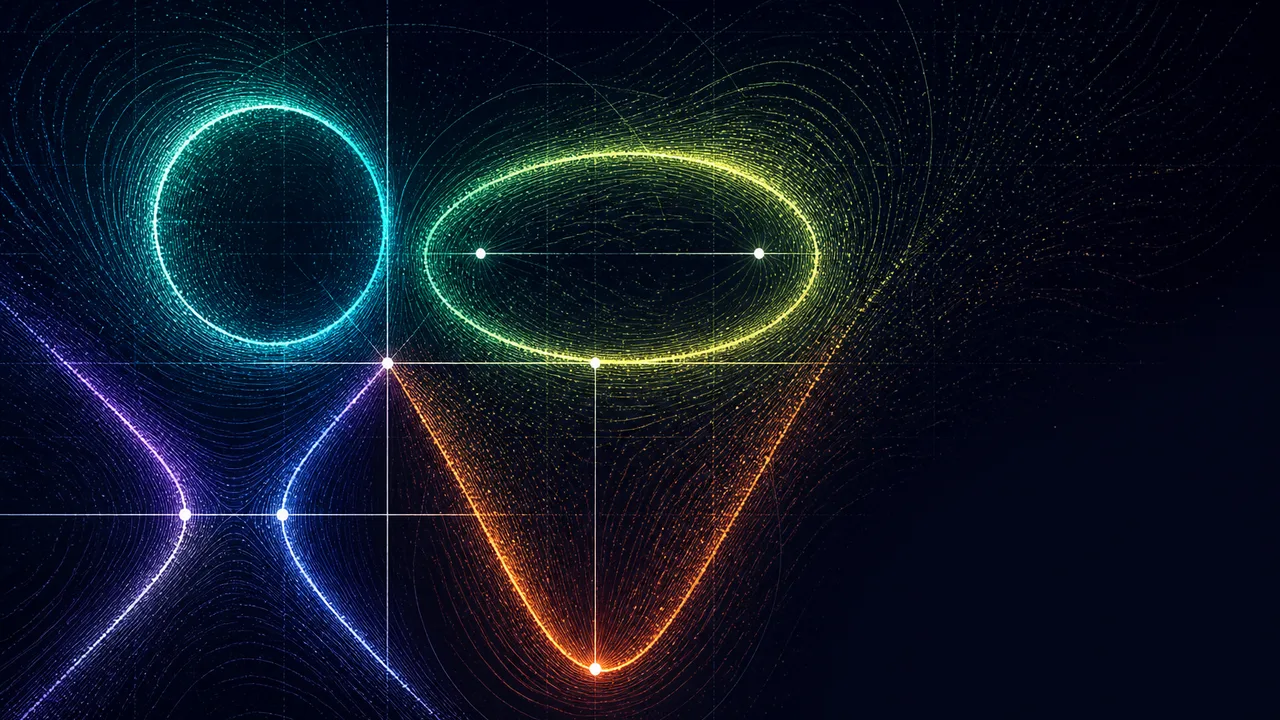
Photo: AI. Dexter Bloomfield
I spend most of my time writing about systems that are failing us—carbon cycles pushed past their tolerances, feedback loops triggering faster than models predicted, policy architectures that were never designed to handle nonlinear change. What I've learned, slowly and somewhat against my will, is that the public's difficulty grasping those systems is not a communication problem. It's a structural one. We teach people to think in isolated facts and linear sequences, and then we are surprised when they struggle to reason about interconnection.
That's why a six-minute math video stopped me cold this week.
In a recent upload to his YouTube channel, mathematician Michael Penn walks a small group of students through something that sounds narrowly technical: what geometric shapes appear when you graph the solutions to certain equations involving complex numbers? The answer turns out to be every conic section you ever memorized in high school—circles, ellipses, hyperbolas, parabolas—emerging not from coordinate geometry but from the language of complex analysis. The video is casual, a little chaotic, pedagogically unpolished in the best sense. It is also, I'd argue, quietly making an argument about what mathematical knowledge looks like when it's actually connected to itself.
What Penn shows, and why it lands
The core demonstration is elegant in its simplicity. Penn starts with the equation |Z − α| = R, where Z is a complex number, α is a fixed point in the complex plane, and R is a real number. He asks his students what shape this describes. One student guesses a hyperbola—not wrong to reach for that, given the notation—but Penn walks them to the actual answer: this is just a circle, because the modulus |Z − α| measures the distance from Z to α, and a circle is precisely the set of all points equidistant from a center. The classical geometric definition and the complex equation are the same statement in two dialects.
Then he escalates. The equation |Z − α| + |Z − β| = R—the sum of distances from two fixed points held constant—describes an ellipse, with α and β as its foci. The equation ||Z − α| − |Z − β|| = R—the absolute difference of distances from two fixed points—describes a hyperbola. Penn notes that the outer absolute value bars are necessary because the difference of two distances can be negative, and a modulus is by definition non-negative. As he puts it in the video, "if you look at the classical definitions of these shapes, they're all defined with these words"—the circle by equidistance from a center, the ellipse by a fixed sum of distances from two foci, the hyperbola by a fixed difference. The parabola, he adds, is the set of points equidistant from a fixed point and a fixed line—the focus and directrix most students encounter briefly in precalculus and then forget.
The pattern is not coincidence. Each classical definition is a constraint on distances, and the modulus in complex analysis is, fundamentally, a distance measure. Of course the two systems are speaking the same language. That's the point.
The structural problem hiding in plain sight
Here is what I can't stop thinking about: most students encounter conic sections in one course and complex numbers in another, separated by a year or more, with no one explicitly drawing the map between them. The ellipse is a precalculus object. The complex plane arrives later, presented as something genuinely new—a strange extension of the number line, requiring a conceptual leap. The fact that the complex modulus encodes the very same distance relationships that define the shapes students already know is almost never the first thing taught. Sometimes it isn't taught at all.
This is the math version of the problem I watch play out constantly in climate policy: knowledge that exists in different institutional silos, never integrated, producing practitioners who have all the pieces and none of the synthesis. A student who never sees that complex equations are secretly encoding conic geometry has to carry two separate frameworks in her head. A climate negotiator who never integrates atmospheric chemistry with economic modeling into a single systems view is working with the same liability.
Penn's video doesn't resolve this pedagogical gap—it's not trying to. What it does is demonstrate, in real time with actual students, what the moment of integration feels like. When the class arrives at the hyperbola equation, one student immediately notices that the modulus symbol and the absolute value symbol are identical in Mathematica, and asks whether modulus is just a generalized version of absolute value. Penn essentially confirms this. That student just made a cross-domain connection with no prompting. That's not a small thing.
The sequence question
The revelation Penn is working through has a pedagogical subtext that his informal classroom setting makes unusually visible: the order in which we introduce mathematical ideas shapes what connections students are capable of making.
If students encounter the complex modulus before they fully internalize what conic sections are, the modulus reads as abstract machinery. If they encounter it after—with the classical definitions of those curves still accessible in memory—the modulus reveals itself as a distance function that was already doing geometry all along. The connection becomes available to make.
I'm going to land where my editor told me to land, because I think the evidence actually supports a conclusion: we should teach the classical metric definitions of conic sections—not just their equations, not just their graphs, but the distance-based definitions—before students encounter complex analysis, and we should make the connection explicit when they get there. Penn does this implicitly by reciting the classical definitions in the video; his students follow him immediately once they have those definitions in hand. The classical definition of an ellipse, once stated, makes the complex equation obvious. Without it, the complex equation is just notation.
That's a structural argument about curriculum, and I'll stand behind it. Sequencing shapes reasoning. We know this in climate communication—the frame you build first determines what subsequent information can attach to. It's no different in a mathematics classroom. If the goal is students who can see across domains, the curriculum has to build the connective tissue deliberately, not hope that students assemble it themselves after the fact.
Penn's video is six minutes long and features at least one deeply unfortunate circle drawing. It also shows, in a format too informal to be mistaken for a lecture, what it looks like when mathematical knowledge becomes a coherent system rather than a collection of isolated techniques. That's a less frivolous demonstration than it sounds.
More Like This
How the Asteroid Impact Ended the Dinosaur Era
Explore the catastrophic asteroid impact that ended the dinosaurs, its immediate aftermath, and the long-term environmental changes.
Why Some Number Systems Can't Divide
Explore why division with remainder is elusive in certain number systems like Gaussian and Eisenstein integers, and the geometric insights behind it.
Linear Algebra Finally Explained Without the Gatekeeping
A DIBEOS video makes linear algebra intuitive for adults who bounced off it in college. Here's what it gets right — and one thing worth questioning.
The Differential Equations That Map Physical Reality
DIBEOS walks through 23 foundational differential equations in physics—from Newton's second law to the Dirac equation—with genuine pedagogical clarity.
Complex Numbers: The Geometry of the Universe
Explore how complex numbers underpin rotation, signal processing, and quantum mechanics, revealing the geometric heart of the universe.
The Feynman Trick That Stumped a Math Competition
Richard Behiel's competition integral uses the Feynman trick to reach a surprisingly clean answer. Here's what the footage reveals about math, pressure, and access.
Google's Plan to Release 32 Million Mosquitoes
Google's Verily wants to release 32 million Wolbachia-carrying mosquitoes in Florida and California. The science is real. The questions are bigger than the video admits.
Geothermal Energy's Promise and Its Real Barriers
Geothermal delivers 24/7 clean power with near-zero emissions. But drilling costs, financing gaps, and policy inertia stand between the technology and global scale.