Circadian Depression: A Proposed Subtype Faces Key Tests
A study groups 23% of an Australian depression cohort by sleep and mood features. Can the proposed subtype predict clock disruption or better treatment?

Written by AI. Priya Sharma
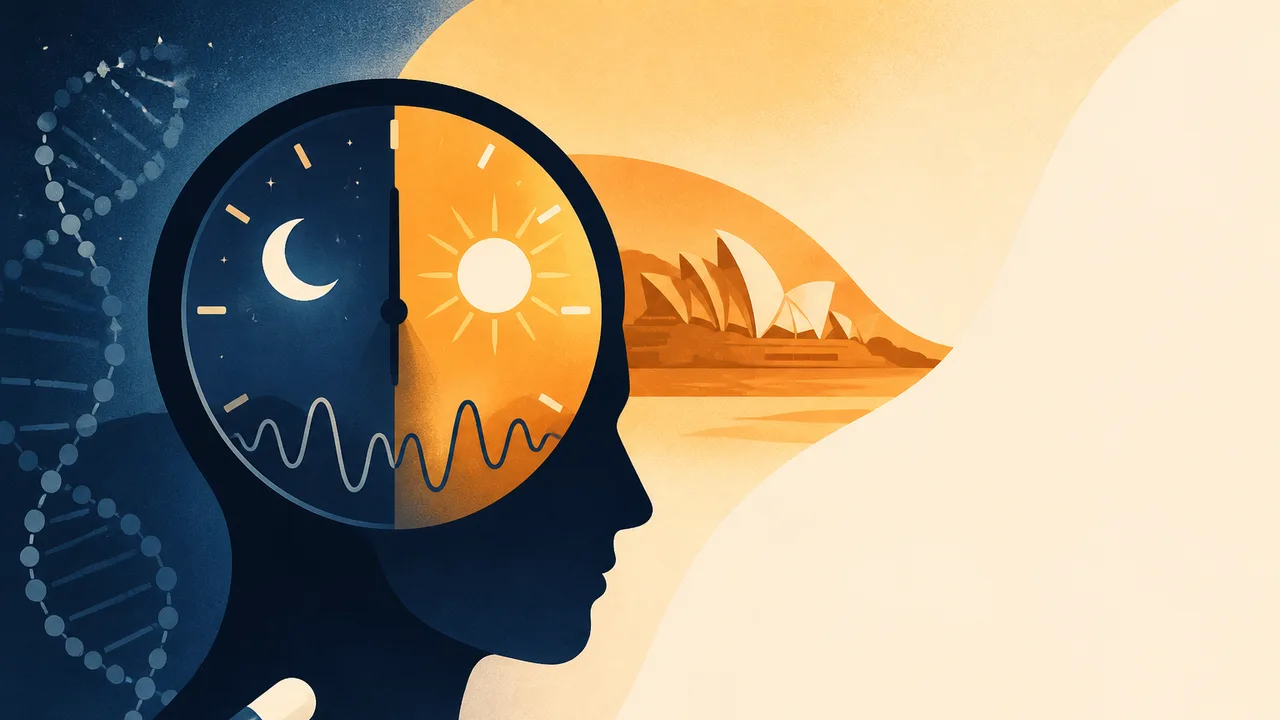
Researchers studying 11,380 Australians with depression classified 2,604 of them, or 23%, in a proposed group they call circadian depression. The group reported distinctive patterns of sleep and mood, more severe symptoms and poorer experiences with some common antidepressants. The name points toward the body’s internal clock. The question now is how far the results can carry that biological interpretation, and whether the label can eventually help choose treatment.
The study, published in The British Journal of Psychiatry, examined people in the Australian Genetics of Depression Study, largely a cohort with severe, recurrent or persistent depression. Its estimate describes that cohort, not everyone who has depression. Researchers have proposed a subtype; they have not established a new diagnosis for use in routine care.
How the Group Was Defined
To enter the circadian group, a participant had to meet at least three of six criteria: a seasonal pattern of illness, a delayed sleep midpoint, a preference for evenings, a mismatch between sleep timing on workdays and free days, sleeping longer during depression, and difficulty feeling alert on waking. The mismatch is sometimes called social jet lag. A delayed sleep midpoint means that the middle of a person’s sleep period falls later than expected.
That rule makes a sprawling clinical observation testable. It also means two people can receive the same research label through different combinations of features. Someone whose mood varies with the seasons, who sleeps longer when depressed and who struggles to wake up need not report the same schedule as someone with late sleep timing, evening preference and social jet lag. If the proposed category is to identify a shared mechanism, researchers will need to ask whether those combinations converge on the same measurable clock pattern. A threshold can identify a group for investigation before anyone knows whether each route into that group points to the same biology.
The authors’ earlier preprint abstract describes a cross-sectional analysis: the team classified participants by the six-feature rule, then compared clinical histories, self-reported medication responses and genetic risk scores. The preprint is an author-posted version, not the final journal text. A questionnaire-defined cluster can be associated with illness history and genetic risk without demonstrating that every member’s physiological clock is displaced.
Self-reported sleep timing correlates only modestly with direct measures, such as the timing of melatonin in saliva. A person can describe themselves as an evening type yet have a physiological rhythm that is not especially late. Sleep timing can reflect a body clock, but it can also reflect the schedule a person has to keep. Testing both reported schedules and biological timing in the same participants would show whether the proposed label consistently captures the mechanism named in it.
Why Researchers Pursued the Idea
The proposed circadian subtype was first conceptualized in 2021. The present analysis moves the idea into a large cohort with an explicit classification rule. That gives other researchers a rule they can apply elsewhere and compare against physiological measurements. The date of the earlier proposal does not tell us whether its criteria were the same.
The researchers found that people meeting the rule reported earlier depression onset and more severe features, including greater psychological distress and suicidal thoughts. The preprint abstract also reports higher polygenic risk scores for several conditions, including major depression, bipolar disorder and attention-deficit/hyperactivity disorder. A polygenic score combines many genetic variants associated with a trait; it is a statistical comparison between groups, not a clock reading or an individual diagnosis.
The strongest case for the proposed subtype is cumulative rather than singular. Sleep-related features identify a substantial group within this cohort; that group also differs on clinical history, reported treatment experience and some genetic associations. If those differences persist in new cohorts, particularly alongside direct measures of circadian timing, the label could become more informative than a list of symptoms. At present, the genetic and clinical associations can also reflect the group’s broader illness burden.
An Existing Grouping Sets a Useful Test
The circadian group overlapped most with another depression grouping, atypical depression. Yet about 1,400 participants met the atypical criteria without meeting the circadian rule. The two groupings therefore capture some of the same people while drawing different boundaries.
The comparison shows both overlap and differences. Overlap suggests the proposed rule captures people already described by another grouping; the participants counted in one group but not the other show that the rules draw different boundaries. Neither observation tells a clinician which label would better predict a physiological measurement or a response to treatment. A useful next comparison would apply both groupings to the same patients and test how well each predicts those outcomes, rather than count how many people receive each label. If the circadian rule predicts an outcome after accounting for the atypical grouping, it would have a clearer claim to added clinical value.
Andrew Coogan, a behavioral neuroscientist not involved in the research, questioned how the feature cluster and its criteria were chosen, The Guardian reported. That question bears directly on the apparent size of the group: the three-of-six rule determines who counts toward the 23%. The authors also noted that participants were limited to people of genetically inferred European ancestry, so the classification needs testing in more diverse samples before its reach can be judged.
From a Pattern to a Treatment Decision
Participants meeting the circadian rule reported poorer responses and more side effects with selective serotonin reuptake inhibitors, or SSRIs, and serotonin-norepinephrine reuptake inhibitors, or SNRIs. The study was cross-sectional and based on past, self-reported treatment experiences.
More severe illness and co-occurring psychiatric conditions can contribute to treatment resistance, Benca said. The circadian group’s greater reported symptom burden makes that possibility consequential. A clock-based mechanism and greater illness complexity could also coexist; separating their contributions would require more than a comparison of recalled medication experiences.
Study researchers have suggested that light exposure, regular daily schedules and melatonin-based approaches might suit people in this group. They are planning a trial of a melatonin-based approach and behavioral strategies. Colleen Loo, a psychiatrist outside the team, cautioned against choosing one medication over another solely from these symptoms. A future trial could put the treatment claim to a sharper test: classify people before treatment, measure their circadian timing, and compare outcomes using the same predefined rule. It could also ask whether people who meet the rule benefit more from a clock-focused approach than otherwise similar patients who do not.
For someone living with depression, a disrupted sleep schedule is worth describing to a treating clinician, along with mood changes and past treatment effects. This study does not supply an individual treatment plan or a reason to change medication independently. The six-feature rule has turned a proposed explanation into a testable question: do the people it captures share a clock disturbance, and does identifying them change what helps?
More Like This

A Star in Andromeda Vanished. A Black Hole Remained.
A massive star in Andromeda faded without exploding. Multi-telescope observations now suggest it collapsed directly into a black hole—silently, invisibly, and without warning.
AHA Says 5 Cups of Coffee a Day Is Safe for Your Heart
The American Heart Association says up to 5 cups of coffee daily is safe and may lower heart disease risk. Here's what that actually means—and what it doesn't.