Chocolate Prices Stay High as Cocoa Costs Fall
Cocoa prices have eased sharply, but chocolate costs keep climbing. Here's who's absorbing the gap — and who isn't benefiting from the relief.

Written by AI. Carmen Rodriguez
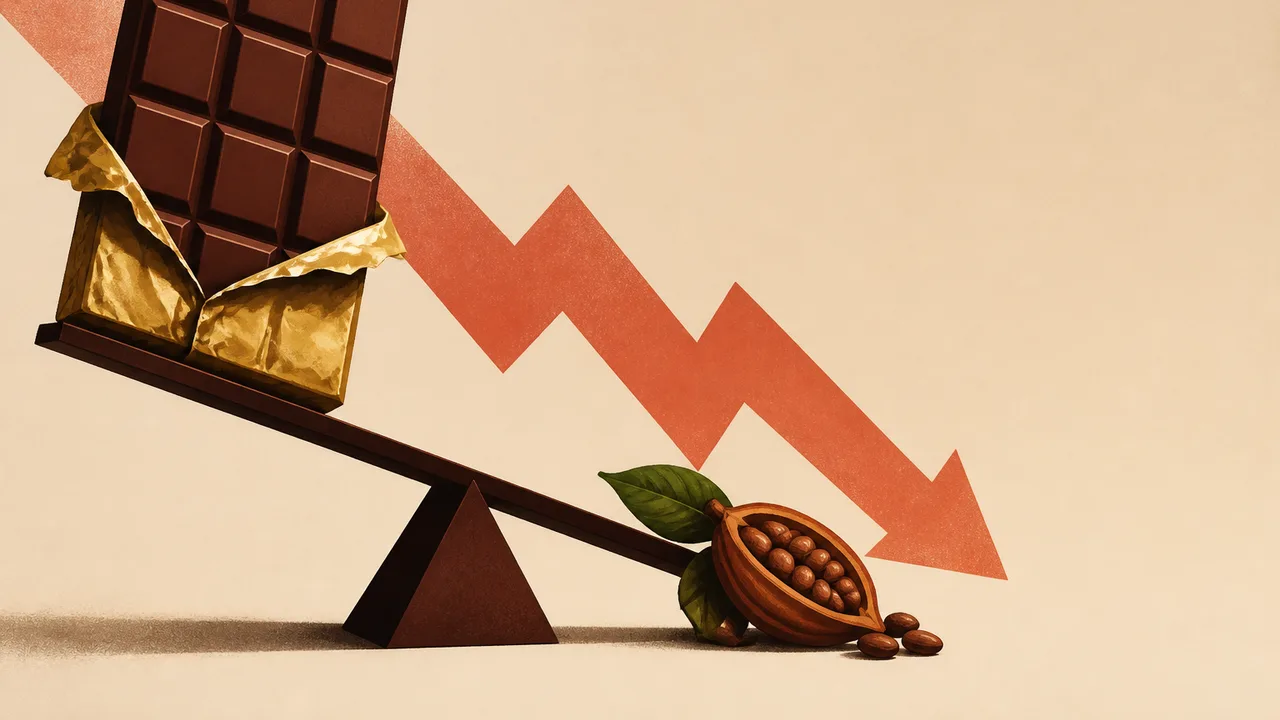
Who benefits from the interval between when commodity costs fall and when retail prices follow? That question sits at the center of the chocolate story right now — and it's worth asking carefully, because the answer looks different depending on where you stand in the supply chain.
Cocoa prices have retreated significantly from the record highs they reached over the past two years, driven by poor harvests and adverse weather across West Africa's growing regions, according to CNBC. Those highs hammered consumer sentiment and pushed chocolate prices to levels that made people genuinely reconsider what a candy bar was worth. And yet the relief that cheaper cocoa should logically deliver hasn't arrived on grocery shelves. Chocolate was still costing shoppers about 14% more year over year in early 2026, and over the past five years the cost of a full Easter basket has jumped 71%, with roughly three-quarters of that increase driven by candy, according to Axios.
So where does the story actually begin? Not at the corporate hedge desk. It begins in the fields.
The Farmers Who Absorbed the First Shock
The cocoa price spike of the past two years was in many ways a story about West African smallholder farmers — the growers in Ghana and Côte d'Ivoire who produce the majority of the world's cocoa supply. When drought and disease cut into harvests, those farmers faced reduced yields with little of the financial cushion that would allow them to weather a bad season. The commodity spike that followed was real, and their labor produced what was being priced at record levels. But the structural reality of cocoa farming — where farmers sell into government-regulated pricing systems or long-established buyer contracts — means that market price spikes do not translate automatically into higher farmer incomes. The record cocoa futures prices that chocolate manufacturers cited as justification for retail price increases were, in many cases, already locked in before those price spikes materialized.
That dynamic matters now that prices are falling. The same mechanisms that kept farmer income from fully rising when cocoa spiked will likely limit any income recovery as prices ease. The question of who absorbed the cost of the bad harvests — and who is now benefiting from the recovery — is not answered simply by pointing at the commodity ticker.
The Hedge Book and the Factory Floor
The reason retail chocolate prices haven't dropped alongside cocoa futures comes down to how large manufacturers manage commodity risk. Companies like Lindt, Barry Callebaut, and Nestlé purchase cocoa through futures contracts — locking in prices months or even years in advance to protect against volatility. EBC Financial Group explains the mechanics plainly: cocoa prices have fallen from record highs, but futures, hedging strategies, supply risks, and sticky inflation delay relief from reaching the consumer. The manufacturers who locked in cocoa at peak prices are still burning through that expensive inventory. Cheaper spot prices don't help them until the next round of procurement kicks in.
This is a real and documentable phenomenon. It is also, worth noting, a risk-management tool that primarily serves manufacturers, not workers or consumers. The companies that built hedge books at record prices are now managing a solvable corporate accounting problem. The workers on their production lines are managing something else.
Manufacturers are reconfiguring what they make. PBS NewsHour reported that chocolate getting more expensive has led manufacturers to cut the amount of chocolate they use or shift to other products like gummy candies to keep prices in check. That pivot — away from chocolate lines, toward confections that require different equipment, different formulations, and potentially different labor skills — is a real workforce disruption dressed up as a product-mix decision. When a factory retasks a line from chocolate enrobing to gummy production, the workers who ran that line either retrain, transfer, or find themselves surplus. None of that shows up in a company's investor presentation about portfolio optimization.
The Conversation noted that Mondelez stated its chocolates continued to be "much more expensive to make," which is why the company slightly reduced the weight of some products while raising list prices — the industry practice known colloquially as shrinkflation. The Conversation is careful to note there is no suggestion Mondelez is misleading the public about the reasons for price increases. But there is a distinction worth drawing: being truthful about cost pressures and being transparent about margin decisions are not the same thing. Cocoa is one input. Labor, packaging, energy, and logistics are others. When a company explains a price increase by pointing at cocoa, and cocoa subsequently falls, the natural expectation is that prices will follow. The fact that they haven't — and that manufacturers are pivoting to higher-margin premium products in the gap — is information that shapes how workers, consumers, and policymakers should read these corporate communications.
Geopolitical Noise and Supply Chain Reality
Beyond the hedging lag, manufacturers have pointed to broader geopolitical instability as a sustained cost pressure. The 2026 conflict involving the United States, Israel, and Iran — with particular disruption centered on the Strait of Hormuz, according to Britannica — has added shipping and energy cost volatility to an already stressed food supply chain. That's a real and ongoing pressure, not a manufacturer's convenient excuse. Strait of Hormuz disruptions affect fuel prices, container shipping costs, and commodity transport across multiple industries simultaneously. The chocolate industry is not uniquely vulnerable, but it is not immune either.
Tariff pressures compound the picture. The current trade environment has added cost uncertainty to supply chains that were already stretched by pandemic-era disruptions and weather shocks. Manufacturers operating across multiple jurisdictions face input cost variability that is genuinely difficult to price through in real time.
None of that changes the fundamental question of who absorbs cost volatility at each level. The farmers who lost yields to weather absorb it first. The factory workers whose line assignments shift absorb it in the middle. The consumers who pay 14% more for Easter candy absorb it at the end. What the hedge book data and the premium product pivot suggest is that the interval between cocoa relief and consumer relief is not empty — it's where margin recovery happens.
The Premium Product Play
CNBC reports that companies including Lindt are leaning into premium products and leveraging social media trends to attract consumers who will pay more for perceived quality. This is a rational market segmentation strategy. It is also a strategy that effectively accepts the loss of price-sensitive consumers — including lower-income households for whom a chocolate bar is not a luxury purchase — while maintaining margins on the segment willing to pay for artisanal framing.
There's nothing illegal about that. But it's worth being clear about what it means: the mass-market chocolate consumer who drove volume for decades is being consciously deprioritized in favor of the premium buyer. The workers who made mass-market chocolate — often in unionized or partially organized manufacturing facilities — face different job security than those working premium lines. The grocery store worker watching customers put the name-brand bar back and reach for a store brand, or nothing at all, is watching that market segmentation happen in real time, transaction by transaction.
The hedge books will eventually clear. By the current projections circulating in financial analysis, cheaper cocoa costs are expected to start feeding through to manufacturers' input costs somewhere around the third quarter of this year. Whether that relief gets passed to consumers, retained as margin, or somewhere in between will depend partly on competitive dynamics — and partly on how much transparency consumers and workers are willing to demand in the meantime.
The cocoa is cheaper. The question is still open about for whom.
More Like This

Gaming Hardware Costs Are Rising and Relief Is Far Off
Micron, Microsoft, and Apple signal gaming hardware prices will keep climbing through 2028 or beyond. Here's what's driving the squeeze and what it means.
Business Rules 2026: Impact on Labor and AI
Explore how emerging business rules and AI technology reshape labor dynamics and worker dignity by 2026.

Uganda Vanilla Could End the Price Chaos
Madagascar's vanilla monopoly has wrecked small business budgets for decades. Uganda's emerging industry might finally offer the stable supply chain Main Street needs.

Anthropic's Subscription Mess Has a Regulator's Name on It
Anthropic's quiet pricing changes and Easter-weekend policy announcements aren't just bad comms—they may meet the FTC's definition of deceptive subscription practices.

Financial Crises Follow Patterns — But Not for Everyone
Kuran Francis maps four recurring patterns behind every major financial crisis. The framework is solid. What it leaves out is the story of who pays when the system breaks.

Wall Street Knew the Crash Was Coming. Saying So Got You Fired.
Jeremy Grantham's famous poll revealed 398 analysts knew the dot-com crash was guaranteed. A 2003 study shows why none of them said so publicly: accuracy cost careers.

Trump's Forced-Labor Tariffs Trigger Global Backlash
Trump's new tariffs on 80+ countries cite forced labor, but trading partners call it protectionism. Here's what's actually at stake in the escalating dispute.

CuspAI's $450M Bet: Who Gains When AI Does Science?
Jeff Bezos and the UK government just backed CuspAI at a $2.6B valuation. The bigger question: what happens to the researchers whose expertise AI now models?