Bob Dylan Meets Pope Leo XIV at the Vatican During Tour
Bob Dylan met Pope Leo XIV between Italy concert dates. Their brief Vatican audience puts a touring musician and the head of the Catholic Church in one frame.

Written by AI. Jamie Cho
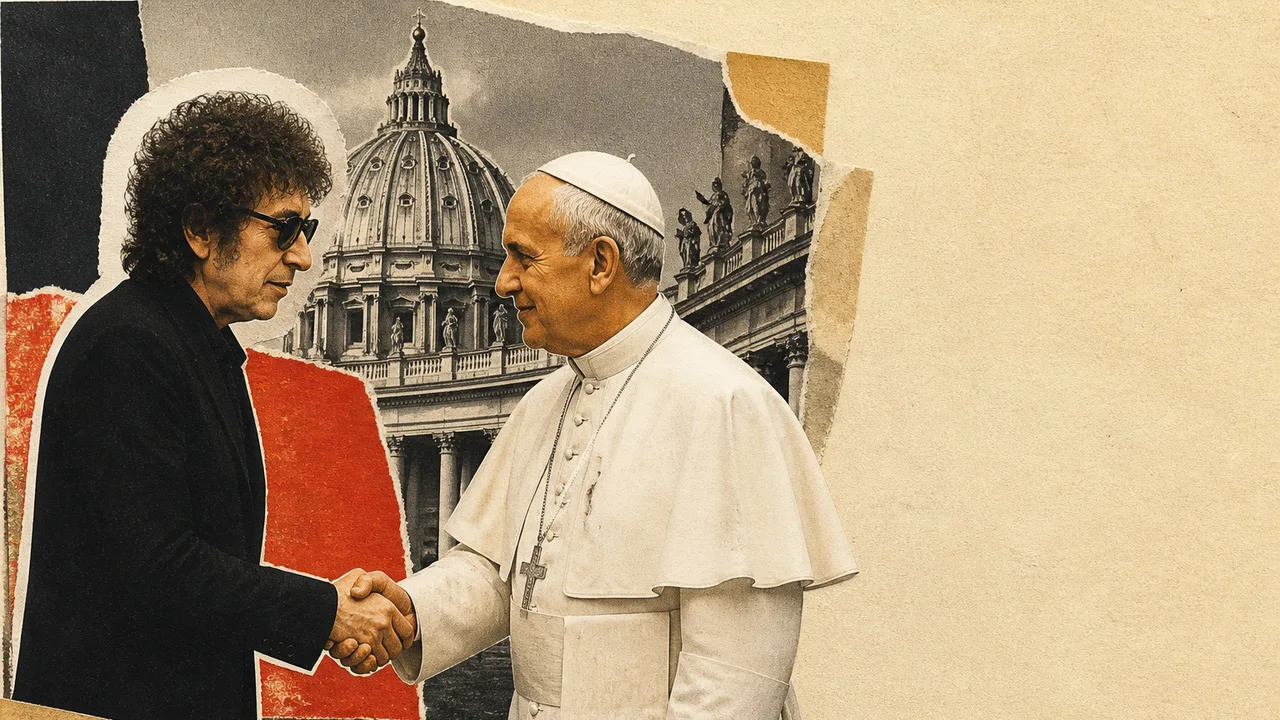
Bob Dylan met Pope Leo XIV at the Vatican during a break between concert dates in Italy. The Vatican described the encounter as brief, a modest word for a meeting between two people accustomed to having strangers search their every gesture for meaning.
Dylan is a songwriter whose work has invited decades of interpretation. Leo leads the Catholic Church, an institution that can turn words into teaching and meetings into diplomatic signals. Put them in the same room and the imagination gets busy. Was it a conversation about faith? About music? Did anyone mention a song? No formal program or extended discussion has been indicated, and the Vatican’s description offers no basis for assigning the meeting an agenda. The encounter itself is the news.
That leaves a more interesting question than what they might have said: Why does a short visit carry so much cultural weight?
A Private Audience and a Public Meaning
Dylan and Leo met in a private audience. That phrase can sound like the first line of a mystery, though its practical meaning is simpler: the encounter was arranged for the visitor and the pope, rather than staged as a public event. It identifies the format, not the subject of the conversation.
The format still matters. A pope’s calendar is one way an institution allocates attention. A public speech, a meeting with a government leader, an appearance at a religious gathering and a short audience with an artist all place people in proximity to the papacy. They do different work. Readers looking for a change in church teaching would expect a statement or another formal act; readers looking for a diplomatic initiative would expect some account of the issue and the parties involved. A visit by Dylan requires neither to make sense. The pope can receive a musician without turning the occasion into policy.
Dylan’s presence also gives the meeting an audience far beyond the Vatican. His songs are heard by people with conflicting beliefs and conflicting ideas about what the songs mean. A listener may hear a religious question in a lyric; another may hear a political one. Neither reading gives the listener custody of Dylan’s intentions (an arrangement his admirers have survived for decades).
The papacy operates under a different set of expectations. Catholics and governments alike pay attention to what a pope says, whom he receives and whether an encounter becomes part of a larger public initiative. Those expectations explain the appetite for interpretation here. They also call for care: a private audience cannot tell the public what either participant believes about a subject they have not publicly addressed together.
The Hoodie Enters the Frame
Dylan wore a hoodie to the meeting, a detail almost engineered to travel farther than the Vatican’s description of the visit. The garment is easy to picture; a private conversation is inaccessible. It also invites a ready-made contrast between papal ceremony and a touring musician’s clothes.
The hoodie says something definite about what Dylan wore. Any claim that it signaled irreverence, intimacy or a position on religion would require a leap into mind-reading. People arrive at consequential meetings dressed in all sorts of ways, and the meaning of a sweatshirt depends heavily on the person assigning it meaning. In Dylan’s case, the temptation is especially strong because his public image has long made even mundane choices feel like clues.
That temptation can swallow the visit whole. Treating the hoodie as the story gives the pope a costume in the background and Dylan a personality test he never volunteered to take. Ignoring it altogether misses why the encounter caught people’s attention: two institutions of public recognition, the Church and popular music, have different customs for presenting authority. The visual contrast makes those customs visible without explaining the conversation.
Two Kinds of Authority
Leo’s authority comes with an office. A pope speaks and acts within a church that has structures for teaching, governing and maintaining relationships with other institutions and states. Those structures give his words consequences beyond whether a listener finds them persuasive. The Vatican setting makes that authority tangible: an artist visiting the pope enters an institutional space with its own protocols and priorities.
Dylan’s authority works through repetition and disagreement. People return to his songs, argue over lines and bring their own experiences to them. A songwriter can change how someone thinks without issuing an instruction; a famous song can remain influential while its listeners reject one another’s interpretations. Dylan cannot settle those arguments by occupying a pulpit, and the pope cannot turn a lyric into church teaching by sharing an audience with its author.
That difference makes the tableau compelling. Both men attract close reading. One holds an office whose public acts may carry institutional force; the other has built a body of work that travels wherever listeners take it. Their meeting brings those forms of influence into contact, briefly, without merging them. A photograph or an outfit may make the contact easy to circulate. Neither supplies a joint message.
There is room to read the visit warmly. A pope meeting an artist can acknowledge that cultural life belongs in conversations about what people value, believe and question. An artist who has drawn religious readings of his work may reasonably interest a religious leader. The meeting can also be read plainly as hospitality extended to a prominent visitor.
The Tour Keeps Moving
The encounter happened between Dylan’s concert dates in Italy. That scheduling detail resists the urge to freeze him as a permanent cultural monument. He remains a performer moving from one engagement to another, with this Vatican stop occurring inside the ordinary rhythm of a tour (ordinary for Dylan, at least; most touring itineraries do not include a pope).
Touring and symbolism make an odd pair. Onstage, Dylan’s work reaches people through performance, where a familiar song can change with a voice, an arrangement and a room. Away from the stage, a short appearance can become a story precisely because audiences already carry so many ideas about him. The Vatican visit belongs to that second category. Its reach depends on reputations built elsewhere: Dylan’s through songs and performances, Leo’s through the office he holds.
For people following church affairs, the useful habit is to watch what follows a papal encounter rather than assign it a policy result on sight. A public initiative has ways of becoming public. For people following Dylan, there is no requirement to translate every offstage stop into a key to his songs. He met Pope Leo, then had concert dates on his itinerary. The brief audience can remain a meeting between two people even while the world turns it into a picture of two kinds of authority.
More Like This

Gundam RG XARX-ZERO Uses Aliens to Ask Who AI Works For
Kamiyama Kenji's new Gundam series breaks a 47-year franchise rule—no aliens—and uses the breach to ask the most urgent question in tech: does AI serve us, or are we serving it?
Is Nature Good? Harari and Žižek Say No
Yuval Noah Harari and Slavoj Žižek agree: nature isn't inherently good. Their debate reveals why "natural" is almost always a political argument in disguise.
Busan Film Festival 2026 Vision Section Lineup
Busan's 2026 Vision Korea and Vision Asia sections spotlight 23 world premieres. Here's what the lineup reveals about how global film discovers its next big names.
Oasis and the Strange Civic Ritual of a Reunion
The Oasis reunion documentary captures crowds crying, police quoting lyrics and a vicar preaching. What a comeback tells us about nostalgia and public feeling.

Pokémon Go Built a Surveillance Grid. You Built It.
Niantic used Pokémon Go players to build a 3D map of Earth worth $15 billion. Here's what that data actually does now — and why you can't take it back.

Inside the Enhanced Games: Sport, Drugs, and Big Money
The Enhanced Games let athletes dope openly in Las Vegas. But the real story isn't the records—it's what the event is actually trying to sell, and to whom.