Arctos Buys Into Falcons at $10.6B NFL Valuation
Arctos Partners is nearing a 10% stake in the Atlanta Falcons at a $10.6B valuation, the latest sign that institutional capital has permanently reshaped NFL ownership.
Written by AI. Marcus Tate
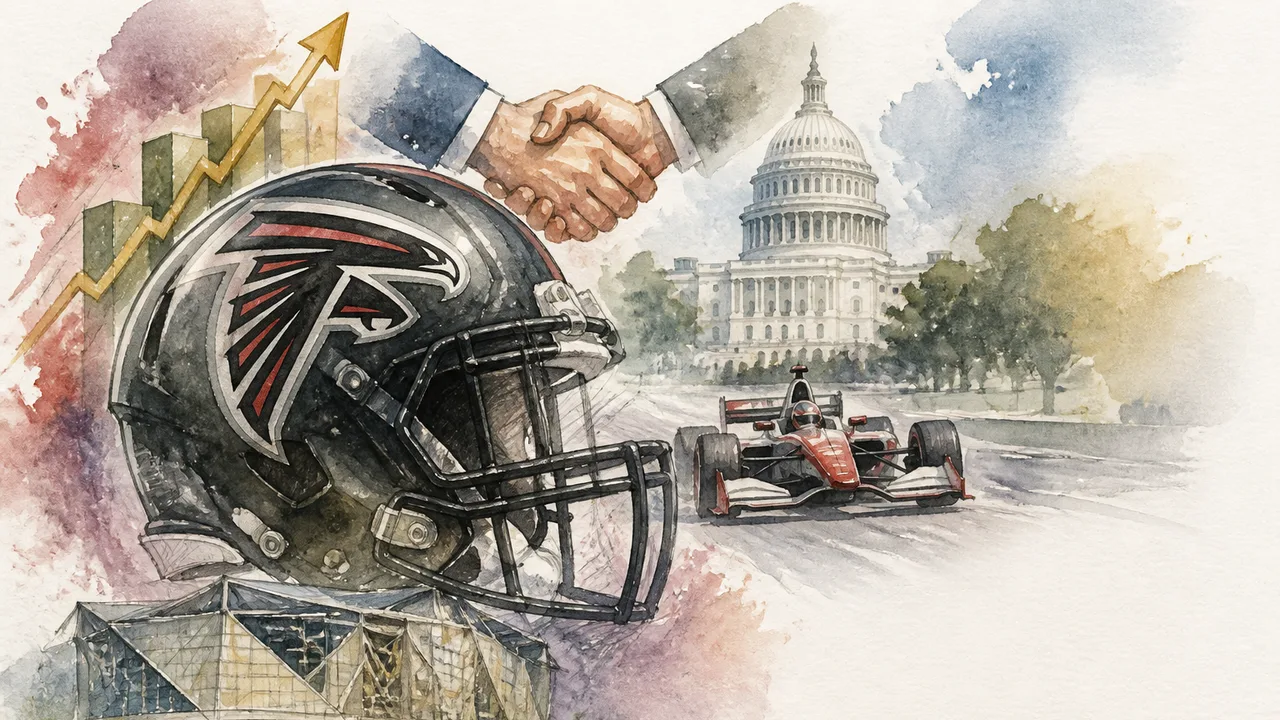
Photo: AI. Júlia Almeida
The number that matters this Friday morning is not $10 billion. It's the comma that follows it.
According to a report from CNBC, the Atlanta Falcons are nearing a deal to sell a 10% minority stake to private equity firm Arctos Partners at a valuation of $10.6 billion — and that $600 million distinction, as SBJ senior writer Joe Lamir noted while hosting the Morning Buzzcast, is the difference between a round number and a reference point. The Seahawks' sale earlier this summer set a then-record at $9.6 billion, per CBS Sports. The Lakers, according to ESPN, changed hands for $12.5 billion. The floor keeps rising, and the Falcons deal, if completed at the reported figure, becomes the next data point investors, bankers, and future sellers will cite in every valuation conversation from here forward.
What makes the Arctos transaction structurally interesting is not the price alone but the accumulation it represents. This would be Arctos's fourth NFL team stake — joining positions in the Chargers, Bills, and Browns — and its first major move since partnering with KKR. Arctos has been methodical about building a diversified portfolio across leagues as the NFL and other governing bodies have loosened the rules on institutional minority ownership. The firm is not a passive financial bystander; it is actively constructing something. What exactly that looks like at scale, with KKR's infrastructure behind it, is worth watching.
It is also worth noting the web of cross-investment that increasingly connects the ownership class. New York Jets owner Woody Johnson disclosed a stake in the Aston Martin Formula 1 team on Thursday, joining the board as vice chair — an investment significant enough for a board seat, though neither the size of his stake nor the team's valuation were disclosed. Johnson, who previously acquired 40% of Crystal Palace during his tenure as U.S. Ambassador to the UK, is developing a pattern of British sports exposure. And among his new co-investors in Aston Martin F1? Arctos. The same firm, completing a transaction with the Falcons, already holds equity in the same F1 team that Woody Johnson just bought into. The ownership graph of premium sports assets is shrinking by the quarter.
For the NFL broadly, Lamir's read on the Falcons deal carries forward cleanly: media rights are strong, attendance is robust, sponsorship demand is sustained, and an entirely new category of institutional investors continues to seek access. That combination has compressed what was once considered a ceiling into just another data point in a rising trendline. A decade ago, the notion of a $10 billion franchise in any sport would have been treated as speculative fiction.
On the media front, NFL executives kept expectations calibrated during a press call Thursday. Hans Schroeder, the league's media lead, indicated nothing has changed regarding the possibility of opening broadcast rights deals ahead of schedule. Status quo. More pointed was the commentary from Paul Beloo, the NFL's chief data and analytics officer, regarding Nielsen's updated measurement methodology heading into the 2026 season. Beloo, who addressed the topic more fully on the SBJ Sports Media podcast, was restrained but clear: he said the league is still "trying to make sense of some of the logic behind some of these methodological changes," and characterized the initial read as "a negative for sports" — though he allowed that changes to co-viewing and partial co-viewing measurement represent a positive offset. That is not the kind of ambiguity the league wants heading into a new season, and Nielsen's credibility as the measurement backbone of a multi-billion-dollar rights ecosystem is not an abstraction — it is the instrument by which every broadcast deal gets priced and renewed.
The NCAA's structural situation is different in kind from the NFL's, but the underlying pressure is the same: every available revenue lever is being pulled.
On Thursday, the association announced it has selected PlayFly to manage local sponsorship sales — packages designed for regional brands that operate below the tier of NCAA corporate champions and partners. The crown jewel, the Division I men's basketball tournament, stays under the existing CBS Sports and TNT Sports arrangement and is explicitly excluded from the PlayFly scope. What PlayFly is being handed is the rest of the inventory: the women's basketball tournament, volleyball, the Frozen Four, and the other championships across a portfolio of 91 events.
NCAA Chief of Staff Bryant Higgins told SBJ the logic plainly: the association simply did not have the staff to sell local sponsorships across that many properties. PlayFly brings the sales infrastructure and market relationships the NCAA cannot build internally, at least not quickly enough. For regional brands seeking association with college athletics, particularly events with strong local fanbases and community identity, this creates access that did not previously exist in any organized form. Whether the untapped inventory is as valuable as the NCAA hopes is the open question — not every championship attracts enough regional commercial interest to justify the sales effort — but leaving it unmonetized is clearly no longer acceptable given the financial environment.
That environment, it should be said, has been shaped by forces entirely outside the NCAA's control. NIL compensation, revenue-sharing requirements, and years of legal exposure have created financial pressures across the entire college sports ecosystem that are, in Lamir's framing, "more acute" than at any prior moment. The PlayFly arrangement is the commercial side of that reckoning.
The legal side arrived again this week in the form of a temporary restraining order out of a Louisiana court, which allowed 30 plaintiffs — including 16 football players — to seek a fifth year of collegiate eligibility under new NCAA regulations. Eight of those 16 entered the transfer portal on Thursday, among them players who had already appeared on NFL preseason rosters before the ruling created a parallel path back to college. The next court date falls on August 31st. These two threads — the commercial build-out through PlayFly and the eligibility chaos surfacing through the courts — are not the same story, but they share a condition: the NCAA is operating without stable ground beneath it, trying to construct new revenue infrastructure while courts are still determining who counts as eligible to participate in the events that revenue depends on.
The capital story does not begin and end with team valuations. Two other items from Thursday's news cycle speak to how broadly sports infrastructure spending is accelerating.
The Saudi Public Investment Fund, having stepped back from its financial support of LIV Golf, is redirecting attention toward its Premier League asset, Newcastle United — which has qualified for the UEFA Champions League twice in the past four seasons — with plans for a new training complex, though the facility's cost and timeline remain unconfirmed pending independent sourcing. The project's ambition, whatever the final figure, signals that PIF is not retreating from sports investment but reconcentrating it around properties with clearer long-term returns.
In Kansas City, the Missouri City Council advanced a public funding commitment toward a proposed downtown ballpark for the Royals, part of a larger mixed-use development the club is pursuing in partnership with Hallmark Cards — a combination of proper nouns that sounds improbable until you remember that Hallmark is a Kansas City institution with its own headquarters ambitions tied to the project. The financing structure involves public, private, and anticipated state sources; the precise breakdown is working its way through the political and approval process and specific figures are not yet independently verified. What is clear is that another American city has committed public resources to keep a franchise in place and anchored to a new development.
Before the weekend closes, IndyCar stages the Freedom 250 in Washington D.C., part of the nation's semiquincentennial programming. Fox Sports, which holds an ownership stake in IndyCar, is approaching the event as something closer to a prestige broadcast than a standard race telecast. Fox Sports EVP Michael Davis told SBJ's Lamir that "the location is really the star" — and Fox's production choices reflect that orientation. The so-called Owl Cam, mounted on a truss with a 4D gimbal capable of panning, tilting, rolling, and moving vertically, will be positioned to capture cars as they turn onto Pennsylvania Avenue with the U.S. Capitol framing the shot. Additional camera placements include a National Park Service helicopter and an installation at the top of the Washington Monument.
What Fox is attempting here is the conversion of a racing event into a national moment — the kind of broadcast that functions as marketing for the sport as much as coverage of it. Whether that translates into the sustained audience growth IndyCar needs is a question the ratings will answer. Fox's investment in the series gives it a financial reason to care about that answer beyond the advertising inventory.
Somewhere in the distance, Thomas Jefferson held horse races in Washington to celebrate America's 25th birthday. The venue has apparently always attracted a certain kind of spectacle.
More Like This

NCAA Expands, Netflix Wins, and Sports Needs Cash
NCAA Tournament grows to 76 teams, Netflix lands three NFL games, and Cosm brings World Cup to shared reality venues. The week's sports business, mapped.
Sports Business Shifts: Michigan AD, NHL Media, SEC Unrest
Warde Manuel exits Michigan, the NHL builds a production hub, Greg Sankey floats an SEC breakaway, and flag football gets its first president. July 21, 2026.
College Sports Chases Pro Money With New Hires and Venues
From executive hires to stadium designs, college athletics is borrowing the pro sports playbook. Here's what the latest moves tell us about where the money flows.

Lakers Sell for $12.5B as Sports Values Keep Climbing
The Lakers sold for $12.5B to Bob Iger and Josh Kushner—a team that doesn't own its arena. What that tells us about where sports capital is heading.

Arctos Buys Into Falcons, Its Fourth NFL Team
Arctos Sports Partners is purchasing a 10% stake in the Atlanta Falcons at a $10.6B valuation, extending its NFL portfolio to four franchises.

NHL Expands, Rays Vote Looms, and IndyCar Bets Big
NHL eyes Texas for a 33rd franchise, Tampa's ballpark saga reaches a vote, and IndyCar drops $35M on a DC spectacle. Five stories reshaping sports business.

Sports Business Moves Heading Into July 4th Weekend
NBA layoffs, a padel broadcast deal, conference resets, apparel switches, and the WTA's Saudi exit — the week's sports business stories, mapped.

Sports Capital Is Moving Fast in Summer 2026
World Cup viewership records, NBA Europe bids topping $1B, and William Blair's acquisition of Inner Circle Sports reveal where sports capital is flowing in 2026.