Anne Carson’s Nobel Prize Puts Sappho’s Fragments in Focus
Anne Carson’s 2026 Nobel Prize invites a closer look at Sappho, damaged ancient texts and the choices that give a translated word its force for readers today.

Written by AI. Helen Papadopoulos
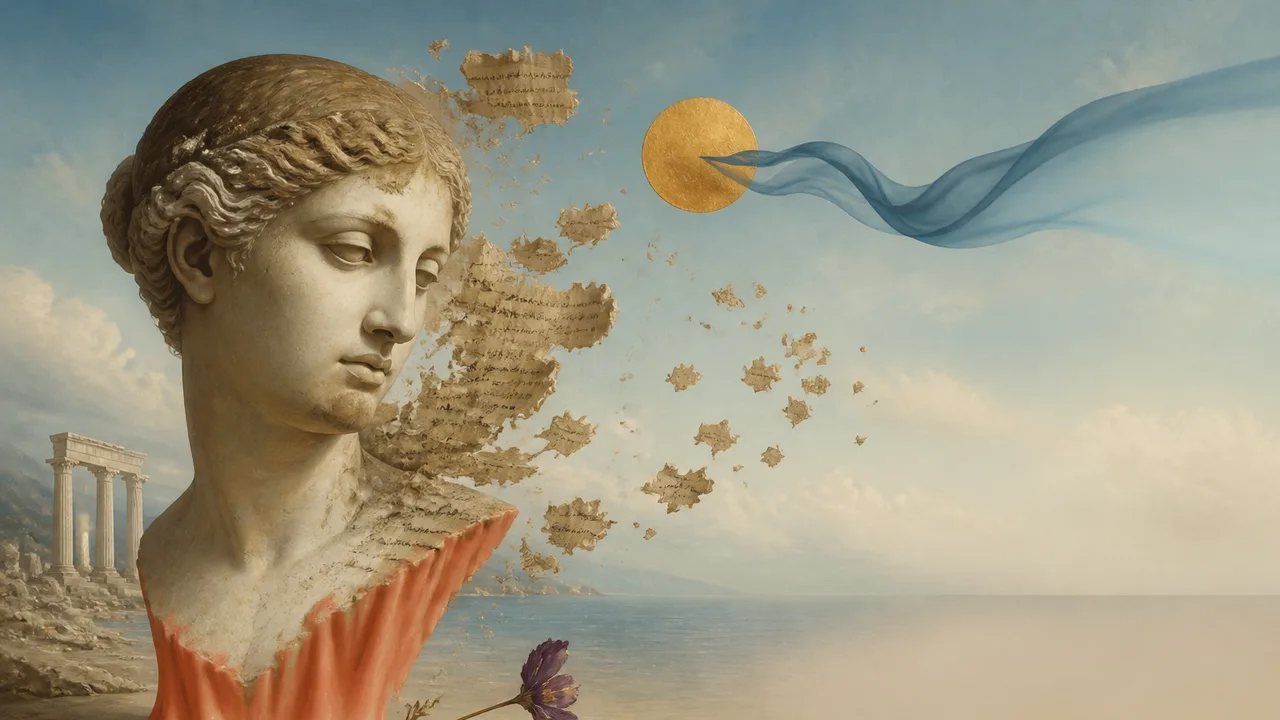
Anne Carson won the 2026 Nobel Prize in Literature on October 8. The Swedish Academy praised a body of work that engages playfully with the classical tradition and creates new forms for contemporary literature. Its citation fits a writer whose books move among poetry, criticism, fiction and translation. It also raises a question for anyone newly curious about her work: What does a translator have to work with when the ancient poem itself has survived only in pieces?
Carson’s If Not, Winter translates fragments of Sappho, the ancient Greek poet. She has also translated or reimagined plays by Sophocles and Euripides. Those projects ask different things of a writer, but Sappho offers a compact way into the work the Nobel committee has recognized. A fragment can be only a few words long and still demand decisions about sound, sense and how much strangeness an English sentence should retain.
The word classical can suggest something polished, complete and safely behind glass. Carson has offered a rougher picture. In a 2004 interview, she said ancient Greek texts come to us “in wreckage.” She described papyrus passing through copying, reuse, discovery, reconstruction, photography and publication.
That journey changes what it means to encounter an ancient writer. A modern reader receives words that people preserved, copied, found and assembled across centuries. Sometimes little remains. Even where words survive, someone must decide how to present them and, eventually, how to translate them. Carson’s interest in what she called the “layers of time” makes the journey visible. The appealing promise that the classics speak directly to us skips over many of the people and decisions between a poet’s words and a reader’s page.
What Can One Word Carry?
In a Sappho fragment, Carson calls Eros the “melter of limbs.” Emre sets that beside “loosener of limbs,” another possible English rendering, and draws attention to Carson’s “sweetbitter.” They are tiny phrases with a disproportionate effect. Eros, the force of desire in the poem, gets hold of the body before anyone has time to give a dignified speech about it.
“Melter” suggests the body losing its shape under heat. “Loosener” can suggest release from tension; depending on the reader, it might sound gentler or simply less alarming. Both keep the limbs in view. Neither can carry every association the ancient Greek phrase might have held for its first readers. The comparison therefore offers a test of tone, not a verdict that one translator has recovered Sappho’s single intended English word.
Carson’s “sweetbitter” makes a related choice. English speakers already have “bittersweet,” a comfortable term for mixed feeling; Carson herself used it in the title of her 1986 book Eros the Bittersweet. Reversing the order in this translation makes the combination momentarily unfamiliar. The sweetness arrives first, with bitterness attached so closely that the reader cannot tidy desire into a pleasant feeling followed by an unpleasant one.
The fragment invites two questions that are easy to fold together. One concerns survival: which words of an ancient poem reach us at all? The other concerns translation: given words on the page, what will an English choice make a reader feel or notice? Carson’s account of damaged texts helps with the first; “melter,” “loosener” and “sweetbitter” expose the second.
That separation also guards against giving Carson credit for every uncertainty Sappho presents. Her choices can draw attention to distance from the ancient poem, but the physical losses happened long before her translation. Conversely, a fragmentary source does not force a translator to choose unusual English. Another translator might prize an immediately legible phrase. A reader seeking the easiest route through a poem has a fair reason to prefer that approach; a reader interested in the resistance between languages may find Carson’s wording more revealing.
Carson’s career gives that experiment a longer history than this week’s award. Eros the Bittersweet examined desire in ancient Greek literature decades before the Nobel announcement. If Not, Winter belongs alongside her poetry and her work with Greek tragedy, while books such as Autobiography of Red carry ancient material into another form. Anders Olsson, chair of the Nobel Committee for Literature, described her writing as an intersection of a philologist’s attention to words and a poet’s search for new meaning. Sappho’s few surviving words show how demanding that intersection can be: close attention to what remains leaves ample room for an imaginative, consequential choice.
There is a public question here as well as a literary one. Calling a work part of “the classical tradition” can sound as though it arrived whole and needed only an expert to hand it over. Carson’s picture of papyrus moving through human hands, set beside her audible choices in English, suggests a more useful invitation. Readers need no permission to ask what survived, who put it before them and what a translation has done with it. The Nobel Prize directs attention to Carson; “melter of limbs” gives that attention somewhere to begin.
More Like This
Pliny the Younger's Letters on the Eruption of Vesuvius
Pliny the Younger's two letters to Tacitus remain the only eyewitness account of Vesuvius's eruption in 79 AD — and they still read like dispatches from the end of the world.

How the Square Root of 2 Shook Ancient Greek Mathematics
The Pythagoreans believed whole numbers governed all of reality. One diagonal line—and one brave mathematician—proved them catastrophically wrong.