Android vs. iOS: The Business Model Divide
The real iPhone vs. Android divide isn't cameras or home screens—it's two completely different business models. Here's what that means for your wallet and your data.

Written by AI. Tyler Nakamura
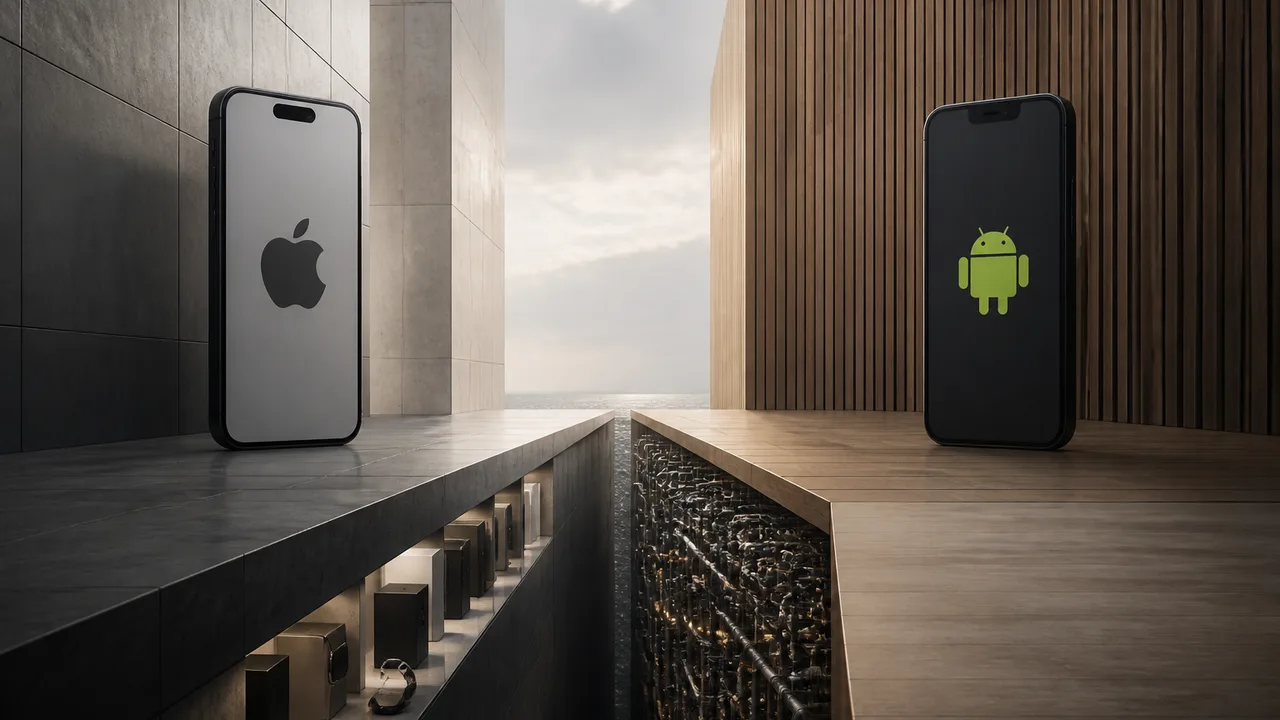
Photo: AI. Hayden Cross
Nobody warned me when I walked into a phone store at nineteen that I was actually being asked to choose between two payment plans that had nothing to do with the sticker price. One store rep pushed the iPhone. Another leaned toward Samsung. Neither one mentioned data. Neither one mentioned update timelines. They talked about cameras.
That's the conversation most people are still having, and a recent video from The Unexpected History cuts through it in a way I genuinely found useful. The thesis is blunt: the Android vs. iPhone debate isn't about features. It's about what each company is actually selling—and those are two very different things.
Here's the line that stuck with me: "The phone is the vessel. Your attention is the cargo."
That's not hyperbole. That's the business model.
What's Actually Being Sold
Apple's money comes from the hardware. The iPhone is the product. iOS exists—as The Unexpected History puts it—as something "designed with genuine craftsmanship, but a trap nonetheless." Every software decision Apple makes is downstream of one goal: make the iPhone so seamless, so integrated, so genuinely good to live in that you buy the next one. And the one after that. iMessage lock-in, AirDrop, AirPods switching, the way your Apple Watch only pairs with an iPhone—none of that is accidental. It's architectural.
Google's approach is the inverse. Android is free. Free for Samsung to ship, free for Motorola, free for the no-name brand you find at a gas station. Google doesn't charge manufacturers a dollar to use it, because the phone was never the product. You are. Your search patterns, your location, your app usage—that's what feeds Google's advertising business, which is massive by any measure. Android exists to keep you inside the ecosystem where that data gets generated. Every moment you use an Android device, that data loop is running.
When The Unexpected History frames it as "one company profits when you buy the device, the other profits every moment you use it"—that's not a hot take, it's just an accurate description of two publicly documented business strategies. And it explains design decisions that otherwise seem random. Why does Android allow sideloading by default? Because openness keeps you engaged with the platform. Why does Apple review every App Store submission? Because the product is the experience, and a virus would be bad for hardware sales.
I find this framing more useful than any spec comparison I've read, because it answers the "why" behind everything.
The Architecture Part (Stay With Me, This Actually Matters)
Here's something that sounds like trivia until you realize it affects literally whether your phone gets security patches.
Most people think "Android" and "Google" are the same thing. They're not. There's AOSP—the Android Open Source Project, a free codebase anyone can use or modify—and then there's the proprietary Google layer on top: Play Store, Gmail, Maps, Chrome, all of it. Those are separate things that just usually come bundled together.
Amazon's Fire tablets? Android under the hood, zero Google. Huawei phones, after US sanctions cut off their access to Google's licensing? Same deal—AOSP, no Google services. This is why a Huawei phone feels like a totally different universe even though it's technically "Android."
Why does this matter to you? Because this architecture is what creates fragmentation—and fragmentation is what determines whether your phone gets security updates.
When Google pushes a security patch, it has to travel through the manufacturer's custom Android skin, then potentially through your carrier, before it reaches your device. That chain can take months. Sometimes the patch never arrives at all, especially on budget devices that manufacturers deprioritize after the first year or so. Meanwhile, every supported iPhone on the planet gets Apple's security patches within days of release, no middlemen involved.
The Unexpected History calls this "a security gap that barely gets discussed openly, but cybersecurity professionals take it very seriously." That tracks—enterprise IT departments have preferred iOS for years, and update fragmentation is a documented part of why.
Google has been chipping away at this with something called Project Mainline, which lets them push updates to critical system components directly through the Play Store, bypassing manufacturers entirely. It's genuinely good progress, and it doesn't get nearly enough coverage. But the structural gap hasn't closed. If you bought a budget Android last year and updates have already slowed down, you're living the fragmentation problem right now.
The Trade-off I Actually Want to Talk About
Here's where I want to be honest with you, because I think a lot of coverage on this topic goes deliberately foggy.
If you're 19, in college, and a $200 phone is your realistic budget—not a compromise, a strategy—Android is almost certainly where you land. The hardware diversity is real: foldables, stylus devices, perfectly capable smartphones at prices Apple won't touch. That's a genuine advantage. I'm not dismissing it.
But the data trade-off hits differently depending on your situation. If you're using a budget Android, Google's data collection is the economic engine that made that cheap phone possible. You're not getting a deal. You're getting an alternative payment structure. That's worth knowing going in, not figuring out later.
On the iOS side, you're paying upfront—and paying a lot, because Apple's entry point for new hardware isn't friendly to tight budgets. What you're buying is consistency. iOS on a four-year-old device still feels like iOS. Apple has historically delivered software support for five to six years on its hardware, which means an older iPhone you picked up refurbished might actually be a better long-term bet than a cheap Android that stops getting updates in 18 months. I think that math is underappreciated.
What The Unexpected History gets right is that neither of these is a scam. They're genuinely different value propositions. iOS is the phone where you pay the cost upfront and get predictability in return. Android is the phone where the upfront cost is lower—or zero for the software—and the cost gets distributed differently, over time, in data.
The part that bothers me isn't that these trade-offs exist. It's that nobody in the phone store is explaining them. You go in, you look at screens and cameras, and you leave having made a decision about your data and your security update timeline without anyone framing it that way.
So Which One?
I'm not going to tell you which phone to buy, because that genuinely depends on your life. But I'll tell you what I'd actually think about:
If long-term security and update reliability are your priority, iOS wins on structure alone. The centralized update pipeline isn't a preference, it's an architectural advantage.
If budget is the real constraint, Android's hardware diversity is a feature, not a consolation prize. Just be real with yourself about the data exchange happening in the background, and—if you can—aim for a Pixel over a no-name device, because Google's own phones are far less fragmented than the broader Android ecosystem.
If you're already deep in one ecosystem, the switching cost is real and it's designed to be. iMessage, photos, contacts, app purchase history—that friction is intentional. Factor it in honestly rather than pretending it doesn't exist.
The Unexpected History closes with something I keep thinking about: "iOS is a product you pay for up front in the price of the hardware. Android is a product that many people pay for continuously in the data they generate every day."
That's the sentence I wish someone had said to me in that phone store. You're paying either way. The only question is when, and in what currency.
More Like This

World's Fastest Drone Reclaims Record with V4
Discover how Peregreen V4 reclaimed the world's fastest drone title with a speed of 657 km/h.

Google Pays $250K for 16-Year-Old Linux KVM Flaw
A 16-year-old Linux KVM flaw called Januscape earned a $250K bounty after enabling guest VM escapes on Intel and AMD systems. Here's what it means for cloud security.
This Tool Treats Your Home Lab Like Infrastructure Code
RackPeek documents home labs as YAML code in Git. Brandon Lee shows how this infrastructure-as-code approach beats static diagrams and spreadsheets.
30 Self-Hosted GitHub Projects Trending Right Now
From media automation to AI chat apps, here are 30 trending self-hosted GitHub projects that put you back in control of your data and infrastructure.
Why Amazon Sells Apple Products Cheaper Than Apple Does
Apple never discounts its products, but Amazon routinely does. Here's what you gain—and what you actually lose—buying your MacBook or iPad from Amazon.
iPhone 18 Pro's Three Most Rumored Upgrades, Assessed
Variable aperture, a smaller Dynamic Island, and Apple's C2 modem headline the iPhone 18 Pro rumors. Here's what they actually mean for you.

Multicast Networking Explained: How It Works
Multicast delivers one packet that the network duplicates—not the server. Here's how it works, where it actually matters, and how to set it up at home.

Marina Wyss Went From $60K to $600K in 8 Years
Marina Wyss details the pay cuts, pivots, and 100+ job rejections that took her from $60K to $600K in AI—and what her creator business actually reveals.