American Airlines' Zero-Bump Rule Changes Gate Decisions
American Airlines has told gates to find volunteers rather than bump passengers. Here is how its new rule changes offers, delays and the choices travelers face.

Written by AI. Tomas Reyes-Kim
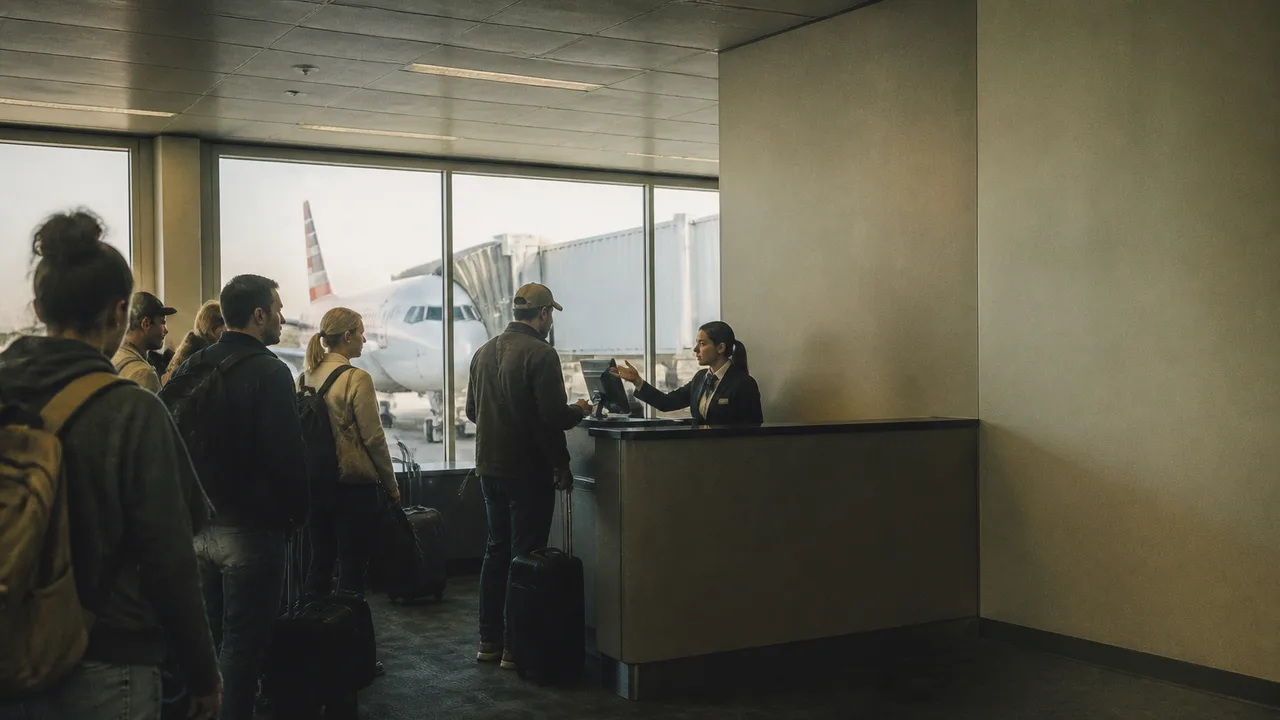
American Airlines has told gate teams to keep an oversold flight’s door open until enough passengers volunteer to take another flight. The directive, in effect since September 30, makes avoiding involuntary denied boarding a company requirement, according to an internal memo obtained by View from the Wing. Staff can take a departure delay while they keep looking for volunteers.
If you are standing at the gate with a cheap ticket, a shift tomorrow and approximately zero interest in a voucher you cannot use, the change is concrete: employees have been told to keep working the oversale instead of ending it by denying an unwilling passenger boarding. Your plans may still run into the gate clock while they do. A policy that protects your booked seat does not make your boss move the start of your shift.
The rule covers mainline and regional flights, domestic and international. An aircraft swap or a weight-and-balance restriction can leave fewer usable seats than passengers expecting to fly. American’s instruction is to keep seeking agreement from travelers who can change plans, with a manager at the gate who can approve a stronger offer. That solves the immediate problem only if enough people accept one.
The Person Who Can Approve More Money is at the Gate
Under the instructions reported by View from the Wing, a customer service manager or more senior airport leader must be at an oversold flight’s gate and help resolve it. Station leadership can approve compensation above the usual maximum. The memo does not announce a new dollar ceiling or promise any passenger a set offer. Agents must start announcements early, explain when an aircraft change or weight-and-balance restriction has reduced the available seats, and record when they sought volunteers and raised offers.
American’s gate instructions also allow a delay while staff secure volunteers who have accepted the terms and confirmed their travel. Keeping an unwilling passenger on their booked flight may cost everyone aboard some time. It gives the gate team time to make an offer someone actually wants. If you have a connection after this flight, how much of its buffer disappears while the door stays open? The directive does not say how often a flight will wait or for how long.
The approval change has a backstory. Earlier American oversales instructions described three preset voucher amounts at each station, View from the Wing reported after publishing those instructions in March. Going above the maximum shown to an agent required approval from the airline’s Day of Departure team. Now station leadership makes that call at the gate. American already had a route to exceptional offers; the new instruction puts the decision-maker beside the unresolved flight and tells the team to keep looking for volunteers.
That arrangement could shorten the approval chain when the advertised amount gets no takers. The cost has somewhere to go: potentially into a higher offer from American, into minutes spent negotiating at the gate, or both. A traveler already on the flight and a traveler considering the offer feel those minutes differently. If your ticket was cheap because you have no flexibility on arrival, even a brief delay can eat into time before work, a connection or another commitment.
The person considering a voucher has a separate calculation. Say the revised itinerary would require an extra night away. What would you pay for a room and a ride to it? Would you lose wages from a missed shift? The offer has to work against those expenses, not against the price of the original ticket. An airport announcement can make a voucher sound like found money; your rent does not accept applause from a gate agent.
Delta tested a related lever in 2017. After a United passenger’s removal from an aircraft drew international attention, Delta raised the amount its customer service agents could offer volunteers from $800 to $2,000, CNBC reported at the time. Higher offers, up to $9,950 in some cases, needed additional authorization. Delta’s staff bulletin advised starting lower and increasing an offer if necessary. American’s new instruction addresses a similar gate problem through station-leadership approval above its usual limit, plus explicit permission to delay departure. Delta’s 2017 dollar ceilings are neither American’s current ceilings nor proof that either policy produced a particular bump rate. They show why authority to raise an offer belongs in the conversation alongside the headline promise.
The Next Flight is Part of the Offer
The directive lets American confirm a volunteer on the very next departure even if that flight currently shows no available seats. Agents can use rebooking tools and seek Day of Departure booking support to arrange the confirmation. The instructions also tell staff to obtain the passenger’s applicable involuntary-denied-boarding compensation amount and explain it alongside the voluntary package. An offer you agree to take and compensation owed after an involuntary denial are different decisions; ask what is actually in the voluntary package.
The next departure could make volunteering workable for someone who cannot absorb a long wait. First, find out when that departure would arrive, including any onward connection. If it gets you home after your shift starts, compare the offer with the wages at stake. If it strands you overnight, price the room before you get dazzled by the voucher amount. Ask whether the compensation is a voucher or something else, and whether you would use it. A voucher’s face value does not pay a bill by magic.
A confirmation on a departure showing no availability deserves a follow-up question. Changing a booking does not add a physical seat, and the instructions do not spell out how American would make room if that later flight remained full. Ask the agent what the confirmation means for your booking. Get the revised itinerary before treating the next departure as a settled plan.
That offer can still be excellent for a traveler with a flexible arrival and a useful voucher. It can be awful for someone who would buy a hotel room, lose a shift and spend the next day sorting out a missed connection. The directive provides a way to offer the next departure; it does not publish a standard volunteer payout. Price your own schedule before agreeing to give up the seat you already have.
The Bump Numbers Come from Before the New Rule
American entered this change with a substantial recorded bump count. In 2025, it involuntarily denied boarding to around 15,000 passengers out of roughly 25,000 across US airlines, One Mile at a Time wrote, citing Department of Transportation figures. Those are rounded totals. They describe the pressure behind the new mandate, not what the mandate has accomplished.
In DOT figures cited by View from the Wing, American and its regional carriers recorded 5,247 involuntary denied boardings from January through June 2026, or 0.52 per 10,000 passengers. Frontier recorded 2,475, with a reported rate of 1.42 per 10,000. Delta’s reported entry was zero involuntary denied boardings. These figures come through a published carrier comparison; the underlying DOT table and passenger denominators are not available here to check the rates independently.
American had the larger count; Frontier had the higher reported passenger-level rate. The count captures the scale across each carrier’s operation. The rate is more useful if your question is how often a passenger encountered involuntary denied boarding. Delta’s zero shows a different recorded outcome, but it cannot tell a passenger what Delta spent on volunteers, how long its gates waited or which practices produced that result. A zero on one measure leaves those other costs of an oversale unanswered.
American’s second-quarter count also fell to 1,953, from 4,257 in the same quarter a year earlier, according to View from the Wing. Both quarters preceded September 30. The decline was already happening before staff received this instruction, so it cannot show whether keeping the door open will change future bump counts. Likewise, those January-to-June carrier figures compare outcomes before American’s new rule, not results of different airlines applying this rule.
A future zero in the bump column would tell you whether American met its stated target. It would leave the gate-clock question open: how many minutes did passengers on the original flight wait while the team found volunteers? If you are offered the next departure, put its arrival time next to the cost of your missed shift or overnight stay. That is the number a shiny voucher cannot calculate for you.
More Like This

What Smart Travelers Do Right After Boarding a Plane
From seat checks to jet lag tricks, here's what experienced flyers actually do in the first few minutes after boarding—and why it matters.

Mass Media Doesn't Change Your Accent. Your Friends Do.
A linguist breaks down why Netflix won't flatten your vowels, what the Peppa Pig effect actually proves, and why teenage girls lead every major sound change.