Abydos Skull Injuries Revive Debate on Royal Sacrifice
A forensic study found potentially fatal injuries in skulls from graves near Egypt’s first kings, strengthening a century-old case for retainer sacrifice.

Written by AI. Helen Papadopoulos
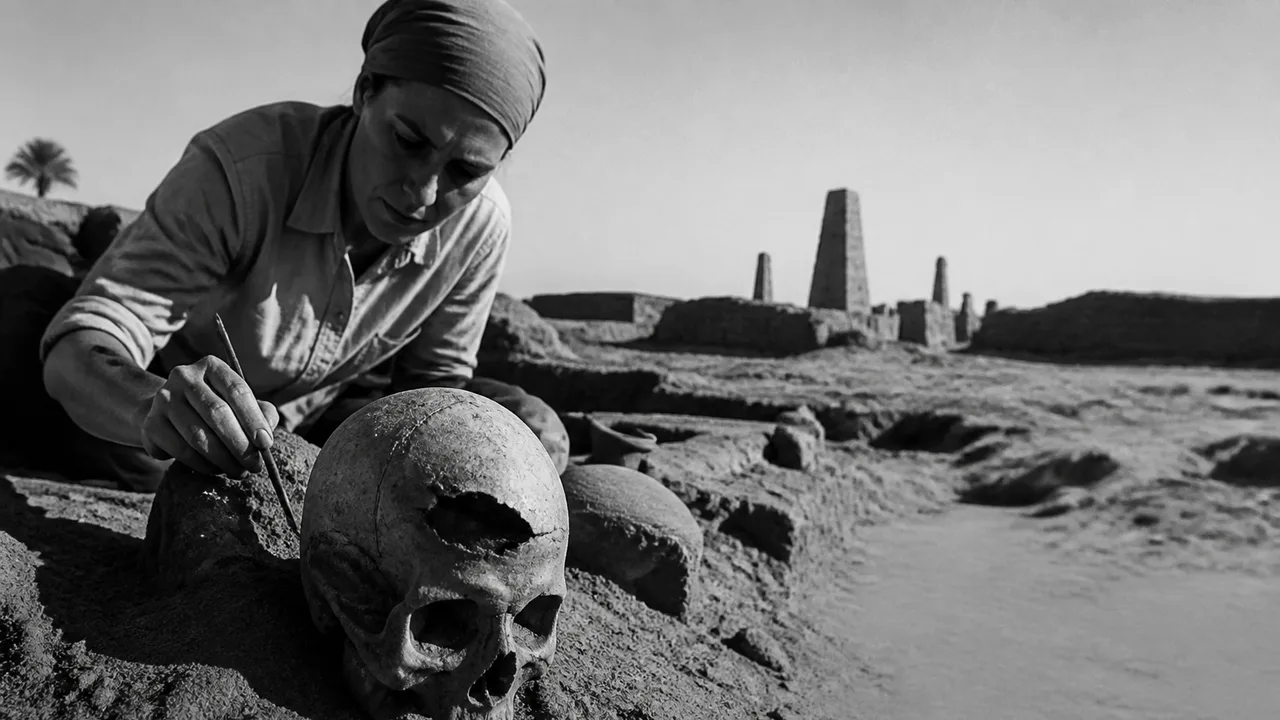
Roselyn Campbell found signs of potentially fatal injury in 18 of 46 preserved skulls excavated from burials around Egypt’s First Dynasty royal tombs at Abydos. The fractures reopen a question that has followed those graves since the 1920s: Did people close to the first kings die so they could accompany a ruler into the afterlife?
Campbell’s re-examination identified mainly linear fractures consistent with blows to the head. She interprets the injuries as occurring around the time of death; such blows would likely have caused rapid unconsciousness, internal bleeding and death. The figure describes the skulls she examined, not the hundreds of people buried around the royal complexes. It gives the longstanding idea of retainer sacrifice a bodily trace to set beside the arrangement of the graves.
That combination is more revealing than either clue alone. A fractured skull cannot tell us why a person was struck. A row of graves cannot tell us how its occupants died. At Abydos, the two lines of inquiry now meet.
Why the Graves Troubled Petrie
Around 3000 BCE, Egypt’s first kings built funerary complexes at Abydos, including royal tombs and enclosures probably used in funerary rituals. Rows of smaller chambers surrounded them. Some chambers held simple coffins; many contained modest objects, among them ceramic vessels and small copper or ivory items. A few grave markers recorded names and titles that appear to identify artisans and lower- or mid-level officials. The people around the kings had work, names and places in a social hierarchy, even if surviving markers identify only a few of them.
When British excavator Flinders Petrie investigated Abydos in the 1920s, some royal tombs had hundreds of subsidiary graves nearby. He thought the number of burials and the apparent closure of many graves together made a succession of ordinary deaths unlikely. He proposed retainer sacrifice: people killed after a ruler’s death, potentially to serve that ruler in an afterlife. Yet he identified no fatal wounds on the remains. The graves suggested a ceremony; the bodies, as he understood them, did not explain how it happened.
The apparent clustering also shaped the argument. In Campbell’s account of Petrie’s reasoning, the closure of many tombs at once, coupled with the officials’ apparent ties to the royal court, made individual burials after natural deaths seem improbable to him. That was an inference about timing and social position. Campbell’s work adds a different observation: evidence of injury on people buried in that setting.
The skulls had travelled a route familiar from the history of colonial archaeology. Petrie took them from Egypt; they were subsequently kept at Cambridge University, while most of the other remains he excavated were reburied. Campbell could revisit the preserved crania and Petrie’s notes, but reuniting a skull with the rest of its skeleton would be extremely difficult. What an excavator chose to keep a century ago still determines which questions can be asked of these individuals today.
The Injury Behind the Interpretation
Campbell’s findings concern the shape and timing of damage to bone. The common injuries were linear fractures across the skullcap. Some of the injured skulls also showed sharp-force damage, including an injury to an eye. Petrie appears to have taken the cracks for damage that occurred after death. Modern forensic approaches distinguish how bone responds when fresh from how it breaks when dry, allowing Campbell to interpret the fractures as injuries sustained around death.
There is a useful comparison between the two readings of the same remains. Petrie saw a burial pattern that called for an explanation and found no recognizable fatal trauma. Campbell sees evidence of potentially fatal trauma within that burial pattern. The change concerns what investigators can recognize in the bones. It does not require treating Petrie’s first suspicion as proof, or dismissing the grave arrangement because his account of the bones was incomplete.
The shape of the fractures also checks a tempting visual shortcut. Egyptian rulers are often depicted striking enemies with a mace. A mace would be expected to leave depressed fractures, rather than the linear ones she found. A flat, broad object could produce linear fractures; so could a fall. The familiar royal image does not identify the instrument that injured these people.
A fall severe enough to fracture a skull might also have damaged other bones, Campbell argues, and Petrie’s photographs and notes do not record such associated injuries. That makes deliberate blows a stronger interpretation of at least some of the trauma. The graves then supply a possible setting for those blows: deaths connected to a royal funeral. Neither a fracture pattern nor a grave’s location reveals whether an individual consented, was compelled, or died for some other reason. Campbell has raised the possibility that people drawn into such a rite could have had different experiences of it.
The Frontiers research summary also notes that people without visible skull injuries might have died naturally or by means that left no mark on the bone. That question belongs to the wider burial group; it cannot be settled by assigning the injury pattern of the examined skulls to everyone in the cemetery.
Whose Afterlife?
The phrase retainer sacrifice makes the dead sound like accessories to a royal tomb. The grave markers resist that compression. An artisan or official might have had duties in life, a household and a view of the king quite unlike the king’s view of them. Campbell has asked who these people were and how they understood their relationship to the ruler. Their titles give a partial answer to the first question and none to the second.
Two plausible functions should be considered if these deaths were part of a royal rite. Killing attendants might have been understood as furnishing service in an afterlife. It might also have displayed the power of a new monarchy over the living. Those purposes could coexist; the skulls cannot adjudicate between them. Campbell has suggested that the scale of such burials in the First Dynasty was costly and that the practice appears to have faded quickly. The physical injuries sharpen a question about royal power without making any one explanation of royal belief compulsory.
Colonial excavation history makes the people in the subsidiary graves easy to lose twice: first beside the kings, then inside a collection organized around what an excavator thought worth preserving. Campbell’s analysis shifts attention back to their bodies. Petrie saw a pattern around a throne. The fractures show what at least some people in that pattern endured.
More Like This
Pliny the Younger's Letters on the Eruption of Vesuvius
Pliny the Younger's two letters to Tacitus remain the only eyewitness account of Vesuvius's eruption in 79 AD — and they still read like dispatches from the end of the world.

How the Square Root of 2 Shook Ancient Greek Mathematics
The Pythagoreans believed whole numbers governed all of reality. One diagonal line—and one brave mathematician—proved them catastrophically wrong.