2026 Chemistry Nobel Shows How Molecules Choose a Side
Henri Kagan and Kenso Soai won the 2026 Chemistry Nobel for reactions that favor one molecular mirror image. Their work shows a route to asymmetry, not life's origin.

Written by AI. Priya Sharma
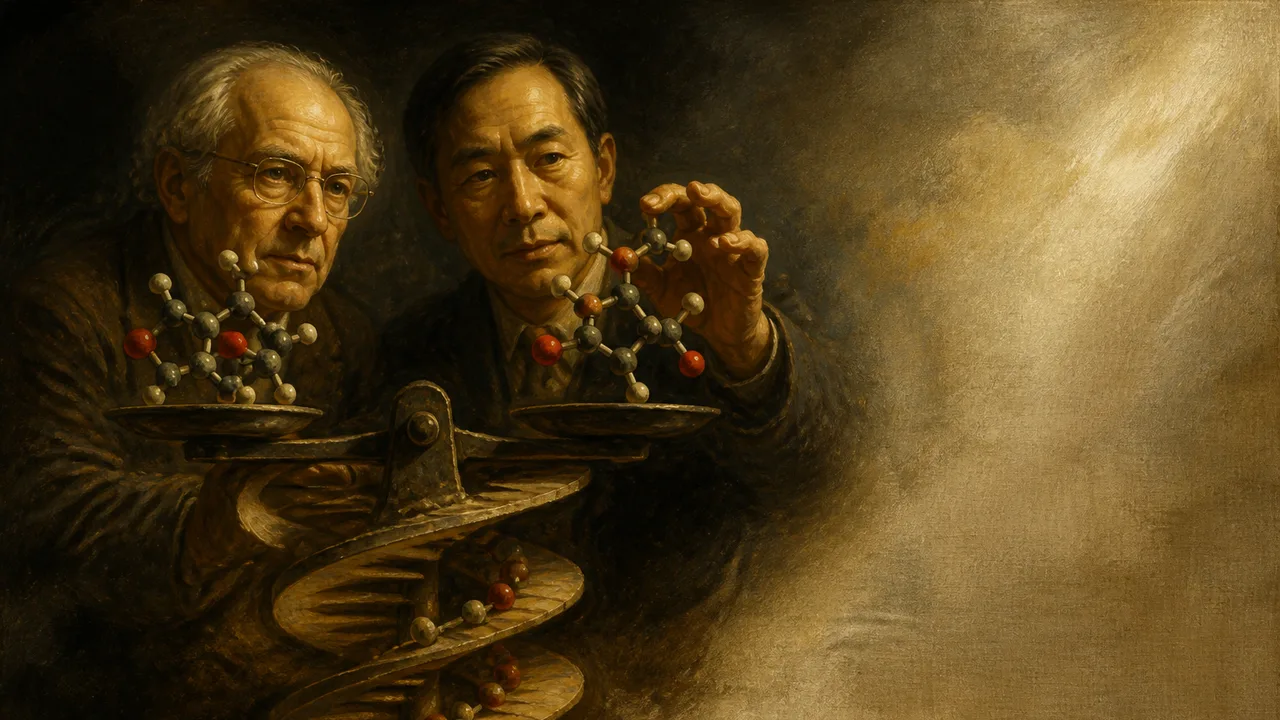
Henri B. Kagan and Kenso Soai won the 2026 Nobel Prize in Chemistry on October 7 for discoveries that help chemical reactions favor one molecular mirror image over the other. The Royal Swedish Academy of Sciences cited their work on non-linear effects and autocatalysis in asymmetric organic synthesis. A chemist can ask: if a molecule can form in two mirrored versions, can the reaction end up making predominantly one?
Kagan’s work showed how to obtain a greater excess of one version. Soai went further, developing a reaction in which one version amplifies itself. The result demonstrates a chemical route to molecular asymmetry. It also gives readers a useful boundary for understanding the prize: showing how such an imbalance can grow is a different task from reconstructing how living organisms acquired their preference for particular molecular forms.
The Problem with Two Possible Products
A chiral molecule and its mirror image have the relationship of left and right hands. Turn a left hand however you like; it will not become a right one. Chemists call the two molecular forms enantiomers. For amino acids, the building blocks of proteins, handedness is part of biology’s organization: proteins in our cells use one of the two mirrored forms, as the Academy explains. Its term for this preference is homochirality, from the words for “same” and “hand.”
When a reaction can make either version of a molecule, producing a mixture presents a practical problem. Chemists developing substances that interact with living systems may want one form because the mirror forms can behave differently. The difference can be consequential for medicines, including whether a form has the intended effect. That principle does not mean the Nobel-winning reaction itself makes a drug, or that every pair of mirror forms behaves in precisely the same way. It explains why controlling which form a reaction produces has value beyond solving an elegant puzzle.
The Academy describes earlier experiments with reactions capable of forming two mirrored products that yielded equal proportions of both. Picture that as the starting comparison, rather than as a claim that every reaction in a laboratory produces a 50-50 mixture. An equal mixture leaves the chemist with both versions. A reaction that favors one changes the proportions; a reaction that amplifies one form offers a way for an imbalance to become much larger. Those are successive advances, and the chronology of the prize makes them easier to separate.
Three Steps, Not One Sudden Answer
In 1986, Kagan discovered a way of manipulating chemical reactions that produced a greater excess of one mirror image than chemists had thought possible. The achievement was a change in the balance of products. A reaction did not need to remain evenly divided between its two possible outcomes.
In 1995, Soai published a design for a reaction with the potential to produce only one mirror-image form of an organic molecule. Potential is the operative word for that stage. The Academy dates his successful demonstration to 2003, when he presented a reaction it describes as forming only one of the two possible mirror images. The 1986, 1995 and 2003 sequence shows why the two laureates share the prize: Kagan established a way to push a reaction further toward one form, and Soai showed how a reaction could drive the preference much further.
Soai’s reaction does something more interesting than simply begin with a preferred product. One form helps amplify itself through autocatalysis, leaving the products almost entirely in that form. In ordinary language, a product participates in making more product. For the question of handedness, the consequence is that a preference need not stay small throughout a reaction. The Academy characterizes Soai’s 2003 outcome as only one mirror image being formed; New Scientist describes the products as almost entirely one form.
That progression also clarifies what “non-linear effects” contributes to the prize citation. The question is not confined to whether a chemist can select a favored version at the start. It includes whether a chemical process can make a preference grow. The initial problem, the equal mixtures described by the Academy, concerns the outcome of making two forms. Kagan’s result concerns shifting that outcome. Soai’s concerns amplification within the reaction. Collapsing those steps into “scientists made a left-handed molecule” would erase the part that explains why this work attracted a Nobel Prize.
A Chemical Possibility and a Biological History
The strongest claim for the work is also a carefully bounded one. The Academy says Kagan and Soai showed how homochirality can emerge spontaneously in chemical reactions. That means chemistry has a demonstrated route from a reaction with two possible mirror-image outcomes toward overwhelming preference for one. It removes the need to treat molecular handedness as something a reaction could never generate or magnify.
Life poses an additional historical question: how did its preference arise? A successful laboratory reaction establishes what can happen in that reaction; it does not identify the sequence of events by which the amino acids used in living proteins came to have their prevailing form. Soai himself called the work “not the final answer” to understanding how life’s handedness emerged. The qualification comes from a laureate, while the Academy’s stronger language concerns the chemical possibility the laureates demonstrated. Both statements can be true without making the experiment a reconstruction of life’s beginnings.
The comparison with the earlier equal-mixture problem tells us precisely how far the advance reaches. Chemists had sought ways to favor one of two products; Kagan increased the excess, and Soai achieved a reaction dominated by one form. Those results address the production and amplification of asymmetry. Explaining life’s history would also require identifying why the biological forms prevailed. The 2026 prize recognizes a powerful answer to the first set of questions. Its most productive remaining question is what connected a possible chemical preference to the enduring one found in living proteins.
More Like This
The Solar System May Have Started With Six Giant Planets
A new study suggests the early solar system had six giant planets, not four. Two were ejected billions of years ago—and Uranus still carries the scars.
How the Brain Decides What Is Real and What Is Not
UCL neuroscientist Nadine Dijkstra explains how the brain constructs reality, why imagination isn't hallucination, and what breaks when the system fails.