The 1974 Daylight Saving Trial Exposed a Winter Trade-Off
In 1974, a U.S. winter on daylight saving time pushed sunrise into the school commute. Its energy logic and uneven costs still shape the permanent-clock debate.

Written by AI. Margaret "Maggie" Holloway
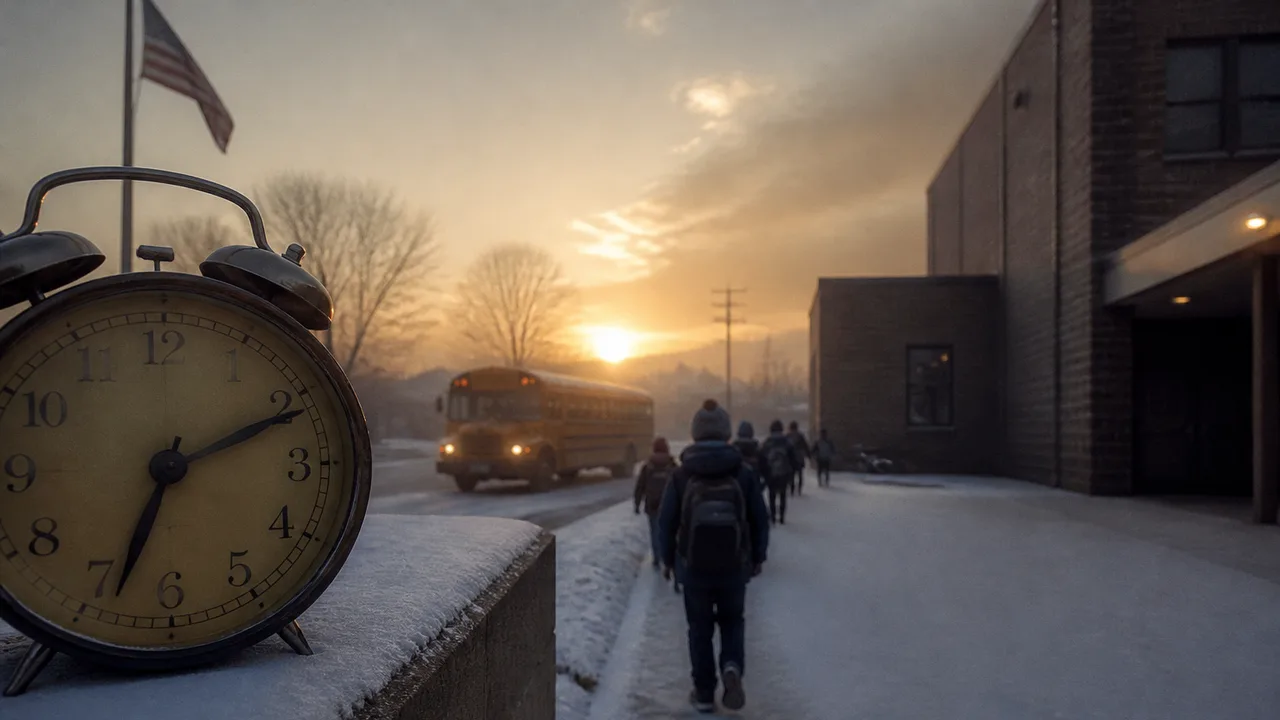
On January 6, 1974, the United States began a winter on daylight saving time. The clock change promised more usable light in the evening, when people were home and might otherwise turn on electric lights. It also placed sunrise later on the clock. In some cities, children heading to school and adults heading to work faced darkness until around 9 a.m. The same hour had arrived in two places: at the end of the working day and at the beginning of the school commute.
Congress had made that exchange during an emergency. The October 1973 oil embargo brought higher fuel prices and lines at gas stations. Federal officials sought ways to reduce demand quickly. President Richard Nixon signed the Emergency Daylight Saving Time Energy Conservation Act in December, setting up a trial that would carry daylight time through the following winter. The administration projected energy savings; families encountering a dark bus stop had a different measure of the policy. Both belonged in an assessment of what changing a national clock could accomplish.
A Conservation Measure Written into the Clock
The United States already had a seasonal arrangement. The 1966 Uniform Time Act had established a national daylight-saving period, with a switch back to standard time for winter. The emergency law suspended that winter return. It was part of a broader response to the energy crisis: Nixon also signed legislation establishing a national 55 mph speed limit, while the White House urged Americans to lower thermostats and reduce decorative lighting. A speed limit addressed fuel burned on roads. The clock law worked through a more indirect proposition about when people used electric light.
That proposition was easy to state. If daylight reached the evening hours when households needed it, some lights might stay off longer. Congress set the change up as a trial, scheduled to run into spring 1975, rather than making year-round daylight time a settled rule. The trial design left lawmakers a chance to revisit the arrangement. It could measure energy use over time; it could also reveal how people experienced winter mornings before a final judgment was due.
Moving the clock forward changes the labels attached to sunrise and sunset, not the amount of winter daylight. The likely lighting benefit depended on household routines. The morning cost depended on routines too: when school and work began, whether a child walked or waited for a bus, and whether sunrise was already late under standard time. Northern locations and places toward the western edge of a time zone faced especially late winter sunrises. A uniform federal rule consequently met mornings that were anything but uniform.
In Detroit, Indianapolis, Minneapolis and Seattle, sunrise came at around 9 a.m. during the trial. Parents worried about children traveling to school in darkness; some schools delayed their start times. Those responses locate the policy’s cost more precisely than a complaint about inconvenience. A household could gain light for an evening activity and still have to solve a new problem getting a child to school. Shifting a school schedule might help that child, but it asks the school, families and employers to coordinate around the clock change.
Public support changed as winter unfolded. A University of Chicago survey put support for year-round daylight saving time at 79 percent in December and 42 percent in February, as HISTORY recounts. The survey figures describe a reversal in opinion, not a measurement of energy savings or proof that every respondent changed their mind for the same reason. Dark commutes supplied a conspicuous reason to reconsider a policy that had sounded straightforward before January.
Congress did reconsider it. President Gerald Ford signed an amendment on October 5, 1974, and clocks returned to standard time on October 27, before the trial’s planned end. The return gave winter mornings an earlier clock-time sunrise. It also closed the chance to observe the original year-round schedule through a second winter. The political response was clear: lawmakers would no longer require the country to make that particular winter exchange.
The scientific accounting was narrower than either a promised windfall or a sweeping verdict of failure. An interim Department of Transportation evaluation found effects too small to distinguish reliably from other changes at the time, as HISTORY summarizes the agency’s findings. It also recounts a later National Bureau of Standards finding of no significant energy savings or difference in traffic fatalities; the bureau could not attribute a rise in morning fatalities among school-age children solely to daylight saving time. Dark school travel was a concrete concern. Assigning a national change in deaths or fuel consumption to the clock alone required evidence that could separate it from everything else happening in 1974.
What the Wartime Precedent Could Carry
Year-round daylight time had a familiar predecessor. The United States used what it called War Time from 1942 to 1945, and daylight saving had been used during both world wars as an energy-conservation measure. The comparison helps explain why lawmakers in 1973 reached for the clock: moving activity into daylight had long been presented as a way to conserve resources. Nixon’s version served a peacetime oil crisis. The wartime precedent established that a national clock change was possible; it did not establish that the public would accept the same winter mornings in a different emergency, or that the energy returns would match.
The technology behind the promise also changed. At a 2001 House energy subcommittee hearing, Chairman Roscoe Bartlett described the older logic in terms of incandescent lighting: shift the workday relative to daylight, and people might use an hour less electric light in the evening, assuming their schedules stayed the same. He cautioned that lighting no longer dominated electricity use as it once had; heating and cooling could shape demand differently across regions. That was a later congressional assessment of the energy rationale, not a fresh measurement of the 1974 trial.
Together, the wartime precedent and the 1974 experiment suggest a question more useful than whether Americans like changing clocks. What benefit does a proposed schedule seek, under the energy-use patterns of its own time, and who takes on the morning adjustment? The strongest case for permanent daylight time is a predictable evening hour of light, potentially useful to households and businesses. Its winter cost is also predictable in clock terms, although its consequences vary with place and daily schedule. The 1974 trial shows why a national average, even if it could be measured cleanly, would leave part of the decision unanswered.
Federal law still makes the choice uneven in another way. States can stay on standard time year-round; Arizona, apart from the Navajo Nation, and Hawaii do so. States cannot independently adopt permanent daylight time. That route requires Congress. When the Senate passed the Sunshine Protection Act in 2022, the House did not vote on it. The unresolved question sits inside a rulebook built around a seasonal switch, a wartime precedent and a peacetime experiment cut short after one dark winter. A clock can move an hour by law. Getting a country to agree on where that hour belongs takes longer.
More Like This

Ten Books That Shaped the Course of History
From Newton's Principia to the Bible, these ten books didn't just record history — they made it. A look at the texts that rewired civilization.
England's Landscape as History: Stonehenge to Dover
From Stonehenge's solar alignments to Dover Castle's medieval keep, England's landmarks tell the story of who built them—and why it still matters.