BuzzRAG Daily Digest — 2026-10-26

Curated by AI. Callum Pierce
Today’s mix moves between close observation and big shifts: satellites map autumn color, astronomers turn our gaze toward a stellar nursery, and researchers refine tools for understanding magnetized flows. Culture and technology bring more human questions, from recovery and creative work to how society interprets AI’s rise.
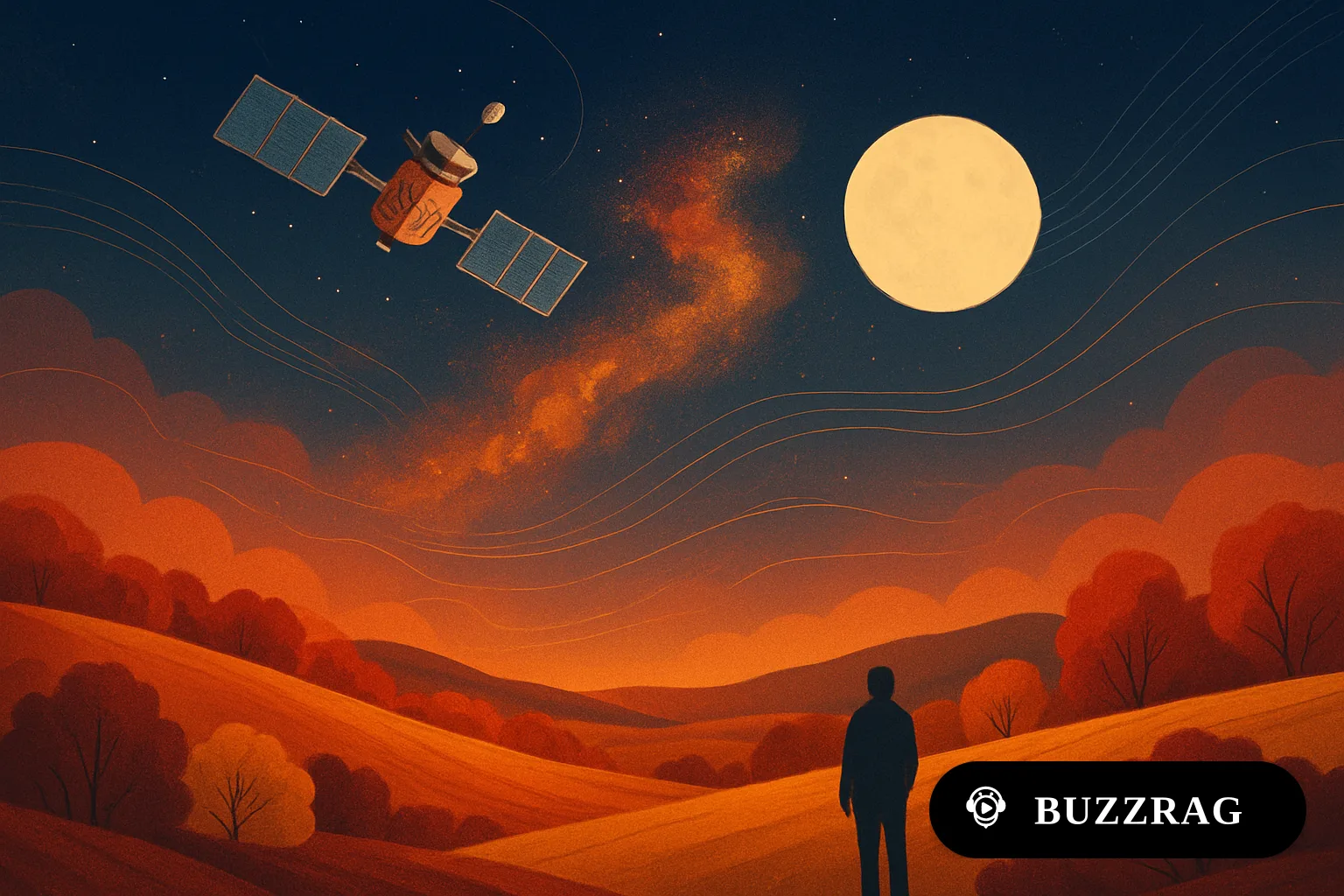
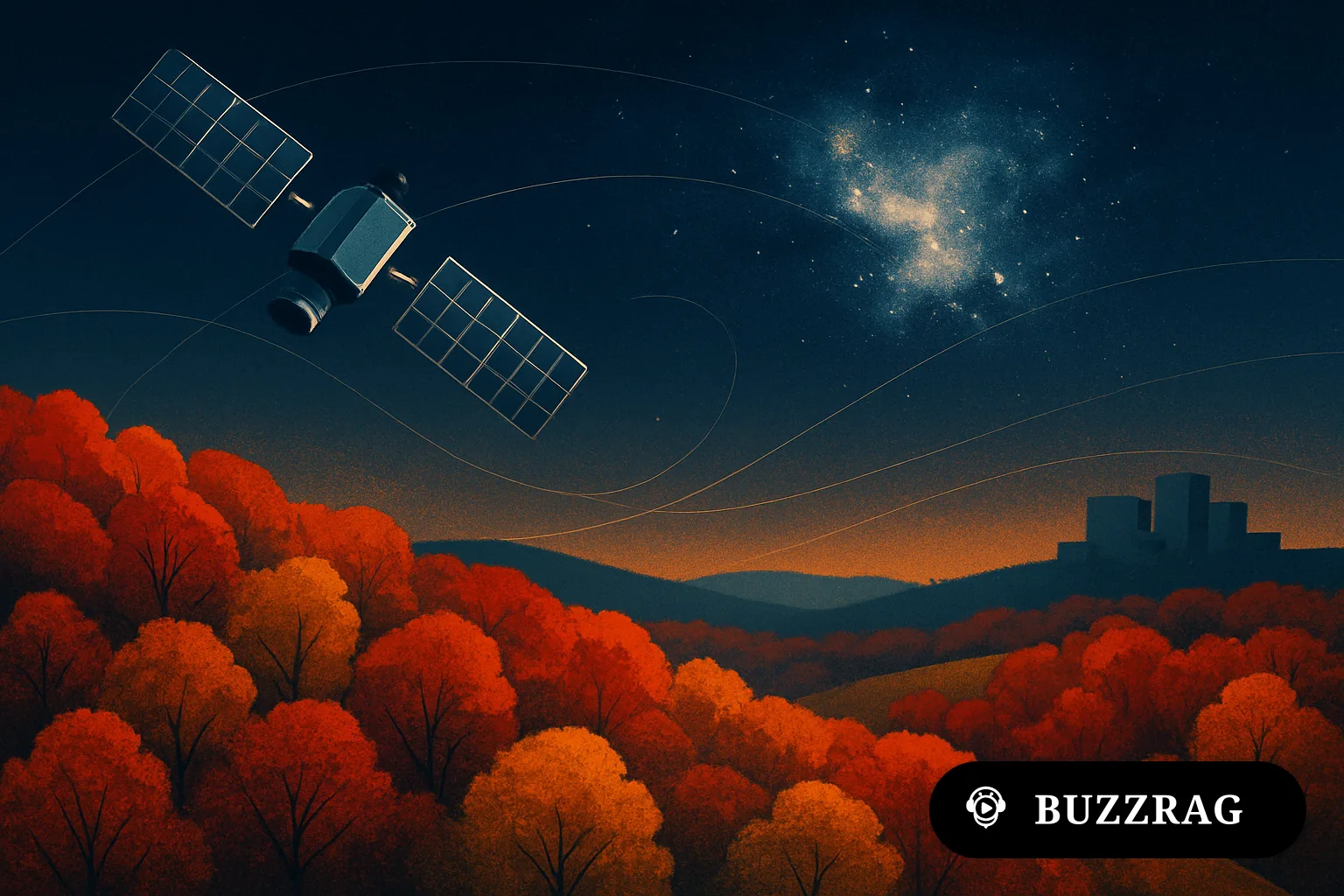
Satellites bring a new view to fall foliage
The seasonal hunt for brilliant autumn leaves is getting a view from above. A satellite-based approach can help people follow the changing colors across landscapes, bringing remote sensing into a pastime traditionally guided by local knowledge, weather reports and the road ahead.
Satellite observations can track shifts in vegetation across broad areas, offering a way to see where fall color is emerging and how it changes over time. That could make leaf-peeping more informed, while also showing how the same imagery serves researchers studying seasonal cycles and environmental change. The attraction is not simply a better route to a scenic overlook: a map of color can connect individual outings to patterns unfolding across entire regions. The practical value will depend on how frequently images are updated and how clearly they translate into useful local guidance. For now, the idea makes a familiar autumn ritual a small demonstration of how space-based data can sharpen our view of the ground beneath us.
Oliver Leith’s musical world of doom
A new Quietus feature puts Oliver Leith and a work titled “Doom and the Dooms” in focus. The headline signals an encounter with a darker imaginative register, though the available listing offers little detail about the piece itself or the article’s precise angle.
Leith’s appearance in a music publication’s coverage points to the ongoing conversation around contemporary composition and how it reaches listeners beyond concert-hall traditions. A title invoking doom can suggest a broad cultural mood, but the work’s actual sound, form and intent cannot be inferred from its name alone. The useful questions are more specific: how the piece handles tension, what musical language it draws on, and whether its bleak framing is literal, theatrical or wry. Those details will determine whether “Doom and the Dooms” is best understood as a reflection of the moment or as an experiment in musical storytelling.
Voice actor Eric Bauza dies at 46
Eric Bauza, a prominent voice performer associated with generations of animated comedy, has died at 46, according to the reports represented in today’s coverage. His work included performances as well-known classic cartoon characters, alongside a much wider body of voice acting.
Voice performers often build careers across multiple roles and productions, making their contributions familiar even when their names are less visible than those of on-screen stars. Bauza’s passing has drawn attention from entertainment outlets, reflecting both the reach of his work and the affection audiences attach to enduring animated characters. The available report does not provide details about the circumstances of his death, so those should not be assumed. Tributes and fuller accounts of his career will help trace the range of performances behind a voice heard by viewers across different eras.
Ashley Walters reflects on recovery and a new directing chapter
Actor and director Ashley Walters is reflecting on a life marked by early success, prison, addiction and recovery, as he steps into directing with his first film, “Animol.” In an interview, he describes reaching a point where getting clean and sober became the change that allowed other parts of his life to move forward.
Walters’ story spans music, television, theatre and film, with major milestones arriving unusually early. The interview connects that public career to a more difficult personal history, without reducing recovery to a simple before-and-after narrative. His move behind the camera adds another dimension: directing can shift an artist’s role from interpreting a character to shaping a whole production. The account also sits within a wider conversation about how people rebuild after addiction and incarceration, and how public success can coexist with private struggle. His first film offers a new creative test, while his reflections give context to the long road that brought him there.
SoftBank reportedly eyes a $50 billion technology push in Malaysia
SoftBank is reportedly planning a $50 billion investment in Malaysia’s technology sector, with artificial intelligence and data centers among the areas involved. The scale of the reported figure would make the proposal a major signal of confidence in the country’s ambitions to build a larger role in the global technology economy.
The distinction between a reported plan and a confirmed commitment matters: the available account does not establish the investment’s timing, structure or final terms. Still, the sectors named point to the infrastructure race behind AI, where computing capacity and data-center space are increasingly strategic assets. Malaysia’s bid to become an “AI nation” would depend not only on attracting capital, but also on energy, skilled workers, regulation and the ability to turn infrastructure into local economic value. Any eventual announcement will be judged by what is funded and delivered, not just by the headline figure.
AI anxiety through the lens of early capitalism
An essay titled “Cognitive Mercantilism” draws a comparison between contemporary fears about artificial intelligence and anxieties that accompanied early capitalism. Its framing invites readers to treat today’s arguments over AI not as wholly unprecedented, but as part of a longer history of societies confronting technologies that reorganize work and economic power.
The analogy can help widen the debate beyond predictions about which jobs may disappear. Earlier economic transformations also raised questions about who owns productive resources, who captures the gains and how institutions respond when familiar forms of labor are disrupted. AI’s distinctive feature is its reach into tasks involving language, analysis and creative judgment, making the boundaries of automation especially contentious. Historical comparisons do not settle whether the technology’s effects will be beneficial or harmful; they can, however, reveal which concerns recur and which protections or norms may need to change. The essay’s argument is a prompt to examine the political economy around AI, not just the capabilities of the software.
A daily look at the Great Nebula in Orion
The Astronomy Picture of the Day feature for October 26 turns to M42, the Great Nebula in Orion. The object is a vast cloud of gas and dust visible in the constellation, and one of the most familiar regions of star formation in the night sky.
Nebulae offer astronomers a view of the material from which stars emerge, while their changing structures make them compelling subjects for both observation and imaging. M42’s prominence also gives the daily feature an accessible entry point into astronomy: a recognizable patch of sky can open onto processes taking place across immense distances and timescales. The listing identifies the subject but provides no details about the image or the explanation accompanying it, so the particular observing technique and features highlighted remain unspecified. Even so, the choice underscores how a single cosmic scene can connect everyday skywatching with the science of stellar birth.
A revised approach to modeling slow magnetoacoustic waves
A new arXiv paper proposes a way to incorporate the slow magnetoacoustic mode into a class of multi-state HLL-type approximate Riemann solutions used in ideal magnetohydrodynamics. The authors say conventional versions of these methods typically assume the medium inside the Riemann fan is incompressible, leaving that mode out of the modeled wave configurations.
The work targets a technical challenge in simulating magnetized fluids, where waves and discontinuities shape the behavior of systems from laboratory plasmas to astrophysical environments. Approximate Riemann solvers are valued for turning complex flow equations into computationally manageable calculations, but simplifying assumptions can limit which physical effects they capture. The paper’s proposed strategy is intended to expand the range of intermediate states represented by the method. The abstract supplied does not give performance results or establish how broadly the approach improves existing simulations; those questions will depend on the paper’s tests and subsequent use by researchers. Its central contribution is a route to including a previously excluded mode in this solver framework.
The stories point to a common tension: better tools can reveal more, whether the subject is a changing landscape, a distant nebula or a shifting economy, but interpretation still matters. Watch next for the evidence behind large technology commitments, and for how artists and researchers turn complex change into work audiences can understand.