BuzzRAG Science Desk — 2026-10-26

Curated by AI. Anika Bose, Science Desk Editor
Today’s science mix moves between seasonal changes visible from orbit and the difficult work of modeling distant cosmic phenomena. Alongside the skywatching calendar, a health-care trend points to a shift in how clinicians and patients manage low-risk prostate cancer—though the available summary leaves important details about the underlying analysis unspecified.
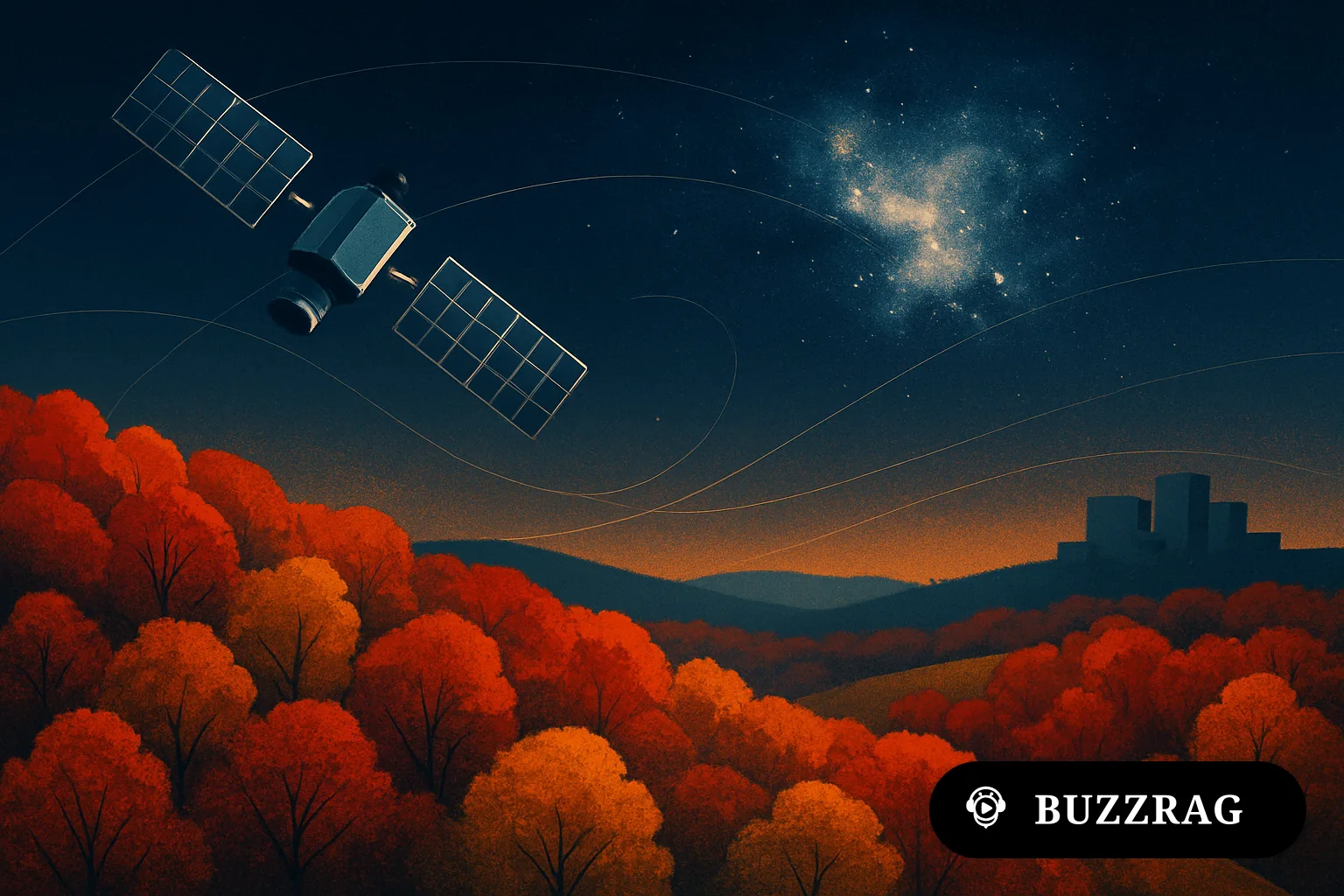
Satellites offer a wider view of autumn color
Satellite observations are adding a large-scale tool to the familiar autumn pursuit of changing leaves. Rather than relying only on roadside reports or local forecasts, people can use remotely sensed views to follow where fall color is emerging across a broader landscape. The brief report does not identify the specific satellite, measurement method, or geographic coverage, so the practical reach of the approach is difficult to assess from the information available.
The scientific value of tracking seasonal color goes beyond planning a scenic outing. Repeated observations of vegetation can help researchers study when plants change through the year and how those seasonal patterns vary across places. But satellite signals are not a direct census of individual trees: clouds, mixed land cover, and differences among species can complicate interpretation, and color timing alone does not explain its cause. The approach is best understood as a way to spot broad patterns, which can then be checked against ground observations. Its usefulness for leaf-peeping will depend on how current and locally detailed the maps are.
Orion’s Great Nebula returns to the daily skywatch
The October 26 astronomy picture features M42, the Great Nebula in Orion, a bright cloud of gas and dust in one of the best-known regions of the night sky. The daily feature is an astronomical image accompanied by an explanation, rather than a report of a new observation or discovery. Its appeal lies in making a familiar celestial object visible in detail and inviting viewers to look beyond the constellation’s outline.
M42 is a stellar nursery: radiation and stellar winds from young stars shape the surrounding material, while dense pockets of gas and dust are associated with ongoing star formation. Images can reveal structure that the naked eye cannot resolve, but they are also representations shaped by the telescope, wavelength, and image processing used. The supplied listing does not include the image’s instruments or technical details, so it would be premature to infer those from the title alone. For observers, Orion’s nebula is a rewarding target in dark skies; for researchers, it remains a nearby setting in which to investigate how stars form.
A revised solver aims to capture a missing plasma wave mode
A new arXiv preprint proposes a change to multi-state HLL-type approximate Riemann solutions used for ideal magnetohydrodynamics, the mathematical framework for describing conducting fluids interacting with magnetic fields. The authors say these methods commonly treat the material inside the Riemann fan—the region representing how a disturbance evolves across a boundary—as incompressible. That assumption leaves out the slow magnetoacoustic mode from the modeled intermediate states.
The proposed strategy is intended to make room for that mode in the solver’s space-time wave configuration. This is a numerical-method development, not evidence of a newly observed plasma phenomenon, and the supplied abstract does not give enough detail to judge its accuracy, computational cost, or performance against existing approaches. Those comparisons matter: a more complete wave description could improve simulations, but added complexity is useful only if it produces reliable gains for relevant problems. The work is a preprint, so independent scrutiny and benchmark results will be important in assessing whether the method is broadly useful.
Iapetus’s discovery began a long puzzle about Saturn’s moon
On October 25, 1671, astronomer Giovanni Cassini identified Iapetus, one of Saturn’s moons. The anniversary recalls an observation made long before spacecraft, digital detectors, or the modern understanding of the Saturn system. Iapetus later became especially notable for its striking contrast between brighter and darker terrain, a pattern that helped earn it the informal “yin-yang” description.
The discovery is a historical milestone, while the moon’s unusual appearance is a separate scientific puzzle. The hemispheric brightness contrast is now understood in the context of surface processes and the moon’s motion around Saturn; the discovery itself did not explain those features. The short source description offers no new findings, so this is best read as a prompt to revisit how observation and later investigation build on one another. Iapetus also reminds us that early telescopic sightings could establish the existence of distant worlds, while explaining their surfaces required much later measurements and missions.
A large simulation seeks to connect early-universe models with observations
Researchers at the Center for Astrophysics | Harvard & Smithsonian have developed Lumina, described as one of the largest and most detailed simulations of the early universe. The project is intended to help astronomers interpret observations of the universe’s earliest chapters, including those being examined with current and planned space telescopes. A simulation can provide a theoretical universe to compare with real data, helping researchers test which physical processes could produce the patterns they observe.
Scale alone does not establish that a simulation is more accurate. Its value depends on the assumptions and physical processes included, the resolution achieved, and whether its predictions can be checked against observations. The short report provides no technical specifications or validation results, so claims about its reach should remain provisional. As observations improve, especially of very distant galaxies, models such as Lumina may help distinguish between competing explanations for how cosmic structure emerged. The crucial next step is not simply generating a vast virtual universe, but showing where its predictions agree with data—and where they do not.
October’s full Moon rose under its traditional name
October’s full Moon, commonly called the Hunter’s Moon, rose on October 25, according to the supplied skywatching guide. The name belongs to a tradition of seasonal Moon names rather than a special astronomical category, and the Moon’s familiar appearance near the horizon can make it seem especially large or warmly colored. The listing offers viewing guidance but does not report a rare lunar event or an unusual change in the Moon itself.
A full Moon occurs when the Moon’s Earth-facing side is fully illuminated by the Sun; its apparent color near the horizon is largely affected by the longer path its light takes through the atmosphere. The timing and visibility of moonrise vary with location, so a general guide cannot substitute for local conditions. For observers, the most useful checks are the local rise time, cloud cover, and a clear horizon. The event also offers a straightforward chance to connect the seasonal skywatching calendar with the geometry of the Earth-Moon-Sun system.
More men with low-risk prostate cancer are choosing surveillance
An analysis of US data reports two linked trends: fewer men are being diagnosed with low-risk prostate cancer, and a larger share of those diagnosed are choosing surveillance rather than immediate treatment. The findings, published in the journal Cancer, sit within a long-running debate over screening. Some prostate tumors grow so slowly that treatment may cause harms without improving a patient’s lifespan, while other cancers require timely intervention.
The shift is consistent with efforts to reduce overdiagnosis and overtreatment, but the summary does not provide the study period, sample size, data source, or exact definitions used. Those details are essential for judging how widespread the change is and whether it reflects screening practices, clinical guidance, patient preferences, or other factors. Active surveillance generally involves monitoring rather than ignoring a diagnosis, with treatment considered if signs of progression emerge. The balance depends on individual risk and reliable follow-up; changes in diagnosis rates alone cannot show whether care is improving. Further detail on outcomes will help establish whether fewer interventions are safely avoiding treatment harms.
The next useful signals will be validation: whether satellite color maps align with on-the-ground observations, whether new simulation and plasma tools outperform established methods, and whether prostate-cancer surveillance maintains good outcomes. In the meantime, the night sky offers familiar targets whose scientific stories are still being refined by better measurements.