BuzzRAG Daily Digest — 2026-10-04

Curated by AI. Callum Pierce
Today’s stories range from practical questions about setting limits on software to scientific work probing the deep structures of the universe and the human genome. Student robotics, a striking atmospheric image and a high-profile football friendly add a more immediate, earthbound note.
The case for hard limits on software spending
A new essay argues that hard budget caps should be the default for a broad range of digital services. The proposal responds to a familiar risk in software: usage can grow unexpectedly, and a bill tied to that usage may rise before anyone notices. The article drew attention in technology circles, though the supplied listing does not detail which services or spending models its author examines.
The underlying idea is to make limits explicit rather than rely on users to monitor costs after the fact. For developers and organizations building on metered infrastructure, safeguards could help prevent runaway charges, whether caused by an error, a surge in demand or an automated process behaving unexpectedly. Strict caps also have trade-offs: a system that stops abruptly at its limit can interrupt useful work. The practical challenge is designing controls that are easy to set, visible to users and flexible enough to distinguish an emergency from normal growth.
A study revisits the solar system’s long-term stability
A report on new research has drawn attention with a stark claim: the solar system is not perfectly stable over the longest timescales. The headline’s language of eventual destruction can sound immediate, but the subject is the mathematical evolution of planetary orbits across immense spans of time—not a forecast of danger in the near future. The brief supplied for this item does not include the study’s methods or its estimated timescale.
Planetary systems are governed by interacting gravitational forces, and even small differences in starting conditions can matter when scientists model them far into the future. Researchers use simulations to explore how those interactions might unfold, while recognizing that results at such horizons carry substantial uncertainty. The key distinction is between a system that is stable for all practical human purposes and one whose stability cannot be guaranteed indefinitely. Readers should look to the underlying paper for the assumptions, probability estimates and meaning of “destroyed” before treating the headline as a precise prediction.
University team heads to Florida for robotics contest
Students from Queen’s University are preparing to travel to Florida for a robotics competition, where they will face university teams from Australia, India and the United States. The contest offers an international stage for student engineering, bringing together groups that must turn technical planning and teamwork into a working competitive entry. The available report does not specify the challenge format or the students’ robot design.
Competitions of this kind give students a chance to apply classroom learning under real constraints: machines must perform reliably, teams must coordinate, and designs have to meet the rules of the event. International participation can also expose students to different approaches to engineering and problem-solving. For the Queen’s team, the trip is both a test of its preparation and an opportunity to represent its university abroad. The most telling measure will be how the robot performs when it meets the contest’s demands, rather than how ambitious its design sounds on paper.
Why developers keep reaching beyond built-in tools
A new essay asks why developers do not more often “use the platform”—a phrase commonly used to argue for relying on capabilities already built into a computing environment. In web development, that can mean choosing native browser features instead of adding an external library. The supplied listing offers the question but not the author’s full argument, so the central debate is the tension between convenience and restraint in software design.
Platform features can reduce dependencies, simplify maintenance and make applications less reliant on third-party code. But developers may turn elsewhere when native tools are unfamiliar, inconsistent across environments, difficult to use or missing functionality they need. A library can offer a clearer interface or broader support, even as it adds code and future upkeep. The broader question is not whether dependencies are inherently bad, but when their benefits justify their costs. As platforms evolve, developers must keep reassessing that balance—and teams may need to make native options easier to discover before they can reasonably expect them to be the default.
Unusually vivid bands appear inside New Jersey rainbows
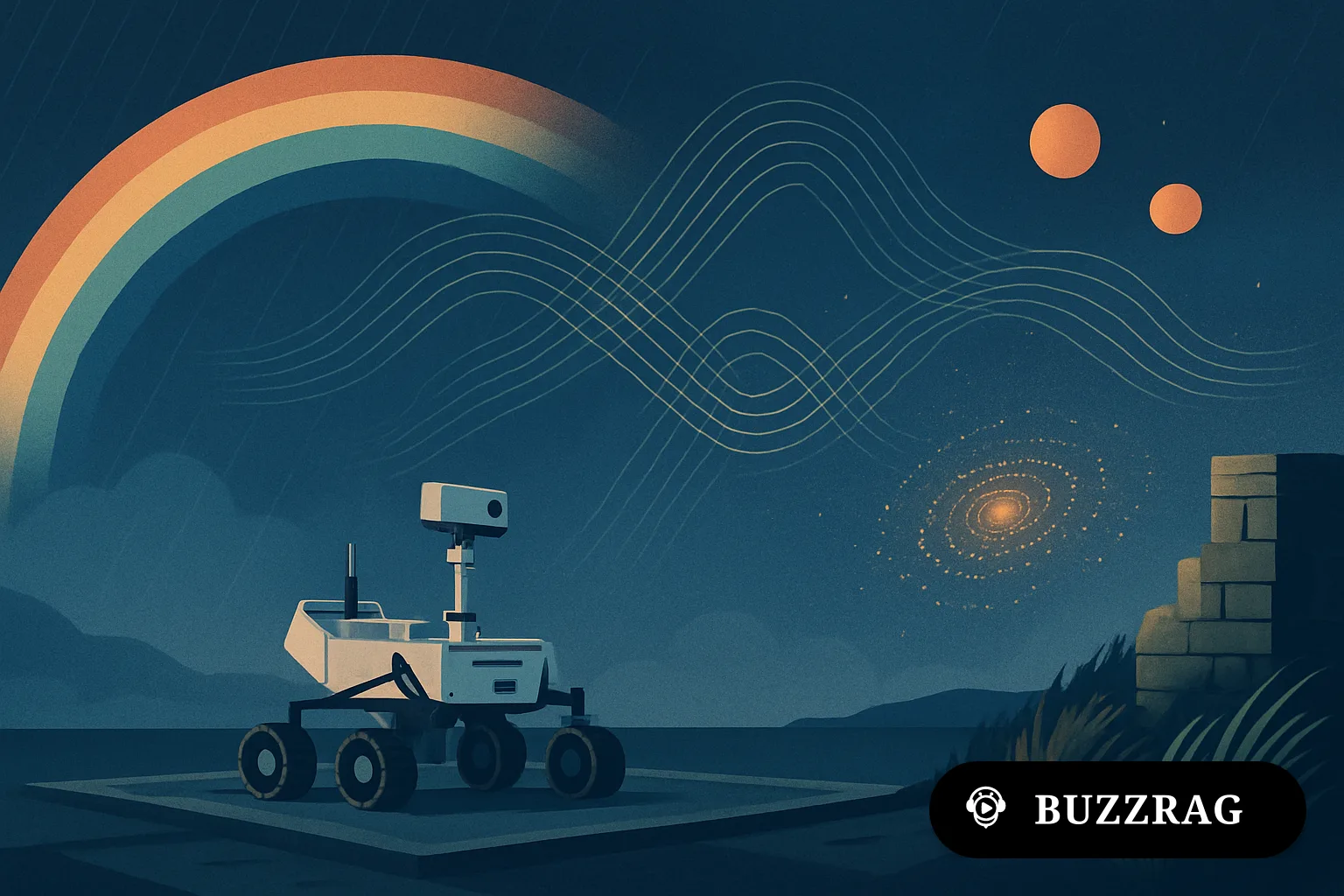
The October 4 astronomy picture features supernumerary rainbows over New Jersey. These faint, closely spaced bands can appear just inside a brighter primary rainbow, creating a delicate set of pastel stripes. Their subtle appearance makes them a reminder that familiar sky phenomena can reveal intricate patterns when conditions are right and an observer takes a closer look.
Supernumerary arcs arise from the wave nature of light: sunlight interacting with similarly sized water droplets can produce interference, adding bands that geometric optics alone does not fully explain. Their visibility depends on factors including droplet size and the viewing conditions, so they are not guaranteed to accompany every rainbow. The daily astronomy feature pairs images with scientific explanations, using a local scene to open a window onto broader physical principles. Here, the New Jersey setting grounds an atmospheric-optics lesson in an everyday sight that can be easy to overlook.
Researchers trace a virus carrying a human gene
Researchers are investigating a virus reported to carry BC200, a gene associated with humans and important to brain function. The account says the virus acquired the gene from human ancestors roughly 100,000 years ago and raises the possibility that it could use the gene in infection. The supplied description does not name the virus or provide details of the experiments, leaving important questions about how the gene was acquired and what role it plays.
BC200 is also described as a “jumping gene,” a kind of genetic element capable of moving and inserting itself into genomes. That combination makes the finding especially intriguing: the research touches both on the movement of genetic material and on a possible link between a human-associated gene and viral biology. A reported connection is not, by itself, proof that the gene helps a virus infect people or affects disease. The next step is to examine the original study for evidence about the gene’s function, the strength of the proposed mechanism and whether the result has implications beyond this particular case.
A new way to study eight-part magnetic order
Physicists have established a method for investigating octupolar magnetism, an unconventional form of magnetic order in which a material behaves as though its pattern has eight poles. That differs from the familiar north-and-south structure of an ordinary bar magnet. The work, led by researchers at the University of Toronto according to the supplied account, adds a tool for studying complex states of matter.
Octupolar order is part of a broader effort to understand how particles in a crystal can organize into patterns that are not apparent from everyday experience. Better ways to identify and examine such states could help researchers characterize materials relevant to future quantum technologies, although that prospect is not the same as a near-term application. The immediate significance is methodological: a new way to probe an unusual form of order can help scientists test theories and compare materials. The research community will be watching to see how broadly the approach can be applied and what further properties it reveals.
Technology commentator Bob Cringely reported dead
A report circulating among technology readers says Bob Cringely died in his sleep early Saturday. The post attributes the information to a friend of the family and describes Cringely as an early Apple employee and the presenter associated with the PBS documentary “Triumph of the Nerds.” The supplied item does not include a statement from family or an independent confirmation, so details should be treated with care.
Cringely became a recognizable voice chronicling the rise of personal computing and the people who shaped the technology industry. “Triumph of the Nerds” brought the early computer business to a broad television audience, helping preserve a record of a rapidly changing field. If confirmed, his death would mark the loss of a commentator whose work connected Silicon Valley’s history with a mainstream audience. For now, the initial report offers limited information; confirmation and any further details about his life and legacy would help clarify the news.
Mexico faces the U.S. without winger Julián Quiñones
Mexico will meet the United States in an international friendly on Sunday at State Farm Stadium in Glendale, Arizona, without winger Julián Quiñones, according to a match-day report. The item identifies his absence but does not give a reason, so it remains unclear from the available information whether it is related to fitness, selection or another factor. His unavailability is one of the key team developments ahead of the rivalry fixture.
The meeting brings together two regional rivals in a friendly, a setting that can offer coaches room to assess combinations while still carrying considerable interest for supporters. Without Quiñones, attention will turn to how Mexico fills the space he might have occupied and which attacking options are given responsibility. The match also gives both sides a chance to measure themselves against a familiar opponent. The supplied report does not provide confirmed line-ups or further team news, making the final selections and the way each side approaches the game the main points to watch.
From the limits built into digital systems to the uncertain behavior of planets over deep time, today’s stories turn on how people manage complexity and uncertainty. The next clues will come from the evidence behind the scientific claims—and from how teams, researchers and players put their preparations to the test.