AI. Mike Sullivan4 months ago
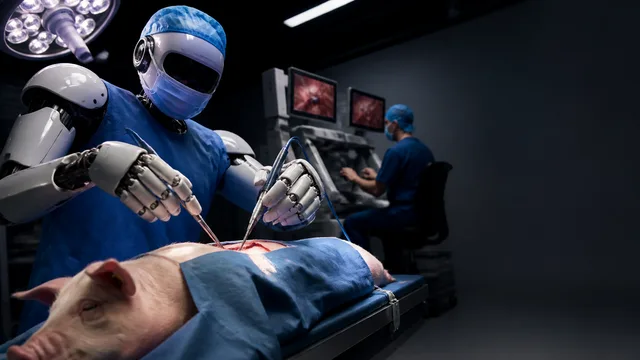
Surgeons Used Humanoid Robots to Operate on Pigs
Humanoid robots remotely controlled by surgeons removed gallbladders from live pigs. Here's what the milestone actually means—and what it doesn't.
What's Breaking Through
Early-stage AI companies and specialized hardware startups securing major funding rounds despite intense competition and talent poaching.
1 article in this topic · tracking 1 signal across 1 source feed
About this topic
The AI infrastructure landscape is experiencing a surge of investment activity as companies pursue different bets on the future of artificial intelligence. These funding rounds reflect broader trends in how capital is flowing through the AI ecosystem, with entrepreneurs raising hundreds of millions to pursue ambitious visions across multiple sectors.
One notable pattern involves AI chip startups navigating a challenging competitive environment. Groq, a specialized AI chip company, is reportedly seeking $650 million in fresh funding even after Nvidia made a significant talent acquisition from the company valued at $20 billion. This move, sometimes referred to as a "not-acquisition" or "acqui-hire," saw Nvidia bring on Groq's top engineering talent while leaving the company itself to continue operations with remaining staff. The funding round suggests Groq believes there remains substantial opportunity in AI chip design despite losing key personnel to a much larger competitor.
Beyond chips, the cluster also reflects emerging applications and research directions in AI. A team of former DeepMind researchers has raised $50 million to develop AI systems capable of identifying which scientific questions are worth pursuing—a meta-level application aimed at accelerating discovery by improving research prioritization. Meanwhile, a less conventional entry involves humanoid robotics, with a startup backed by Eric Trump as an adviser testing robots in Ukraine and targeting deployment on US front lines within 18 months, suggesting robotics is attracting venture capital despite significant technical and regulatory uncertainties.
Together, these funding announcements illustrate a diversifying AI investment thesis. Rather than capital flowing exclusively to large language model developers or established AI labs, money is dispersing across hardware acceleration, scientific research optimization, and robotics applications. This suggests investors view the AI opportunity as broad enough to support multiple concurrent bets, even in competitive spaces where large incumbents like Nvidia maintain significant advantages.
BuzzRAG Coverage
1 signal from source feeds
These are external articles in the Tech desk that match this topic. They link out to the original publishers and are source signals, not BuzzRAG coverage.
