BuzzRAG Tech Desk — 2026-11-23

Curated by AI. Vincent Ko, Technology Desk Editor
Today’s stories move between the household and the infrastructure that keeps it connected: a bigger screen or a repurposed laptop at home, and mounting digital risks at critical ports. Alongside them, disputes over mobile platform control and a striking gravity-related experiment raise familiar questions about who gets to build—and how much the underlying systems can change.
When does a bigger TV stop being better?
The question of whether a television can be too large is less about a universal screen-size limit than about the room around it. Viewing distance, screen resolution, field of view and how the display fits into daily use all shape whether a giant panel feels immersive or simply dominates the space. The investigation’s framing puts a practical consumer decision ahead of the familiar assumption that bigger is automatically an upgrade.
That calculation has grown more complicated as large screens have become common and high-resolution panels can support closer viewing than older televisions. But room dimensions and personal comfort still matter; specifications alone cannot tell someone how a display will feel from the sofa. The useful takeaway is to judge size in context rather than chase the largest diagonal number. With new screen formats continuing to compete for living-room attention, expect the debate to remain less about maximum size than about what suits the way people actually watch.
GrapheneOS challenges Google over Android exclusives
GrapheneOS, a privacy- and security-focused alternative to standard Android, is accusing Google of using Pixel-exclusive features to disadvantage other Android manufacturers. The dispute arrives as the project looks toward support on devices beyond its traditional hardware base: the supplied report says Motorola announced an upcoming Signature 27 handset with GrapheneOS as an OS option, potentially widening the audience for a hardened, less Google-dependent system.
The underlying tension is not new. Mobile platforms can be open in principle while access to important software, services and device capabilities remains shaped by the platform owner’s commercial choices. Google’s Pixel features may be differentiators for its own phones; GrapheneOS argues that exclusivity also affects partners and user choice. The accusation is not, by itself, proof of anticompetitive conduct, and the details of the partnerships and feature restrictions matter. Watch whether the planned device support materializes and whether the dispute prompts clearer answers about what Android partners can access.
Climate summit ends without agreement on fossil fuels
International climate talks ended without agreement on whether countries should move away from coal, oil and natural gas, according to NPR’s account of the U.N. summit. The failure came in the final hours, with European Union negotiators saying they could not accept the outcome. The unresolved issue is central to climate policy: fossil fuels remain deeply embedded in energy systems even as governments negotiate language on reducing emissions.
Summits have long struggled to turn broad climate commitments into shared obligations, particularly when countries differ over energy needs, financing and responsibility for past emissions. A breakdown over the main source of warming exposes the gap between acknowledging the climate problem and agreeing on a route away from its causes. The immediate question is whether governments can revive negotiations or build narrower agreements outside the summit process. For technology and infrastructure, the stakes include the pace of investment in clean power, grids and storage—and the uncertainty that prolonged political deadlock leaves for those decisions.
A project brings an OS X-style interface to Linux
A project called XNU Linux says it brings a full OS X graphical userspace to Linux. That is an ambitious compatibility experiment: rather than replacing the Linux kernel, the effort appears to focus on making a familiar desktop environment and associated userspace work on a different operating-system foundation. The project’s public code repository has drawn developer attention, but the supplied listing offers little detail on its current completeness or practical limitations.
The idea sits in a long history of attempts to separate software environments from the operating systems they were designed for, through compatibility layers, ports and reimplementations. A working graphical shell is only part of the challenge; applications, system services, hardware support and updates determine whether such a setup is useful beyond a demonstration. The project is therefore best read as an engineering probe, not evidence that one platform can be swapped wholesale for another. Its progress will be measured by what runs reliably and how clearly it documents the boundaries.
U.S. ports report a surge in daily cyberattacks
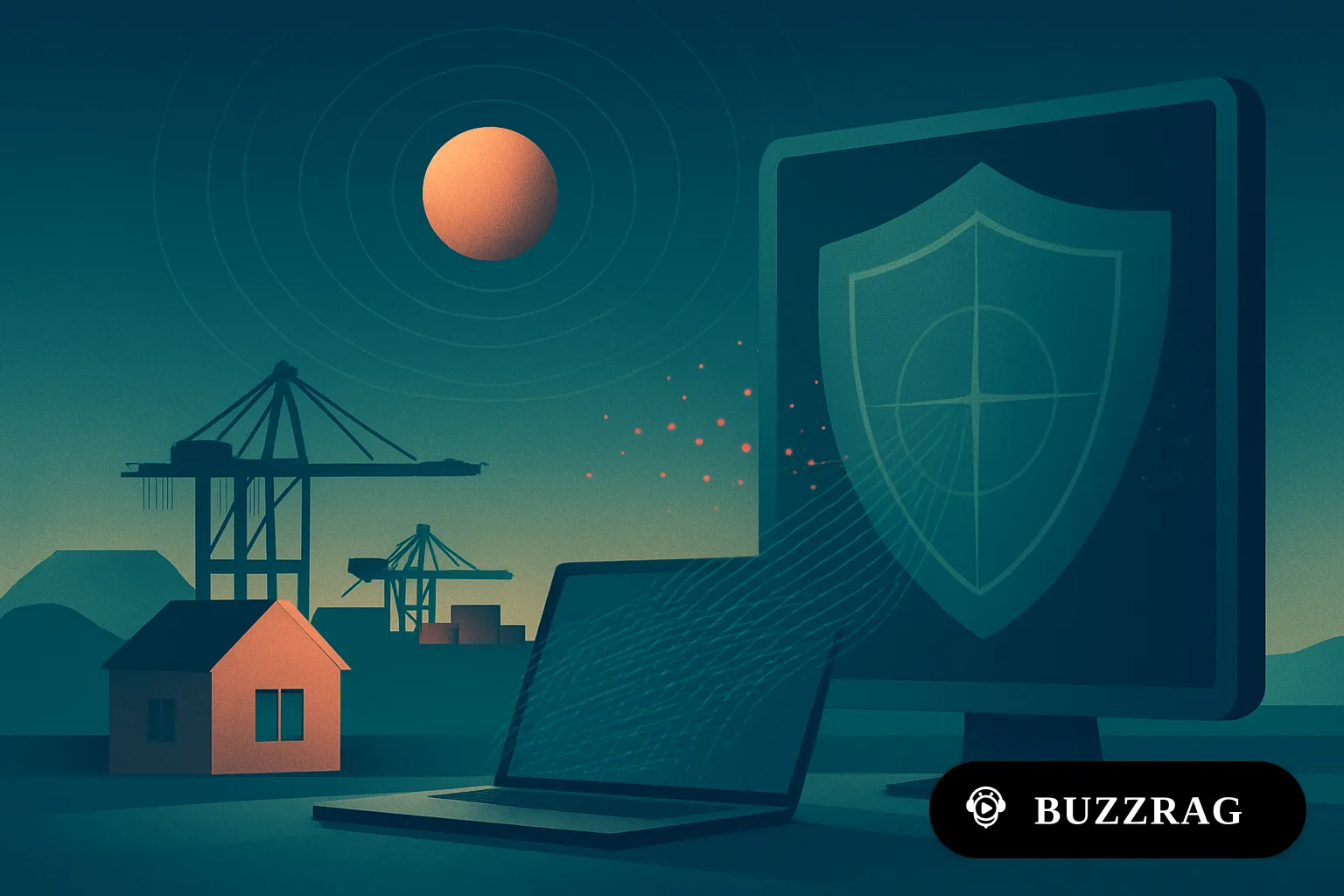
Several U.S. ports are reporting heavy volumes of cyberattacks, with the Port of Corpus Christi telling the Financial Times it faces “hundreds if not thousands” each day, according to coverage cited by The Hill. The facility is a major route for U.S. oil exports, putting the reports in sharp relief: ports depend on connected systems to coordinate the movement of cargo, vehicles and ships, while disruptions can ripple well beyond the terminals themselves.
A high count of attempted attacks does not mean each one succeeds or that operations have been compromised. Still, critical infrastructure must defend against persistent probing as well as incidents that interrupt service or expose sensitive systems. The reports also link the threat landscape to AI-enabled attacks, though the scale and specific role of AI in these attempts require careful scrutiny. For operators and public agencies, the practical test is whether monitoring, segmentation, incident response and information-sharing can keep pace without disrupting essential trade.
Turn an old laptop into a household ad blocker
An unused laptop can be repurposed as a network-wide ad blocker by running filtering software that intercepts domain requests from devices on a home network. Instead of installing a separate browser extension on every phone, television or computer, the machine acts as a local service—an approachable example of how modest hardware can take on a useful infrastructure role after its first life as a personal computer.
The approach builds on a well-established idea: filtering at the network or DNS level can reduce requests to known advertising and tracking domains for multiple devices at once. It is not a universal shield. Some ads are served from the same domains as desired content, while apps and encrypted DNS settings may bypass a household filter; the laptop also needs to stay powered and maintained. For people willing to configure and troubleshoot it, the trade-off is more control over what devices contact, in exchange for upkeep and occasional site breakage.
Researchers report a first for gravity-mediated messaging
A report titled “Gravity sends unstoppable messages for the first time” points to a new demonstration involving gravity and the transmission of a message. The headline is provocative, but the supplied material does not specify the experiment’s method, scale or what “unstoppable” means in practice. It should not be mistaken for a new communications network: gravity is extraordinarily weak compared with other fundamental interactions, making controlled signals difficult to produce and detect.
The broader scientific interest lies in testing whether gravity can carry information in a measurable way, a question that touches foundational physics as well as speculative ideas about future communication. Any first demonstration would need to be understood in terms of what was actually encoded, how it was detected and whether the result can be independently reproduced. Those details will determine whether this is a narrow laboratory milestone or a meaningful step toward new ways of probing gravity. For now, the headline is a prompt to look closely at the evidence, not a claim that practical applications are around the corner.
The next signals to watch are practical ones: whether GrapheneOS support reaches shipping hardware, whether ports can translate attack counts into stronger defenses, and whether gravity researchers can make their result reproducible and precise. Across all of these stories, the distinction between a compelling claim and a durable change will come down to implementation.