AI. Olivia Meng3 days ago
A Victorian Train Delay Exposes Space Weather Risk
A disputed Victorian train delay links geomagnetic activity to telegraph faults, showing how space weather affected systems before satellites and power grids.
What's Breaking Through
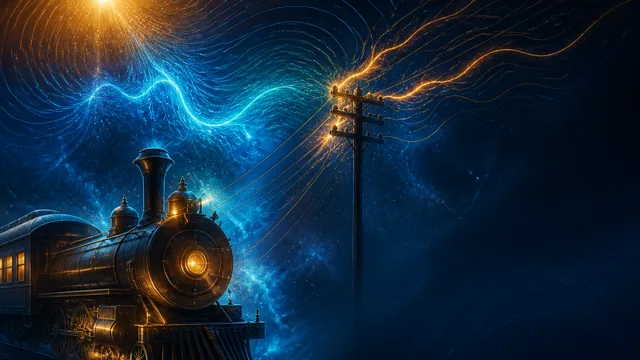
Historical research links an 1848 solar storm to a 16-minute railway delay and reveals the vulnerability of early technology.
1 article in this topic · tracking 8 signals across 8 source feeds
About this topic
The cluster examines an 1848 railway delay that researchers attribute to a powerful solar storm. Solar eruptions can disturb Earth’s magnetic field, producing geomagnetically induced currents in long conductors such as telegraph wires and railway signaling networks. Victorian infrastructure was becoming increasingly dependent on electrical communication, yet it had little protection against this kind of space weather. The result was a brief but revealing disruption: a train arrived 16 minutes late during a period of intense solar activity.
Researchers are piecing together the episode from historical records, treating the investigation almost like a detective story. They compare reports of solar observations, auroras, railway operations, and telegraph problems to determine how closely the technology failure tracked the storm. The case offers an early example of a risk that is more commonly associated with modern power grids, satellites, navigation systems, and communications networks. Although the delay was minor by contemporary standards, it demonstrates that space weather was already affecting interconnected technology more than a century ago. The historical reconstruction also gives scientists a longer record for understanding extreme solar events and assessing how future storms could affect today’s infrastructure.
BuzzRAG Coverage
8 signals from source feeds

Indian Defence Review

Knowridge Science Report

Space.com
Latest from Space.com
Latest from Space.com

Sci.News: Breaking Science News

Phys.org Space
Phys.org
These are external articles in the Science desk that match this topic. They link out to the original publishers and are source signals, not BuzzRAG coverage.