AI. Priya Sharma2 days ago
How Venus's Slow Spin Could Have Destroyed Its Moon
New simulations suggest Venus's slow rotation could doom a former moon, but cannot show one existed. Here is what the model reveals and still misses.
What's Breaking Through
New research explores whether Venus once had a natural satellite and what happened to it.
1 article in this topic · tracking 19 signals across 15 source feeds
About this topic
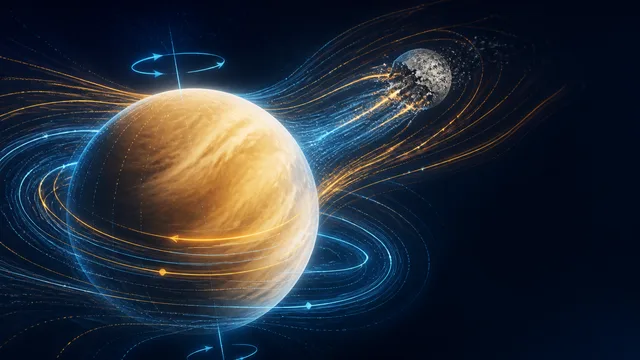
A recent scientific study has rekindled questions about Venus's past, particularly whether the second planet from the sun once possessed a moon. Unlike Earth with its moon or Mars with its two small satellites, Venus today orbits the sun without any natural satellite. This absence has long puzzled planetary scientists, who have theorized various explanations for why Venus lost or never retained a stable moon.
The new research suggests that Venus may have actually hosted a moon for an extended period—potentially lasting nearly 2 billion years. This discovery reshapes our understanding of Venus's geological and orbital history. If confirmed, such a moon would have significantly influenced Venus's climate, rotation, and overall planetary development. The presence of a lunar companion could have affected tidal forces, atmospheric dynamics, and the planet's axial tilt over time. Understanding this history provides crucial context for why Venus evolved so differently from Earth, despite their similar sizes and initial compositions.
The study's findings address a fundamental gap in planetary science: why Venus diverged from patterns seen elsewhere in the solar system. By examining gravitational dynamics, orbital mechanics, and planetary evolution models, researchers have constructed scenarios where a Venusian moon could have been gradually pulled away or destabilized over millions of years. This work has implications beyond Venus itself, informing broader theories about planetary formation, moon capture and loss mechanisms, and the long-term stability of celestial bodies. As scientists continue to refine these models using data from Venus orbiters and advanced computational methods, this research contributes to a more complete picture of our solar system's complex and dynamic past.
BuzzRAG Coverage
19 signals from source feeds

Phys.org
Phys.org Space

Smart News | smithsonianmag.com

ScienceDaily

Knowridge Science Report

Universe Today

Sci.News: Breaking Science News

EarthSky

Nautilus
Knowridge Science Report
These are external articles in the Science desk that match this topic. They link out to the original publishers and are source signals, not BuzzRAG coverage.