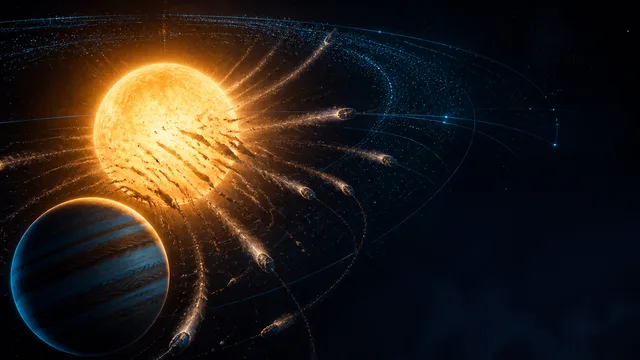
KIC 8462852, colloquially known as Tabby's Star, has captivated astronomers since its discovery in 2015 due to its unusual and dramatic dimming behavior. Unlike typical stars that maintain relatively stable brightness, Tabby's Star experiences unexplained dips in light intensity that have persisted for over a decade, making it one of the most intriguing objects in the night sky. The star's erratic brightness patterns have sparked considerable scientific debate about what could cause such anomalies, with researchers proposing increasingly creative explanations for the phenomenon.
Recent observations have revealed a particularly significant finding: a distinct 21-hour dimming event that may hold crucial clues to understanding the star's long-term brightness decline. This specific dip could represent a smaller-scale manifestation of the same underlying mechanism responsible for the decade-long dimming trend. By analyzing this shorter-term event in detail, astronomers hope to gain insights into the processes occurring around the star and develop more comprehensive models of its behavior.
Among the leading hypotheses is the possibility that a giant planet orbits Tabby's Star, potentially disrupting nearby material and causing the observed light variations. A massive planetary object could gravitationally perturb dust, debris, or other stellar material into configurations that periodically block starlight from reaching Earth. This planetary explanation would distinguish Tabby's Star from other similarly mysterious objects and provide a clear mechanism for the dimming. As research continues, astronomers are employing multiple observational strategies and theoretical models to determine whether a hidden planet, unusual dust clouds, or some other exotic phenomenon is responsible for this star's remarkable and persistent enigma.