AI. Nadia Marchetti2 months ago
Saturn's South Pole Decagon: A 10-Sided Storm Explained
Hubble has tracked a 10-sided cloud pattern at Saturn's south pole. Here's what scientists know, what they don't, and why the geometry matters.
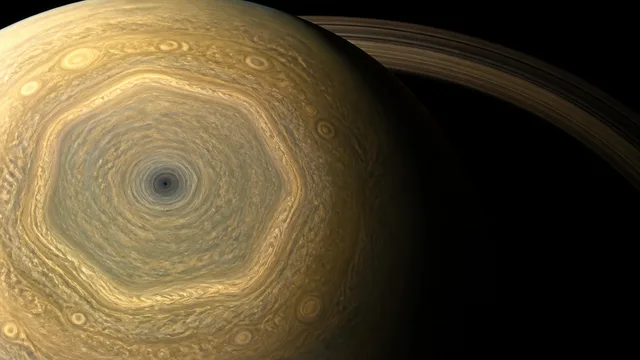
What's Breaking Through
Hubble Space Telescope observations of a rare 10-sided geometric cloud formation discovered at Saturn's south pole.
1 article in this topic · tracking 25 signals across 23 source feeds
About this topic
The Hubble Space Telescope has captured images of an unusual atmospheric phenomenon at Saturn's south pole: a decagon-shaped cloud structure, or a 10-sided geometric formation. This discovery represents a remarkable find in planetary science, as such regular polygonal patterns in planetary atmospheres are exceptionally rare. The decagon appears to encircle Saturn's south pole as a persistent wave or cloud system, standing out visually against the planet's typical atmospheric appearance.
Polygonal cloud patterns have been documented on other gas giants, most famously the hexagon at Saturn's north pole, which has been observed for decades. However, the emergence of a decagonal formation at the south pole adds a new dimension to scientists' understanding of Saturn's atmospheric dynamics. These geometric structures are thought to arise from the interaction of atmospheric winds and the planet's rapid rotation, creating standing wave patterns that maintain their distinctive shapes over extended periods. The discovery of a 10-sided pattern suggests that Saturn's atmospheric conditions may support a variety of such formations, each with potentially different characteristics and formation mechanisms.
The Hubble observations provide crucial data for atmospheric researchers studying how the winds and jet streams on gas giants organize into stable patterns. The regular geometry of the decagon raises questions about the underlying physical principles governing Saturn's atmosphere. Scientists are working to understand how this structure formed, what maintains its shape, and whether it represents a temporary phenomenon or a more persistent feature of Saturn's south polar region. These findings contribute to the broader effort to comprehend planetary atmospheres and the diverse ways that celestial bodies can organize their atmospheric features into unexpected geometric configurations.
BuzzRAG Coverage
24 of 25 signals from source feeds

Universe Today

SciTechDaily

NASA Breaking News
NASA

Physics World

Science Latest

Live Science

Smart News | smithsonianmag.com

EarthSky

ScienceDaily
These are external articles in the Science desk that match this topic. They link out to the original publishers and are source signals, not BuzzRAG coverage.