AI. Amelia Nwofor4 months ago
Neutrinos, Oscillation, and the Matter-Antimatter Mystery
Particle physicist Kirsty Duffy explains neutrino oscillation, what it broke in the Standard Model, and why DUNE may finally answer why matter exists at all.
What's Breaking Through
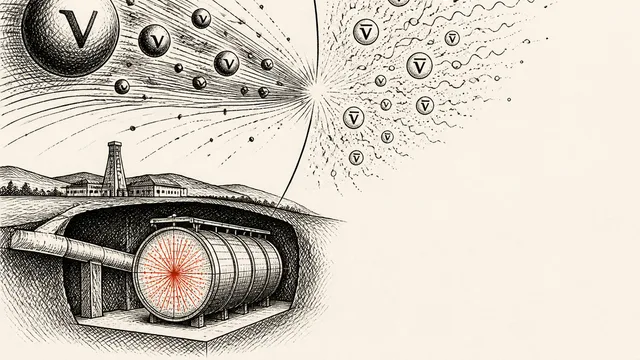
Theories propose that heavy neutrinos helped create the matter–antimatter imbalance that allowed matter to endure after the Big Bang.
1 article in this topic · tracking 3 signals across 3 source feeds
About this topic
The universe contains far more matter than antimatter, even though the Big Bang is expected to have produced nearly equal amounts of both. If matter and antimatter had remained perfectly balanced, they would have annihilated one another, leaving a universe with little more than radiation. Explaining the small excess of matter that survived—often called the matter–antimatter asymmetry—is a major open question in cosmology and particle physics. The articles explore a proposed answer involving neutrinos, electrically neutral particles that are extraordinarily difficult to detect.
In some theories, very heavy neutrinos existed in the early universe and behaved differently from their antimatter counterparts. Their decays could have produced an imbalance between matter and antimatter in the lepton family of particles. Known early-universe processes may then have partly translated that lepton imbalance into an excess of ordinary matter, a mechanism broadly known as leptogenesis. The idea connects neutrino physics, which experiments are still working to understand, with the history of the cosmos. A new theoretical proposal can show how such a chain of events might work, but it does not by itself establish that heavy neutrinos existed or that this was how the universe acquired its matter excess. Researchers seek evidence through neutrino experiments, searches for rare particle processes, and more precise tests of models of the early universe. Together, these stories focus on how tiny differences in particle behavior may have determined why anything material exists today.
BuzzRAG Coverage
3 signals from source feeds

EarthSky

Universe Today

Sci.News: Breaking Science News
These are external articles in the Science desk that match this topic. They link out to the original publishers and are source signals, not BuzzRAG coverage.