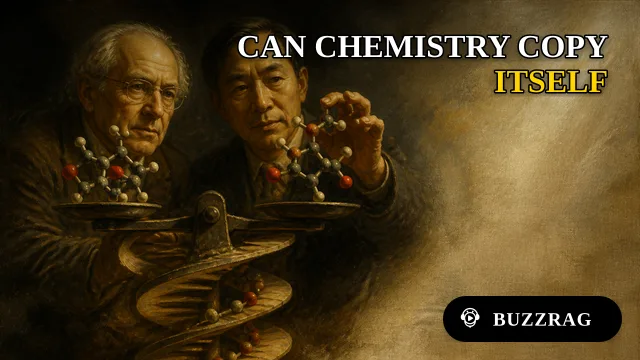
The cluster covers a Nobel Prize in Chemistry awarded to Henri Kagan and Kenso Soai for discoveries involving molecular “handedness.” Many organic molecules exist in two forms that are mirror images of each other, much like left and right hands. Though their atoms are connected in the same order, the forms can behave differently when interacting with other molecules, especially in living systems. Chemists call these versions enantiomers, and controlling which one a reaction produces is a central challenge in chemical synthesis.
Kagan’s work advanced asymmetric catalysis: using a chiral catalyst to steer a reaction toward one mirror-image product. Soai’s research demonstrated a striking form of asymmetric autocatalysis, in which a chiral product helps drive the formation of more of itself, amplifying a small initial imbalance. Together, these lines of research expanded chemists’ ability to make compounds with a chosen handedness and helped illuminate how such imbalances can arise and grow. The chemistry may inform thinking about why life on Earth predominantly uses one handed form of certain molecules, although the origins of life’s asymmetry remain an open scientific question.
The practical stakes are significant for pharmaceuticals. A drug’s two mirror-image forms can have different effects in the body, so producing the desired form selectively can improve efficacy and reduce unwanted effects. The laureates’ work underpins methods used to make medicines and other complex chemicals more precisely, while offering a deeper understanding of how molecular symmetry can be broken.