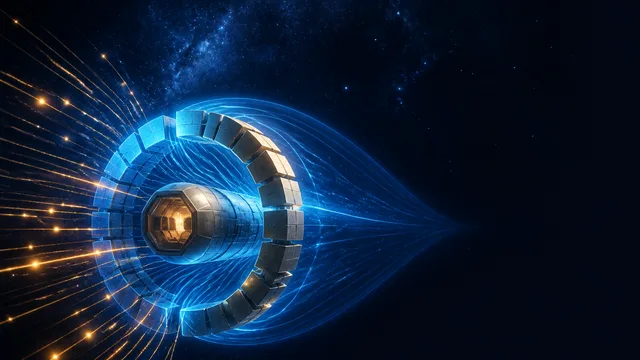
As space exploration expands beyond Earth's protective magnetosphere, radiation protection has become a critical challenge for long-duration missions to the Moon, Mars, and beyond. Solar storms and cosmic rays pose significant health risks to astronauts, potentially causing acute radiation sickness during severe events and increasing long-term cancer risk. Traditional shielding methods using dense materials add considerable mass to spacecraft, making them expensive and impractical for extended missions. This has prompted researchers to explore alternative approaches, including the use of magnetic fields to deflect charged particles away from crew compartments.
Permanent magnets offer a theoretically elegant solution to this problem. Unlike traditional shielding, magnetic deflection doesn't rely on physical barriers but instead uses electromagnetic forces to bend the trajectories of incoming particles. This approach could significantly reduce the mass burden on spacecraft while providing continuous protection without active power consumption. Several research groups have been investigating the feasibility of generating sufficiently strong magnetic fields using modern permanent magnet materials, examining whether such systems could be scaled up to protect habitable spacecraft volumes. The technology builds on principles already understood in plasma physics and Earth's own magnetosphere, which protects our planet from solar wind and cosmic radiation.
However, significant technical challenges remain before this concept becomes practical. Engineers must determine what field strengths are actually achievable with realistic magnet configurations, how to manage the weight and thermal properties of large magnet systems, and whether the protected volume would be adequate for crew operations. There are also open questions about potential long-term biological effects of strong magnetic fields on humans. Current research is evaluating prototypes and running simulations to understand these tradeoffs. If successful, magnetic shielding could become a cornerstone technology for deep space exploration, complementing or potentially replacing conventional radiation protection methods.