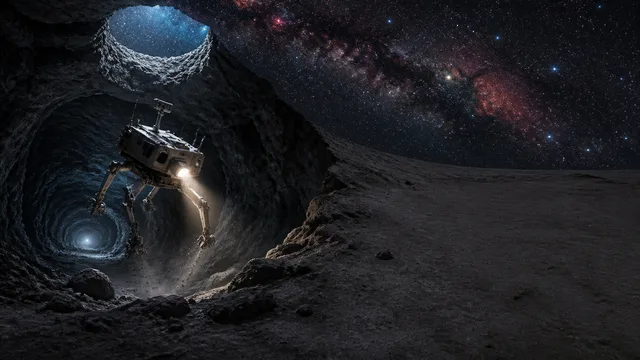
A shadowed opening on the Moon could lead to a substantial underground cavity, drawing new attention to lunar caves and how they might be explored. The cluster reports that a team has been selected for a NASA program focused on investigating the possibility. The work centers on turning an intriguing surface feature into a better-understood destination: researchers need to determine what lies below the opening and whether a robotic mission could safely gather useful information there.
Lunar pits may form when the roofs of ancient lava tubes collapse. Such tubes could preserve clues about the Moon’s volcanic history and offer natural shelter from radiation, micrometeorites, and extreme temperature changes at the surface. Those qualities make caves scientifically valuable and potentially relevant to future human exploration, though their size, stability, and accessibility remain uncertain. A visible hole is not proof that a large, traversable cave exists, and reaching or examining one poses engineering challenges, including steep terrain, darkness, and communications obstacles. The selected team’s planning and investigation can help establish what instruments or robotic systems might be needed. Together, the reports highlight a shift from observing unusual lunar features from above toward considering how they could be explored directly, while underscoring that the cave’s true dimensions and suitability are still questions to answer.