AI. Nadia Marchetti1 month ago
Moon Hides Jupiter in Daylight: Today's Occultation Explained
On September 8 the Moon passes in front of Jupiter in a rare daytime occultation. How the geometry works, who can see it, and how to actually try.
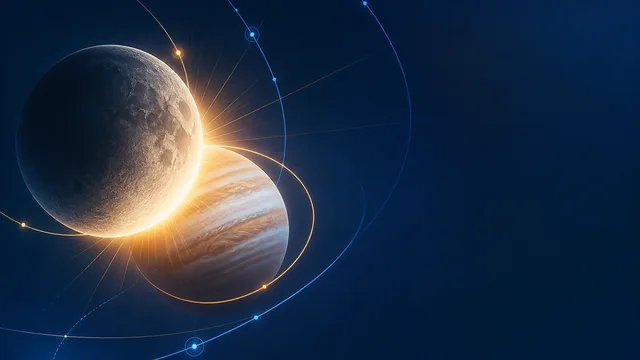
What's Breaking Through
Guidance for viewing the Moon pass in front of Jupiter during a rare daytime occultation on September 8.
1 article in this topic · tracking 12 signals across 9 source feeds
About this topic
This cluster covers the September 8, 2026, lunar occultation of Jupiter, an event in which the Moon passes directly between Earth and the giant planet, temporarily blocking Jupiter from view. Because the alignment occurs during daylight, Jupiter may disappear behind the Moon and reappear while the sky is still bright. The spectacle is unusual not because Jupiter is physically changing, but because the Moon’s apparent position shifts rapidly enough to cover a distant planet from selected locations on Earth.
Visibility will depend heavily on geography, local weather, and the exact timing of the Moon’s passage. Observers should check a reliable astronomy app, planetarium program, or local observing guide for their location rather than relying on a single global time. Jupiter can sometimes be found near the Moon with binoculars or a small telescope, but daytime observations require particular care: never aim optical equipment near the Sun unless it is specifically designed and safely filtered for solar viewing. The safest approach is to identify the Moon’s position first and follow expert observing instructions. The repeated articles in this cluster provide practical context for locating the event and understanding why this rare alignment is worth watching.
BuzzRAG Coverage
12 signals from source feeds

Astronomy Magazine

EarthSky
Astronomy Magazine

Live Science
Astronomy Magazine
Astronomy Magazine

Phys.org Space
Phys.org

Universe Today

Latest from Space.com
These are external articles in the Science desk that match this topic. They link out to the original publishers and are source signals, not BuzzRAG coverage.