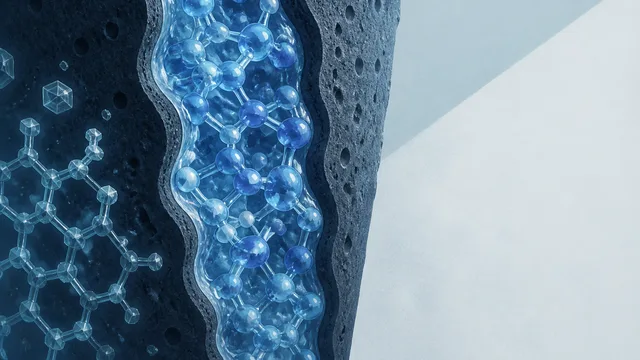
Water does not always freeze when cooled below its usual freezing point. Under carefully controlled conditions, it can remain liquid in a supercooled state, but studying this behavior is difficult because tiny disturbances often trigger ice formation. The articles in this cluster focus on experiments that use soft nanoscale confinement to suppress crystallization and reveal what happens as water approaches its low-temperature limit.
The central finding is that confined water can become glassy rather than forming an ordered ice lattice. In a glass, molecules are disorganized like those in a liquid but move so slowly that the material behaves as a rigid solid. This transition offers a way to investigate the debated liquid-to-glass behavior of water, including how molecular motion changes near freezing and whether water retains distinct liquid states under extreme cooling. Researchers are using the confinement approach to separate water’s intrinsic dynamics from the effects of ice nucleation. The work could improve understanding of water in clouds, biological cells, porous rocks, and other environments where it is restricted to very small spaces. It may also help refine models of anomalous water properties, such as its unusual response to temperature and pressure.