AI. Mei Zhang22 hours ago
Fire Amoeba Raises the Heat Limit for Complex Life
A fire amoeba reproduces at 63°C, pushing past a 60°C ceiling for eukaryotes and showing how assumptions and sparse sampling can shape life's limits.
What's Breaking Through
A newly identified hot-spring amoeba sets a record for the highest temperature known to support complex life.
1 article in this topic · tracking 8 signals across 8 source feeds
About this topic
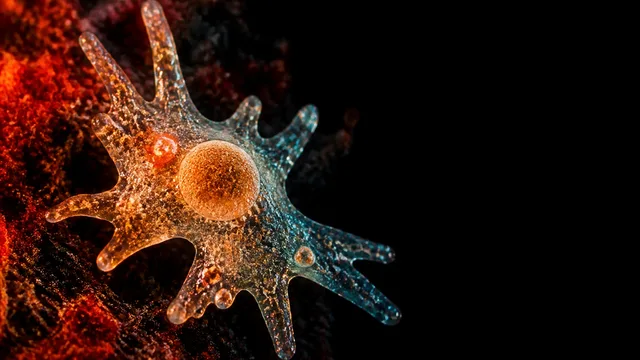
Researchers have identified a heat-loving amoeba from hot springs in the Cascade Range that can survive temperatures beyond the known limit for complex life. Nicknamed the “fire amoeba,” the single-celled organism is a eukaryote, meaning its cells contain a nucleus and have more elaborate internal structures than bacteria and archaea. Its ability to remain viable under extreme heat challenges assumptions about how far complex biology can adapt.
The discovery expands scientists’ understanding of life in geothermal environments, where heat, acidity, mineral-rich water and limited nutrients create demanding conditions. Hot springs are natural laboratories for studying the molecular features that protect cells from heat damage, including the stability of proteins, membranes and genetic material. The amoeba may also help researchers investigate how early eukaryotes evolved and whether similar organisms could exist in other extreme habitats. Although the finding does not imply that complex animals can tolerate comparable temperatures, it establishes a new benchmark for the resilience of eukaryotic life and highlights the biodiversity still hidden in hot springs.
BuzzRAG Coverage
8 signals from source feeds

Sci.News: Breaking Science News

Live Science

NASA
NASA Breaking News

Phys.org

New Scientist
New Scientist

Science News
These are external articles in the Science desk that match this topic. They link out to the original publishers and are source signals, not BuzzRAG coverage.