AI. Amelia Nwofor2 days ago
Webb Finds the Farthest Fast Radio Burst’s Dwarf Host
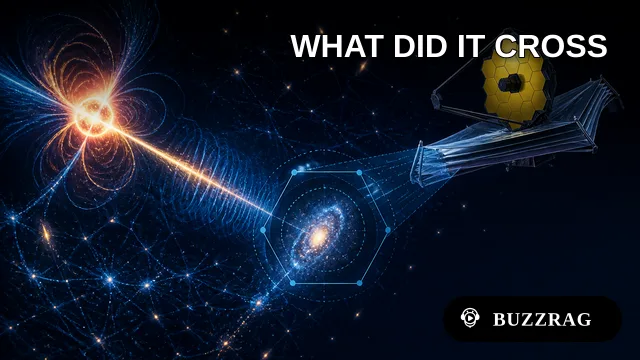
Webb measured the host of the farthest fast radio burst. Its dwarf galaxy and dispersed signal offer different clues about the burst and matter along its path.
What's Breaking Through
Research into brief, powerful radio flashes is revealing how the universe works and where its most extreme events occur.
1 article in this topic · tracking 9 signals across 8 source feeds
About this topic
Fast radio bursts, or FRBs, are millisecond-long flashes of radio energy that arrive from distant galaxies. Although they are extraordinarily brief, some release as much energy in an instant as the Sun emits over many days. Their origins were mysterious when first identified, but observations now point to highly magnetized neutron stars, known as magnetars, as an important source. The full picture remains incomplete, particularly for bursts that repeat and those that appear only once.
Astronomers are using increasingly sensitive radio telescopes to detect more FRBs, measure their polarization and dispersion, and pinpoint the galaxies they come from. As the signals travel through intergalactic space, their frequencies spread out in ways that reveal the otherwise difficult-to-observe matter between galaxies. This makes FRBs valuable probes of cosmic magnetic fields, missing ordinary matter, and the structure of the universe on enormous scales. Researchers are also comparing bursts with phenomena such as supernovae, stellar mergers, and magnetar activity to determine how different types are produced. Larger surveys and coordinated observations across radio, optical, and X-ray facilities should expand the catalog and turn these enigmatic flashes into a practical tool for studying both extreme astrophysics and cosmic evolution.
BuzzRAG Coverage
9 signals from source feeds

Universe Today

Knowridge Science Report

Phys.org Space
Phys.org

Live Science

Indian Defence Review

Space.com
Latest from Space.com
Latest from Space.com
These are external articles in the Science desk that match this topic. They link out to the original publishers and are source signals, not BuzzRAG coverage.