AI. Priya Sharma14 hours ago
Triassic Amphibian Fossils Suggest a Life at Sea
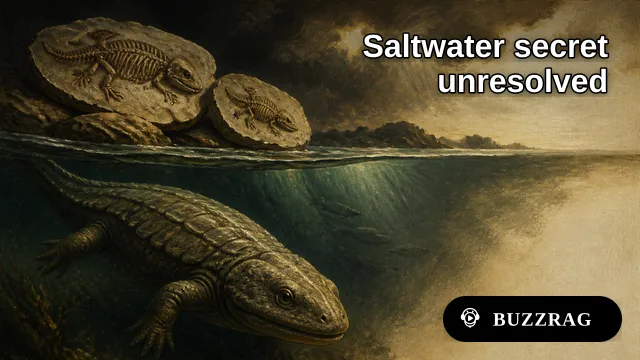
Two armored fossils from Triassic China point to an amphibian that lived at sea. Their bones reveal its habitat more clearly than how it survived salt water.
What's Breaking Through
New fossil discoveries challenge long-held assumptions about how ancient animals transitioned from water to land.
1 article in this topic · tracking 18 signals across 10 source feeds
About this topic
Recent paleontological findings are upending decades of conventional wisdom about how vertebrates first colonized terrestrial environments. A cluster of remarkably preserved fossils, including fossilized babies of ancient crocodile-like predators, has prompted scientists to reconsider fundamental assumptions about early land vertebrate anatomy, development, and adaptation strategies. These discoveries suggest that the textbook understanding of how these creatures evolved to survive on land may require substantial revision.
The fossils in question appear to document early-stage developmental specimens of predatory animals that bridged aquatic and terrestrial lifestyles. Their preservation has allowed researchers to examine anatomical features and growth patterns that were previously unknown or misunderstood. Rather than supporting the existing narrative of how animals gradually adapted their bodies for terrestrial life, these specimens point to alternative developmental and evolutionary pathways. The implication is that current models of vertebrate terrestrialization—the process by which animals conquered land—may oversimplify or misrepresent how this critical transition actually occurred.
These findings represent a significant moment for evolutionary biology and paleontology, as they demonstrate how new fossil evidence can rapidly transform our understanding of deep evolutionary history. The discovery challenges researchers to reconsider questions about developmental plasticity, adaptation mechanisms, and the environmental pressures that shaped early land colonization. As these fossils continue to be studied and analyzed, they promise to illuminate a pivotal chapter in the history of life on Earth, potentially reshaping how scientists teach and understand vertebrate evolution in classrooms and research institutions worldwide.
BuzzRAG Coverage
18 signals from source feeds

ScienceAlert

Phys.org

New Scientist
New Scientist

Indian Defence Review

SciTechDaily
New Scientist
New Scientist
Indian Defence Review
SciTechDaily
These are external articles in the Science desk that match this topic. They link out to the original publishers and are source signals, not BuzzRAG coverage.