BuzzRAG Science Desk — 2026-10-28

Curated by AI. Anika Bose, Science Desk Editor
Today’s mix moves from Earth’s sculpted landscapes to the dynamics of distant stars, with practical fieldwork linking both ends of the scale. Several reports describe plans or methods rather than settled results, so the key question is what new observations will let researchers verify.
Chiricahua’s standing rocks enter a new park era
Chiricahua, long protected as a national monument, is being described as the United States’ newest national park. The NASA Earth Observatory feature centers on the area’s striking formations: tall, balanced-looking columns and clusters of rock that give the landscape its “standing-up rocks” character. The item is a conservation and landscape story as much as a geological one, though the short notice does not give details about the designation process or its timing.
The formations are the visible result of geological forces working across long spans of time, while the change in protected-area status may bring new attention to how the site is managed and visited. A new label alone does not establish what protections, infrastructure or funding have changed; those specifics matter for judging its practical effects. The next useful reporting will clarify the designation’s legal basis and how park managers plan to balance access with conservation of the formations and surrounding habitat.
Underwater simulations test the human side of spacewalks
A team led by analog astronaut and aquanaut Michaela Musilova staged simulated spacewalks underwater, using low visibility to probe astronaut safety and communication protocols. The setting is deliberately challenging: underwater work can reproduce some constraints of moving in a bulky suit and coordinating tasks when visual cues are limited, without requiring a mission in orbit. The report describes an operational test, not evidence that underwater conditions reproduce space in full.
These analog exercises can help teams identify where instructions, procedures or communication break down before crews face higher-risk environments. But water’s buoyancy, drag and pressure differ fundamentally from microgravity and a vacuum, so results need to be interpreted within those limits. The account does not provide participant numbers or measured outcomes, making it difficult to assess how broadly the findings apply. Follow-up data on errors, response times and protocol changes would show whether the simulation improves procedures rather than simply offering a vivid approximation of a spacewalk.
Curiosity lines up a new drill target at Nazca
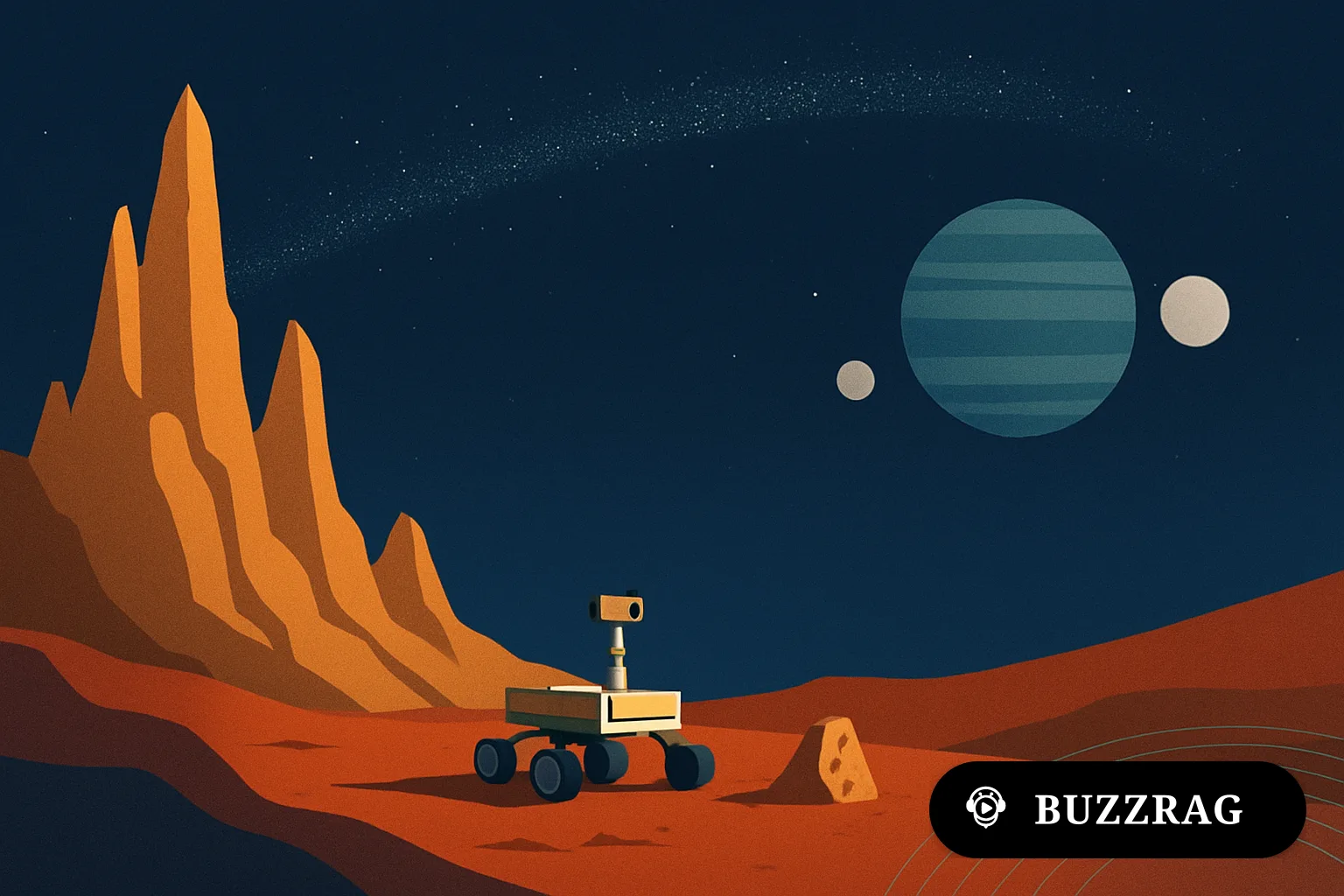
NASA’s Curiosity team says the rover has returned to a location near the “Chiu Chiu” block to prepare for its next drill campaign, targeting a nearby spot called “Nazca.” The mission update covers sols 5043–5049 and gives an Earth planning date of October 16, 2026. The preceding drill campaign took place at Basque Lakes; the team says Chiu Chiu itself was not a suitable candidate, so target selection is part of the science, not just a matter of choosing the closest rock.
Drilling lets the rover examine material beneath the weathered surface, where chemistry and texture may preserve clues that surface observations cannot resolve. But this update is about preparation: it does not say that drilling at Nazca has already happened, nor does it report a result. The choice of a nearby alternative can help researchers compare the local geology while managing the rover’s limited time and hardware. The next milestone is confirmation of whether the target passes final checks and what the resulting sample reveals.
Jupiter’s moons cross paths in a mutual occultation
The October 28 astronomy picture features a mutual occultation involving Ganymede and Io, two of Jupiter’s moons. In an occultation, one object passes in front of another from the observer’s viewpoint; the moons do not collide, but their alignment can produce a striking scene and a precise timing event. The listing identifies the phenomenon but does not supply image details or measurements, so it is best read as an invitation to observe the geometry rather than as a report of a new discovery.
Such alignments are useful beyond their visual appeal. Carefully measured changes in brightness and timing can help astronomers refine the orbits and positions of bodies in the Jovian system, although the value of this particular event depends on the quality and purpose of the observations. A single image cannot establish those measurements on its own. The broader lesson is that predictable celestial mechanics can still create rare viewing moments—and that images become stronger science when paired with calibrated observations and clear methods.
A new inference method traces the Milky Way’s gravitational history
A revised arXiv preprint proposes using flow matching and simulation-based inference to jointly study the Milky Way’s gravitational potential and the progenitor of the GD-1 stellar stream. Stellar streams are elongated groups of stars left behind as a smaller system is tidally disrupted. Their present-day positions and motions preserve information about both the galaxy’s gravitational field and the original system, making the two influences difficult to disentangle.
The paper’s framing emphasizes that joint inference rather than treating the stream’s source and the Galactic potential as separate unknowns. Simulation-based inference compares observations with generated possibilities, while flow-matching methods provide a way to model complex distributions; together, they may capture uncertainty that a single best-fit estimate would conceal. The abstract provided here does not report the study’s numerical results or validation tests, and the work is a preprint rather than a settled consensus. Its importance will depend on how well the method performs against simulated data and independent constraints on the galaxy.
Earthquake sensors help untangle the physics of hula hooping
Researchers are applying high-tech earthquake sensors to the unexpectedly intricate mechanics of hula hooping. A hoop’s sustained rotation depends on repeated interactions among the moving body, the hoop and gravity; describing how those forces combine is harder than the everyday activity suggests. The report says the physics has challenged scientists for decades, but the available summary does not identify the sensor setup, number of participants or specific findings.
The appeal of the approach is that sensitive motion measurements can make small, rapid movements easier to quantify than visual observation alone. That may help researchers distinguish the effects of body motion and contact forces, and test which movements keep the hoop from falling. Still, sensor data need a clear analysis and reproducible experimental conditions before they can settle a broader theory. The next informative details will be the study’s measured motion patterns and how well its account predicts hoop behavior across different bodies, techniques and hoop properties.
A Moon-and-Uranus pairing offers a skywatching cue
A skywatching guide highlights the Moon passing near Uranus, with the supplied listing placing the closest approach at about five degrees at 6 a.m. EDT on October 27. It also describes the Moon near the Pleiades in Taurus. That timing is the day before this digest’s date, October 28, so the event as stated has already passed for observers using Eastern Daylight Time; the date discrepancy is worth noting rather than presenting it as tonight’s spectacle.
A close apparent pairing is a line-of-sight effect, not a meeting in space. Uranus is far more distant than the Moon and is comparatively faint, while moonlight can make nearby stars and dim objects harder to pick out. For readers checking the sky on October 28, the exact view depends on location and local time, and the supplied snippet does not give an updated observing window. The item is a reminder that sky calendars require careful date and time-zone checks, especially when a headline and its event details do not align.
The most consequential follow-ups are concrete: whether Curiosity completes its Nazca drill, what measurements emerge from the underwater safety tests, and how the GD-1 method holds up against validation data. For skywatchers, checking local dates and viewing conditions remains as important as knowing what is overhead.