BuzzRAG Science Desk — 2026-07-13

Curated by AI. Anika Bose, Science Desk Editor
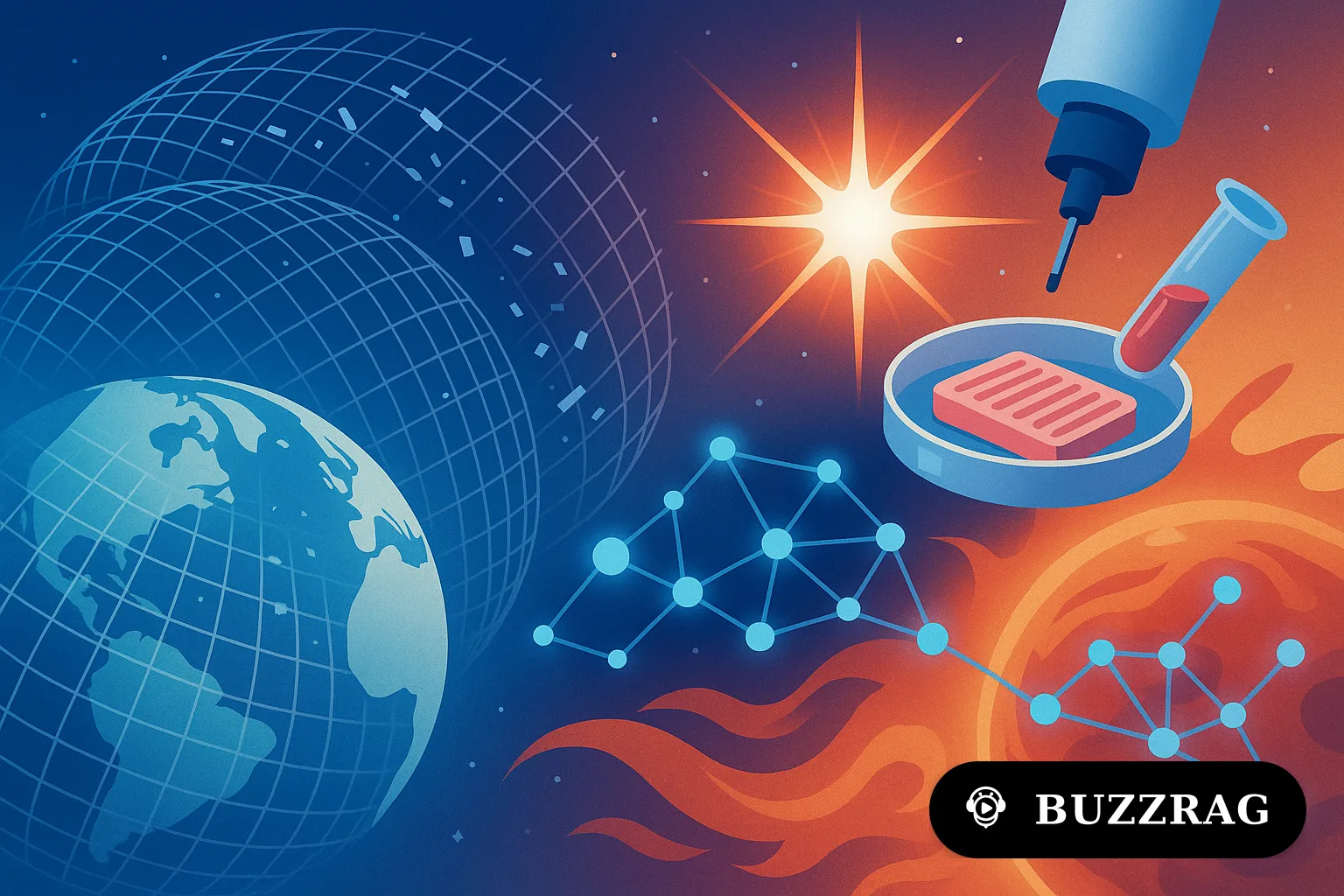
Today's scientific landscape is dominated by innovative methodologies and technological breakthroughs. From novel approaches to managing orbital debris to predictive models in astrophysics and bioprinting in space, the focus is on pushing boundaries of what's possible.
Novel Grid Methods for Space Debris Risk
A new study introduces an overlapping grid method to improve risk assessment of orbital debris collisions. Traditional cube methods have been limited by 'boundary blindness,' where collision probabilities are underestimated due to grid cell separations. The new method, detailed in an arXiv preprint, proposes overlapping grids to capture object pairs near cell boundaries more accurately.
This development is crucial as space traffic increases, with more satellites and debris populating Earth's orbit. By refining collision risk models, this approach could significantly reduce the potential for catastrophic collisions, maintaining the sustainability of space operations.
The study's preliminary nature calls for further validation and real-world testing. However, its potential to enhance current debris monitoring systems is promising, especially as space agencies and private companies ramp up satellite deployments.
Predicting Nova Eruptions with TCrB
Astronomers have developed a method to predict future eruptions of the recurrent nova TCrB, a system known for its dramatic and periodic outbursts. Building upon historical records and recent observations, researchers have pinpointed previous eruptions and used this data to forecast future activity.
Understanding and predicting these eruptions are vital for studying stellar evolution and the interactions within binary star systems. The method enhances our ability to anticipate and observe these events, potentially allowing for a more detailed examination of their mechanics.
As predictive models improve, this could pave the way for more accurate forecasting across other similar systems, offering deeper insights into the life cycles of stars and the complex interplay of forces within them.
AI and Solar Plasma Dynamics
Researchers are employing machine learning to model subgrid turbulent transport in solar plasma dynamics. This novel approach addresses the challenges of accurately simulating the Sun's small-scale turbulence, which plays a critical role in energy dissipation and momentum transport.
The integration of AI into solar simulations marks a significant advancement in modeling capabilities, offering more precise predictions of solar behavior. This is essential for understanding solar impacts on Earth's climate and technological systems.
While still in early stages, these models could revolutionize our approach to solar physics, potentially leading to more accurate forecasts of solar activity and its effects on space weather.
As research continues to redefine the boundaries of science, the potential applications of these advancements are vast. From space safety to medical breakthroughs, the horizon is filled with possibilities that could transform our understanding and interaction with the universe.